Showing posts with label weapons. Show all posts

Tuesday, August 27, 2013

Syria, Chemical Weapons, and More of the Same

Syria is in the news, as usual.

This time, Syria's government seems to have been caught using chemical weapons to kill folks who aren't on the 'approved' list:
The bodies used to be Syrians: civilians who either didn't express enough enthusiasm for Syria's boss, or were just in the wrong place at the wrong time.

Chemical Weapons: So What?

An acquaintance of mine asked 'what's the big deal with chemical weapons? Aren't people just as dead if they're shot?' He has a point: dead is dead.

I think part of the issue with chemical weapons is emotional: perhaps thanks to WWI and WWI-era propaganda, and experience, quite a few folks simply don't like chemical weapons.

Another problem with chemical weapons is that they're notoriously hard to control: unless the attacker simply wants to kill a large number of folks in a particular town or city, and doesn't care who dies.

Finally, although it is possible to die slowly from a bullet wound, my understanding is that most chemical weapons tend to subject victims to a prolonged and painful experience before they finally die. It's one thing to kill someone quickly; quite another to torture the victim first. I'll grant that there's an emotional component to this aspect of chemical weapons, too: but I think that torturing innocent people is wrong, even if I felt like doing it.

America, Syria, and Getting a Grip

The American president seems to be deciding that something military should be done about Syria. He's probably right, but I expect many folks who didn't vote for him to start imitating folks who didn't vote for the previous president.

I didn't vote for the current president myself, and strongly disagree with him on many policies: but that doesn't mean that I'll disagree when he does make a little sense.

Radio news said that the president doesn't plan to send in ground forces. Okay: I believe that. I'm concerned that he'll set up a situation where the next president will have to send ground forces into a seriously messed-up situation: but that may not happen.

I'd like to believe that Syria's leadership would decide to start acting nice, if someone would ask nicely. I'm pretty sure that this won't happen.

Syria's boss and his enforcers have manged to act so badly that even their regional allies decided to step back a few paces, metaphorically speaking. In the Middle East, that's saying something. Sadly.

Related posts:

Friday, April 5, 2013

North Korea Nuclear Attack: "Extremely Unlikely," But - - -

North Korea's new ruler may have the wisdom which told his father when to stop threatening, and accept the best available appeasement.

Or Kim Jong Un may not fully understand the power which he wields.

I don't know: and am very glad that someone else has to make 'go/no go' decisions for America's military. I'll get back to that.

Living with Uncertainty

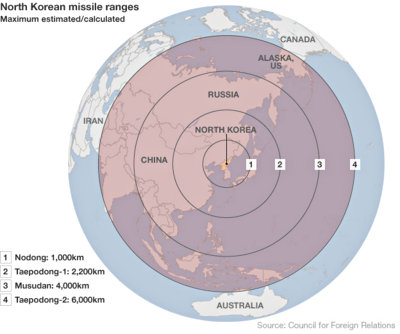
Someone on the American president's national security staff said "it's extremely unlikely" that North Korea has a missile which could reach the United States with a nuclear warhead.1 I think he's right, but I also think a key word in the statement is "unlikely."


(from BBC News, used w/o permission)

North Korea wouldn't have to hit Los Angeles or Portland to reach the United States. Parts of Alaska and Hawaii are within range of that country's Taepodong missile.

So is quite a bit of Asia and the western Pacific, if Kim Jong Un decided to attack a "puppet group."

'Might Not,' 'May Not,' Could be,' and Experts

A missile attack needs more than a missile, though. North Korea would need a warhead: preferably, from Kim Jong Un's point of view, a nuclear weapon. His people have developed nuclear bombs: but may not have been able to make them small enough to fit in a missile.

On the other hand, maybe they have.

I'm not concerned for my immediate personal safety. I live near the center of the North American continent, well away from anything that might be a high-value target.

Besides, North Korea's long-range missiles might not be accurate enough to hit a particular target. The country may not have a nuclear bomb compact enough for a missile. Kim Jong Un could be bluffing.

That's a lot of "might not, "may not," and "could be."

What if the 'experts' are wrong?

Warm and Sunny With a Chance of Nuclear Attack

Let's say North Korea's military has a nuclear weapon which will reach Guam. It's a United States territory, not a state: but closer than Anchorage or Honolulu. It might look like a good place to punish 'imperialists.'

About 44,000 folks live in Dededo, Guam. It's got schools, libraries, and a shopping mall: hardly New York City, but ten times larger than the town I call home.


(from en.wikipedia.org/wiki/File:Micronesia_Mall1.JPG, used w/o permission)

Dededo covers quite a wide area, so a bomb as powerful as the one that hit Hiroshima might not kill everyone there. On the other hand, it would be an extremely unpleasant experience for survivors.


(from en.wikipedia.org/wiki/File:Hiroshima_Damage_Map.png, used w/o permission)

I suppose it could be argued that folks living in Dededo 'deserve' to be killed, since they are either 'imperialists' or in league with the United States.

I think that makes as much sense saying that God killed Haitians in 2010 for something (allegedly) done two centuries earlier: or that Yankee imperialists caused the quake.2

Decisions, Responsibility

As of Wednesday, April 3, a Terminal High Altitude Area Defense (THAAD) missile interceptor system is on its way to Guam. It's expensive, and might not stop an incoming missile attack.

But I think deploying THAAD makes sense. Strategic and tactical considerations aside, it would be nice if folks living in Guam had a little protection.

As I've said before, this isn't a 'political' blog, in the sense that I claim one person or group is always right, and everyone who disagrees is icky. I sometimes discuss political issues, since politics is a means by which some decisions are made.

I did not vote for the current American president, but think that some decisions made during this administration were correct: like sending a THAAD system to Guam.

War, in my considered opinion, is something to avoid. But sometimes using armed force is preferable to the alternative. One of the responsibilities of national authorities is defending their nation: even when force is necessary.3

I suppose Kim Jong Un may think that he is 'defending' his territory. I think he is wrong.

"International Authority" and Looking Ahead

Today, "there is no international authority with the necessary competence and power"4 to restrain the likes of Kim Jong Un or Al Qaeda. Eventually I hope that humanity develops something like Tennyson's "Federation of the world." Until that happens, we'll have to make do with nations like the United States - and North Korea - and international organizations like the United Nations and NATO.

I've discussed some of my hopes in other blogs.

Related posts:

1 Excerpts from news and views:
"North Korea lacks means for nuclear strike on U.S., experts say"
Mark Hosenball, Phil Stewart, Reuters (April 5, 2013)

"North Korea's explicit threats this week to strike the United States with nuclear weapons are rhetorical bluster, as the isolated nation does not yet have the means to make good on them, Western officials and security experts say.

"Pyongyang has slowly and steadily improved its missile capabilities in recent years and U.S. officials say its missiles may be capable of hitting outlying U.S. territories and states, including Guam, Alaska and Hawaii.

"Some private experts say even this view is alarmist. There is no evidence, the officials say, that North Korea has tested the complex art of miniaturizing a nuclear weapon to be placed on a long-range missile, a capability the United States, Russia, China and others achieved decades ago.

"In other words, North Korea might be able to hit some part of the United States, but not the mainland and not with a nuclear weapon.

"The threats against the United States by North Korea's young leader Kim Jong-un are 'probably all bluster,' said Gary Samore, until recently the top nuclear proliferation expert on President Barack Obama's national security staff.

" 'It's extremely unlikely they have a nuclear missile which could reach the United States,' said Samore.

"The North Koreans 'are not suicidal. They know that any kind of direct attack (on the United States) would be end of their country,' said Samore, now at Harvard University's Kennedy School.

"On Wednesday, North Korea's state-run KCNA news agency said its military had 'ratified' an attack involving 'cutting-edge smaller, lighter and diversified nuclear strike means,' an apparent reference to miniaturized nuclear weapons...."

"Korea crisis: UN's Ban warns of 'serious implications' "
BBC News (April 4, 2013)

"UN Secretary General Ban Ki-moon has appealed to North Korea to change course, saying it has "gone too far" in its rhetoric.

"He said he was concerned any 'unwanted crisis' on the Korean peninsula would have 'very serious implications'.

"The warning came hours after South Korea's foreign minister said the North had shifted a missile with 'considerable range' to its east coast.

"Pyongyang earlier renewed threats of a nuclear strike against the US.

"However, its missiles are not believed to be capable of carrying nuclear warheads.

"White House spokesman Jay Carney described the threats as 'regrettable but familiar', adding the US was taking 'all the necessary precautions'...."

"U.S. Military to Deploy Missile Defense Battery Amid Looming Budget Cuts"
Mike Gruss, Space News, via Space.com (April 4, 2013)

"The U.S. Defense Department plans to deploy a Terminal High Altitude Area Defense (THAAD) missile interceptor system to Guam in the coming weeks to defend the U.S. territory against a possible North Korean missile attack, the Pentagon announced Wednesday (April 3).

"In October, the THAAD system had its first-ever intercept of a medium-range missile. In recent weeks, North Korea has renounced the 1953 armistice that ended the Korean War, closed its borders to South Korean workers, severed a diplomatic hotline with Seoul and threatened to launch missiles at U.S. targets.

"Pyongyang has been steadily escalating its war rhetoric since a satellite launch in December and nuclear test in February drew widespread condemnation and tighter sanctions...."

2 Yes, they really said that:
3 There's a none-too-subtle distinction between indiscriminate violence and legitimate defense. As a practicing Catholic, I take Catechism of the Catholic Church, 2263-2267 and 2307-2317 seriously.

4 Catechism of the Catholic Church, 2308.

Wednesday, November 24, 2010

North Korea: Nukes, Missiles, and Underfed Soldiers

A regime like North Korea's has its strengths. Like being able to force large numbers of its subjects into military service. North Korea doesn't seem able to feed its soldiers all that well, or provide them with much of the sort of training that requires fuel or bullets: but boy, does Kim Jon Il's country have a lot of soldiers.

Which is a real concern for folks living in South Korea, among others.

Whether or not the under-fed, ill-equipped North Korean soldiers really believe the propaganda they're fed - it's likely that they believe that they'll be punished if the don't do what the nearest general tells them. Like fire on a South Korean naval ship, or set fire to civilian buildings.

Paranoia, No: Prudence, Yes

I've mentioned Frank Burns, the idiot patriot and quack doctor in the M*A*S*H television series. One of my favorite episodes included a vignette of Dr. Burns looking for land mines in his toothpaste.

That's crazy. It's also funny, and fiction.

This is the real world.

Sadly, no matter how many factually-challenged paranoiacs infested America of the 1950s, today's North Korea is a serious - and very real - problem for anyone within about 2,000 miles - give or take a few hundred.

North Korea's nuclear weapons probably aren't all that much. Last year, Russia confirmed that North Korea had tested a 20-kiloton nuclear bomb. (GlobalSecurity.org (May 25, 2009)) That's a little more powerful than the bomb that devastated Hiroshima, but not by all that much. (GlobalSecurity.org (November 14, 1996))

If North Korea decided to launch a nuclear warhead against, say, Tokyo, folks living on the other side of Mt. Odake might not be hurt a bit. Not directly, anyway. But it would still be a really bad day for Tokyo. And the rest of Japan - and the world.

That 'no man is an island' stuff isn't just poetry. We live in a very interconnected world, and what happens in one nation gets felt everywhere.

I have no reason to believe that someone in North Korea will think it's a good idea to obliterate part of a Japanese city. Or one in South Korea. I have little reason to think that someone won't, either.

It'd be nice if everybody would be nice: but the last several thousand years of recorded history don't suggest that 'being nice' is as common a practice as it should be.

North Korea, Scrambling for Power, and "Miscommunications"

As for North Korea: It looks like Kim Jong Il is - willingly or not - turning control of the country over to someone else. Given the sort of operation he's been running, there could be quite a scramble soon, as generals and other wannabe warlords make a grab for power.

Then there are rumors, mentioned in the following article, about "miscommunications or worse within the North's command-and-control structure."

It's the sort of thing that makes me glad to live over a thousand miles from the Pacific Ocean, deep in the heart of North America.
Excerpts from:
"North Korea's military aging but sizeable"
Tim Lister, CNN World (November 24, 2010)

"It's a bit like train-spotting but rather more serious. On October 10, Korea-watchers pored over live televised coverage of a massive military parade in Pyongyang, held to mark the 65th anniversary of North Korea's ruling party. Just like the Soviet parades of yore, it was a chance to see what military hardware the North might be showing off.

"The official news agency said the parade showed 'the will and might of Songun Korea to wipe out the enemy.' The hardware was accompanied by slogans such as 'Defeat the U.S. Military. U.S. soldiers are the Korean People's Army's enemy.' And besides the incredible synchronized goose-stepping, there were tanks and new missiles.

"Analysts paid special attention to the first public appearance of a road-mobile ballistic missile with a projected range of between 3,000 and 4,000 kilometers (roughly 1,900 to 2,400 miles), though reports of its existence had circulated for several years.....

"...North Korea's nuclear capability and ballistic missile technology are its trump card, to make up for its aging conventional forces and as a bargaining chip in negotiations. So that's what receives the bulk of funding and expertise. But despite economic stagnation, technological limitations and international sanctions, its conventional forces can't be discounted, if only because of their size.

"According to South Korean analysts, the North scraped together what little foreign exchange it had to buy $65 million of weapons from China, Russia and eastern Europe between 2002 and 2008. One example: It appears to have bought Chinese-made ZM-87 anti-personnel lasers, using one to 'illuminate' two U.S. Army Apache helicopters flying along the southern side of the Demilitarized Zone in 2003. None of the crew members was injured.

"China says it continues to be open to military collaboration with Pyongyang and last month welcomed a senior North Korean official to Beijing to 'enhance coordination of the two militaries.' China is thought to have supplied the North with multiple rocket launchers and spare parts for planes, among other equipment. Pyongyang has also turned to Iran and Egypt for military transfers.

"Much of the North's hardware is locally built using Chinese and Russian templates. It has begun deploying a new tank, called the P'okpoong (Storm), which is modeled on the Russian T-62 tank but hardly a match for modern U.S. battle tanks. It's not clear how many of these are in service, but Jane's Armed Forces Editor Alexander von Rosenbach says it is thought that only a few have been delivered -- and they lack devices like thermal imaging sights.

"Also on show at the October parade: a new surface-to-air missile similar to a Chinese model. Jane's concluded that it represented 'a major expansion in North Korea's air defense potential,' with a radar/guidance system that would be harder to jam. And although little is known about the size and scope of the North's artillery, the barrage fired this week at Yeonpyeong Island suggests that it can't be ignored.

"The North Korean regime has also devoted great resources to developing its navy, not with battleships but fast-attack vessels and an array of submarines. Jane's estimates that it has more than 400 surface vessels. And it is not hesitant to use its maritime forces, as demonstrated by the sinking of the 1,200-ton South Korean corvette Cheonan by a torpedo in March. But in a confrontation, the South Korean navy is likely to come off best, as happened in a firefight in 1999.

"The main weakness of the North's military is a chronic shortage of computers, modern command and control and electronic warfare assets -- in other words, much of what makes up the 21st-century battlefield. At the same time, South Korea has used its economic strength to modernize its armed forces: for example, building three $1 billion Aegis-class destroyers to counter ballistic missiles.

"The same applies in the air. North Korea's air force largely comprises aging Soviet MiG fighters (though it has some MiG 29s) .... In addition, the North's air force has suffered fuel shortages, and Jane's estimated that the North's fighter pilots may get as little as 25 flying hours per year. The North Koreans also have a large fleet of Russian-design biplanes that would be better suited to crop-spraying but could be used to drop special forces behind enemy lines in the event of conflict.

"To compensate for obsolescence, the North deploys boots on the ground in great numbers. Jane's estimates that its standing army numbers just over 1 million personnel, with reserves estimated at more than 7 million. But North Korean soldiers are poorly fed, according to analysts and reports from defectors, and rarely train due to scarcity of fuel and ammunition....

"...'With the ongoing leadership transition in North Korea, there have been rumors of discontent within the military, and the current actions may reflect miscommunications or worse within the North's command-and-control structure,' geopolitical risk analysis firm Stratfor says....

"...Short of a general assault, the North clearly has enough in its arsenal to cause damage and death to its adversary, as the torpedo attack in March and the barrage this week have shown. And it has thousands of artillery pieces close to the Demilitarized Zone, which is just 30 kilometers (18 miles) from Seoul. Recent events show that it is also quite ready to exploit the element of surprise...."
Related posts:

Tuesday, April 6, 2010

Dangerous Technology and Common Sense

Remember the Peloponnesian War?

Chemical weapons aren't all that new. Sparta employed a sort of napalm analog at Plataea, in 429 BC. Wood, pitch and sulfur don't sound all that dangerous - but they produce quite a lot of heat. And toxic fumes.

See:The Peloponnesian War almost certainly had an economic angle to it - but it was also an armed struggle between two radically different political philosophies: Athens' version of democracy, and Sparta's oligarcy.

Athens apparently didn't use the sort of (for the time) high-tech weaponry that Sparta had.

Athens lost.

Related post:

Obama Limits Nuclear Weapons: That's Nice

From today's news:
"Obama limits U.S. use of nuclear arms"
Reuters (April 6, 2010)
"The Obama administration unveiled a new policy Tuesday restricting U.S. use of nuclear weapons but sent a stern message to nuclear-defiant Iran and North Korea that they remain potential targets."
"Kicking off a hectic week for President Barack Obama's nuclear agenda, his aides rolled out a strategy review that renounced U.S. development of new atomic weapons and could herald further cuts in America's stockpile.

"The announcement, calling for reduced U.S. reliance on its nuclear deterrent, could build momentum before Obama signs a landmark arms control treaty with Russia in Prague Thursday and hosts a nuclear security summit in Washington next week.

"But Obama's revamped strategy is likely to draw criticism from conservatives who say his approach could compromise U.S. national security and disappoint liberals who wanted the president to go further on arms control.

"Under the revamped policy, the United States for the first time is forswearing use of atomic weapons against non-nuclear countries, a break with a Bush-era threat of nuclear retaliation in the event of a biological or chemical attack.

"But the new strategy comes with a major condition that the countries will be spared a U.S. nuclear response only if they are in compliance with the Nuclear Non-Proliferation Treaty. That loophole means Iran and North Korea would not be protected...."
That's very nice and civilized of President Obama.

I'm not surprised to hear Reuters opine that liberals - the contemporary American political variety, at any rate - are disappointed. Nuclear weapons are not nice. It would be nice if they didn't exist. From some points of view, anyway.

Does This Sort of - Thinking? - Sound Familiar?

For that matter, it would be nice if gunpowder didn't exist. Then those awful nasty guns wouldn't work and people wouldn't hurt each other.

Wait a minute.

Okay: we can keep assuming that technology makes people do things. Quite a lot of people were killed with steel weapons: like swords. If only there were no steel weapons, people would live in peace and harmony.

Something doesn't seem quite right here.

Maybe it isn't any particular sort of metal: it's metal itself.

That's it! Ban all metal weapons, and then we'll all be nice.

Meanwhile, in the World I'm Stuck With

I like to think that I'm a nice guy. I think it would be nice if everybody was nice.

That would be nice.

War isn't nice. Things get broken and people get killed. That isn't nice.

Quite a few things got broken, and quite a few people got killed when New York City's World Trade Center was destroyed. That wasn't nice, either.

I suppose the CIA could 'really' be the ones who blew up the WTC. They could have used radio waves from their invisible helicopters and forced those hijackers to do naughty things. Or maybe made all the people in southern Manhattan think they saw those airliners hit.

You can do quite a lot with radio waves from invisible helicopters.

Particularly if you're the shape-shifting space-alien lizard people who really run the world. (I'm not making that up.)

Terrorists Aren't Always Nice

I suppose it may be impossible for a nation to have complete control over all of its residents, and know exactly what's going on in every part of its territory.

That would explain why the (allegedly) oppressive United States government has trouble with alternatively-sensible militia groups now and again.

Let's some outfit with a name like "the Nation of United, Triumphant States" smuggled a suitcase nuke into Paris and imposed instant urban renewal on the Champs-Élysées. And that the NUTS operated mostly out of a compound in Minnesota's lake country.

That's a hypothetical situation, by the way.

I wouldn't like it at all, if the American government claimed that they couldn't do anything about the NUTS: and didn't think they were really there, anyway. I'd like it still less, if France lobbed a nuke back, and solved Washington's problem for them.

But I think I might understand France's position. Particularly if, a little later, a second nuke took out the Eiffel Tower and that warmonger Parc du Champs de Mars. (What can I say? It's named after an old god of war.)

That Would Never Happen

I like to think that the federal government I pay taxes to wouldn't be quite that suicidally inept. But you never know.

Situations like that can happen though. It looks like Pakistan's central government isn't exactly omnipotent, when it comes to places like the Swat Valley. Then there's the LeT.

Which "obviously" means that warmonger America is using wicked Pakistan to attack nice India. Or maybe it's one of the other ways around.

You want "obvious?" Read a spy novel.

Obama, Nukes, and Being Nice

As I said, I think it's nice that President Obama has changed American policy. Now, until things change again, we won't use nuclear weapons against nations that don't have them.

Or against non-governmental organizations operating within those nations.

I hope that the Taliban, Al Qaeda, and like-minded organizations are impressed, and decide to be nice, too.

Like I said: I hope so. Somehow, I don't think that's a likely outcome.

Related posts:

Saturday, August 29, 2009

No Nukes on North Korean Cargo Ship

So much depends on how things are put. And, what part of an event is considered important by those describing it.

The United Arab Emirates (UAE) recently seized a cargo ship on route to Iran from North Korea. News services around the world reported what happened. Each hand its own angle on the story. In this sense, "angle" means "a biased way of looking at or presenting something". (Princeton's WordNet)

I'm not sure I buy that definition entirely: at least, if the word "biased" is taken as a pejorative. If "biased" is used to describe having a particular point of view, okay.

Provided that the reporting doesn't have a shot at implying that, since no North Korean nuclear weapons material was found on the ANL Australia, terrorist claims about the Democratic People's Republic of Korea by imperialist capitalist warmongers are all lies. And no: I didn't read anything like that: but, being born during the Truman administration, I've read - and heard - plenty of serious thinkers express that sort of idea.

Australian Ship Seized, Korean Ship Seized: It's the Same Ship

The ship that was seized was reported as being North Korean (The Korea Times) and Australian (The Age). It's also a Bahaman ship.

The ANL Australia is owned by the ANL Shipping Company, an Australian firm; flies a Bahaman flag, and was hauling cargo for North Korea. (The Age, ANL)

It Depends on What You Think is Important

An Australian paper focused on the probe that the Australian-owned ship - and probably its owners - will face. My take on that is that the probe is necessary, but the company may not have knowingly been breaking the United Nations rules about North Korea exporting weapons.

The South Korean paper focused on actions of the UAE and the possible (probable) violation of U.N. Resolution 1874 by North Korea.

The Wall Street Journal and CNN had more to say about the diplomatic angle of the event. The Wall Street Journal's article went into a bit more detail.

And, typos happen: CNN reported that the ship is the "AML Australia." The company doesn't have a ship by that name, but does have one called the "ANL Australia," the ship identified by The Age. (ANL Schedule Search) I haven't been able to find a ship called the "AML Australia," apart from iterations of the CNN story, or CNN's source, and my guess is that an Australian news service is more likely to know the name of an Australian ship, than editors on the other side of the world. My guess is that The Age and Reuters are right about the ANL Australia's name.

Australian/Bahaman/Korean Ship Seized, Weapons Found: Good News, Bad News

The bad news is that it looks very much like North Korea is determined to ignore U.N. Resolution 1874. And, is quite willing to supply weapons to Iran, including:
  • Rocket launchers
  • Detonators
  • RPGs
It's not just Australia, The Bahamas and North Korea that's involved. Reuters says France, Italy and China are linked to the situation. That could mean anything from being involved with the illegal shipment of arms, to having cargo on the same ship.

The good news is that the weapons apparently were quite conventional. No nuclear material - at least none that got mentioned in the news. After what happened (or didn't, depending on which of Syria's stories you read) in the Syrian desert, nuclear weapons material from North Korea bound for the Middle East isn't that much of a stretch.

Like I said, good news.

Related posts: In the news:

Friday, June 19, 2009

USS John McCain Positioning for Intercept of North Korean Ship: More Radioactive Kimchi for Syria?

First off, the USS McCain is named after John McCain - the father of Senator McCain. The senior McCain was an admiral. And, it's the same ship whose sonar array hit a Chinese submarine. Near Subic Bay off the Philippines. But it was an accident, apparently. (CHINAdaily)

Now, what's actually important is that there's reason to believe North Korea is shipping weapons material: in violation of a United Nations Security Council resolution passed a week ago. The material may be on the North Korean ship Kang Nam.

The USS McCain has moved to a position where it can intercept the Kang Nam, but hasn't received orders to do so.

The Security Council resolution seems to be very careful about just what can be done, if North Korea is suspected of smuggling contraband weapons material out.
"...If the North Koreans refuse to allow a US crew to search the ship, the US could order it into the nearest port. Failing that, the USS John McCain could closely follow the ship until it reaches a port. The US would then be entitled to demand, under the UN sanctions agreement, that that country inspect the ship...." (guardian.co.uk)
Sounds reasonable.

All Countries are Not the Same

On the other hand, the part about the country on the receiving end being willing - or interested - in inspecting the ship is something I'm not so sure about. The resolution, as described by the Guardian, seems to assume that whatever country is receiving North Korean weapons material will be perfectly willing to do an open and honest inspection.

That assumption might be fairly reasonable, if every country were like America, or Italy, or Indonesia. But, let's say the Kang Nam is headed for Syria.

Does anyone seriously believe that the Syrian government would search the ship and find weapons material? When the shipping order is probably to that reactor that Syria didn't have, at the warehouse - or agricultural lab - that wasn't there? (May 5, 2008)

Still - A Deal is a Deal

Apparently, that's what the resolution says, so the American navy will, I'm confident, abide by it. I'm nowhere near 'sophisticated' enough to believe that the American armed forces are composed mostly of psychotic murderers, sadists, and pathological liars.

As a military source said, "...'This is a very delicate situation and no one is interested in precipitating a confrontation.'..." (FOXNews)

We Come in Peace: But We're Not Stupid

Apparently, anti-missile defense systems are being moved into place near Hawaii, just in case North Korea 'test fires' a 'communications satellite.'

Whatever else can be said about this period: it isn't boring.

Related posts: In the news:

Sunday, April 5, 2009

North Korea and Missile Concerns: Nations are Not All Identical

North Korea's launched another missile. It worked, but not perfectly. The North Korean rocket did successfully separate and start its second stage ("staging," it's called). That's doing pretty well, even if the vehicle didn't complete its flight as planned. (Space Daily)

A discussion thread today included some rather familiar attitudes:
  • "eh, everyone can shout and posture but at the end of the day they are still a sovereign nation and can do what they want. ..."
  • "Other countries launch missles [!] why not NK also?..."
  • "I bet Japan isn't happy right now. They're probably still edgy about missiles since the nuclear bombs our terrorizing government dropped in World War II."
  • "The missile's third stage failed and the satellite fell into the ocean. They're still a long way from being a threat. That said, who are we to dictate who can and who can't launch missiles? China is a much greater threat yet they're our number one trading partner."
    (BlogCatalog Discussion thread)
There are some good points there: North Korea is a sovereign nation. Just like America, Guinea-Bissau, India, and Burkina Faso.

I think that one reason the United Nations Security Council is meeting, and why Japan (among other nations) is concerned, is that not all nations are exactly alike.

Related post: News and views:

North Korea Launches Missile; U.N. Security Council to Meet: Here We Go Again

North Korea launched a missile that might be a communications launch vehicle (North Korea's version) or a missile which could deliver a nuclear bomb (quite a few other nations' version).

Now, the United Nations Security Council is going to talk about it, and national leaders will say what they think about it. President Obama already has. He doesn't approve.

I can't say I'm too happy about the situation myself.

The Associated Press ran an op-ed that may have hit the nail on the head: North Korea wants something. That's why they did that test-firing.

It's too early to tell what Dear Leader wants. It could be money, one-on-one talks between North Korea and America, lifting of U.N. sanctions, a crate of lobsters: I'd say that almost anything's possible.

That one-on-one meeting with the American government is a big deal for North Korea's leadership. America has been meeting (or trying to) with North Korea, as part of a six-nation arrangement. That doesn't give North Korea the status it would get if North Korean diplomats had a private meeting with American diplomats.

Related posts: News and views:

Thursday, April 2, 2009

The 90% Solution: American Guns, Mexican Raids, and Common Sense

By now, my guess is that "everybody knows" that 90% of guns in Mexico come from America: You know what those Americans are like!

Everybody's saying it!
  • Secretary of State Hillary Clinton
  • CBS newsman Bob Schieffer
  • California Senator Dianne Feinstein
    • " 'It is unacceptable to have 90 percent of the guns that are picked up in Mexico and used to shoot judges, police officers and mayors ... come from the United States. " (FOXNews)
  • Assistant director for field operations at the Bureau of Alcohol, Tobacco, Firearms and Explosives William Hoover
    • "...there is more than enough evidence to indicate that over 90 percent of the firearms that have either been recovered in, or interdicted in transport to Mexico, originated from various sources within the United States. " (FOXNews)
Just one problem with what 'everbody knows.' In this case, it's not true.

"90%" Does show up in ATF statistics. No question about that.

A clarification of the ATF's assistant director " 'is that over 90 percent of the traced firearms originate from the U.S.' "

Well! That's 90%!

Just one thing: a big percentage of guns recovered in Mexico don't come over the border to America for tracing. There's no point: their markings make it obvious that the didn't come from the United States.

If you believe that FOX News is part of the vast right-wing conspiracy, and always lies: you're probably not reading now.

The rest of us aren't likely to read it, either: unless traditional news services decide to research their stories a little deeper than is their wont. In cases like this.

Here's what special agent of U.S. Immigration and Customs Enforcement (ICE), Matt Allen said: " 'Not every weapon seized in Mexico has a serial number on it that would make it traceable, and the U.S. effort to trace weapons really only extends to weapons that have been in the U.S. market.'..." (FOXNews)

No (Intentional) Deception Here, I Think

I do not believe that Clinton, Schieffer, Feinstein, and Hoover said something that they do not believe to be true. In fact, a horrifying 90% of weapons whose origins can be traced back to America can be proved to have come from America.

So, they say, '90% of weapons [redacted] confiscated in Mexico come from America.'

The [redacted] part is a point which I think they may not even be aware of: 'whose origins are obviously in America.'

That 90% statistic fits very well with the assumption that if America would stop being a big meanie, most of the world's problems would go away. Never mind that "...only 17 percent of guns found at Mexican crime scenes have been traced to the U.S.'..." (FOX News).

This sort of filtering isn't limited to America's leadership. During Australia's Victoria fires, quite a few people sincerely believed that the Muslims, or Islamic terrorists, had set the fires. One particularly enthusiastic defender of Islam (his view of the matter, not mine) had even called for a 'forest jihad.' Turns out, some sincerely non-Muslim nut case set at least most of the fires.

But I think some of the people who were convinced that the Muslims did it will never believe otherwise.

Those Four People Are Stupid, Right?

Wrong. America is still, to a great extent, a meritocracy: You get a job, or a position, because you're at least competent for the post. And, generally, I don't think that people rise to the top of their field unless they're very competent at what they do.

Those are four very smart people. They're also human, just like everyone else. And part of human nature is to filter out what we don't want to hear. If one is part of a group that dominates the culture, that person may never become aware of the filtering: and be genuinely intelligent.

America is a Republic with Strong Democratic Roots - Citizens Have to be Knowledgeable

Even - or especially - when the official leadership isn't.

I think that many American leaders in government, information media, and education, have at least a mild form of hoplophobia. Don't bother looking that up. Unless you've got an extremely extensive or specialized home library, or pretty good research skills, you won't find that word in your reference books. Researching for another post, I ran across "Contemporary Diagnosis And Management of Anxiety Disorders" (Ninan and Dunlop (2006)). This book defined hoplophobia as an irrational fear of weapons. At least, that's what I found in late 2007. The book may have been (corrected?) by now. These things happen occasionally.

Since, in my view, hoplophobia is endemic to American culture - and most likely to Western culture as a whole - most of the 'best and brightest' would see nothing odd about a fear of weapons that goes beyond reasonable caution.

I think that this '90%' SNAFU has some of its roots in hoplophibia. And, since some of the people involved are in a position to affect American foreign policy, I think it's well to know what the facts are - even if the leaders don't.

It comes down to the old cliche - 'write your congressman/woman/person/whatever.'

News and views: Vaguely related posts:

Thursday, June 26, 2008

DC Gun Ban Nixed - Second Amendment Defined (Finally!)

The Supreme court conclusively interpreted Second Amendment to the United States of America's Constitution for the first time today.
  • "High court strikes down gun ban"
    CNN (July 26, 2008)
    • "WASHINGTON (CNN) -- The U.S. Supreme Court ruled Thursday that a sweeping ban on handguns in the nation's capital violated the Second Amendment right to bear arms.
    • "The justices voted 5-4 against the ban, with Justice Antonin Scalia writing the opinion for the majority.
    • "The case's lead plaintiff, Dick Heller, applauded the decision, saying, 'I'm very happy that I am now able to defend myself and my household in my own home.'...
  • "Supreme Court Shoots Down D.C. Gun Ban
    • "5-4 Ruling Says Washington's 32-Year-Old Ban Incompatible With 2nd Amendment
    • "(CBS/AP) The Supreme Court ruled Thursday that Americans have a right to own guns for self-defense and hunting, the justices' first major pronouncement on gun rights in U.S. history.
    • "The court's 5-4 ruling struck down the District of Columbia's 32-year-old ban on handguns as incompatible with gun rights under the Second Amendment. The decision went further than even the Bush administration wanted, but probably leaves most firearms laws intact.
    • "The court had not conclusively interpreted the Second Amendment since its ratification in 1791. The amendment reads: 'A well regulated militia, being necessary to the security of a free state, the right of the people to keep and bear arms, shall not be infringed.'
    • "The basic issue for the justices was whether the amendment protects an individual's right to own guns no matter what, or whether that right is somehow tied to service in a state militia...."
And it's about time. That two-century-old amendment has been a point of contention between Americans with hoplophobia, those with a more balanced view of the world, and, of course, 'gun nuts.' (Haven't heard of hoplophobia? I'm not surprised. See "EEEK! Guns! Hoplophobia and Foreign Policy" (December 23, 2007).)

What Does This Have to do With The War on Terror?

Quite a lot, actually. America is a free country. One of the freedoms that American citizens have is to own potentially dangerous technologies, like
  • Guns
  • Containers of
  • Fertilizer containing ammonium nitrate
  • Printing presses
  • Fax machines
  • Computers
Printing presses? Fax Machines? Computers?! I'm serious: It's been argued that Martin Luther's 95 Theses would have been discussed Wittenberg, and maybe surrounding towns, and stopped there: if some incendiarist hadn't gotten his hands on them, printed copies, and distributed the things.

Fax machines and especially computers represent technologies that give ordinary people access to enormous amounts of information: and the power to communicate with others that hadn't existed before the Information Age.

So far, America doesn't place many limits on who can own computers, and what they can do with them. Other countries do. China has been in the news a bit, since some people over here find China's well-regulated Internet distressing: and for good reason.

I like freedom. On the whole, I'd rather live in America than, say, Zimbabwe.

Back to the Supreme Court Gun Ban Decision

I don't think that the screwballs on either end will be happy with this decision.

"The Constitution does not permit 'the absolute prohibition of handguns held and used for self-defense in the home,' Scalia said. The court also struck down Washington's requirement that firearms be equipped with trigger locks or kept disassembled, but left intact the licensing of guns." (CBS News)
  • Hoplophobes will be appalled that those scary guns will run rampant in the streets, killing people
  • 'Gun nuts' will see the idea of licensing guns as anathema
I doubt that we've heard the end of this issue.

As for me, I'm glad to see that social action from the Groovy Age is getting reviewed. I've been uncomfortable with the self-styled best and brightest of America trying to protect the common lot from their lack of intelligence and self-control. Particularly since my ungroovy beliefs make me one of the common lot.

Copy of the opinion

From the Supreme Court website:

Thursday, March 6, 2008

Non-Lethal Weapons

"Water Cooler Cannon Takes on Terrorism" FOXNews (March 6, 2008)

This thing shoots water cooler jugs and can punch a man-sized hole in a concrete wall.

It joins pepper spray and rubber bullets in the growing lists of weapons that incapacitate, but aren't designed to kill.

The author says there will be more on the subject.

Sunday, December 23, 2007

EEEK! Guns! Hoplophobia and Foreign Policy

"French Logic, Islamic Reality" [URL no longer valid] is just a sort of cartoon, but the post may have a point.

The "Sear and Hammer" blog has an intriguing definition in its header: "Hoplophobia (n) - mental disturbance characterized by irrational aversion to weapons." 1

The post's picture is a speech balloon with a quote, "Security is the responsibility of the state. I am against the private ownership of firearms. If you are assaulted by an armed burglar, he will use his weapon more effectively than you anyway, so you are risking your life." The speaker is a photo of French president Nikolas Sarkozy. The background image shows a street scene that could have been taken in the Middle East. (The photo was probably taken in one of the French cities where young Muslims have been expressing their feelings about French wisdom and policies in a crudely physical manner.)

The caption reads, "So...how's that working for you folks?"

How Not to End a War

This reminds me of European leaders' reaction to World Wars I and II. After "the war to end all wars," European leaders pondered how to prevent another conflict. Pooling their wisdom, they decided that the war happened because
  • They'd had weapons
  • They were developing more weapons
  • And it was Germany's fault
So, the assembled luminaries at Versailles arranged punishments for Germany, and assurances that the civilized countries in Europe wouldn't have too many weapons.

Yes, I'm over-simplifying. A lot.

However, I think it's arguable that the Versailles party helped Germany's National Socialist party rise to power, by giving the German people something to be legitimately offended at. On top of that, the peace-loving nations of Europe now didn't have the military power to effectively negotiate with a Germany that wasn't quite so scrupulous about treaty obligations.

So, we got WWII.

'War to End All Wars' Number Two: Lessons Learned?

I'll give European leaders credit. After the Second World War,
  • They formed NATO, a blatantly military alliance
  • Germany got better treatment than after WWI - the half that wasn't given to the former Soviet Union, at least
  • Japan wasn't treated too badly
Some of Japan's international help, a great deal of it from America, was admittedly intrusive. However, the intent was to get Japan re-built and on its feet. Since Japanese industries have been very serious competitors with American and European businesses, from Toyota to Nintendo, it seems that the efforts were successful.

Spirit of Versailles: Still Here

Back in Europe, though, I'd say that the spirit of Versailles is still alive and well in Europe. A plausible explanation for Europe's pervasive negotiate - and - conciliate preference is that the people of Europe got two horrible shocks, a generation apart, and so want to avoid armed conflict at any cost.

Besides, it feels so much nobler to plea for peace and hand out Nobel Peace Prizes, than to engage in the sort of rough and destructive military action that's occasionally necessary when dealing with leaders who are willing to kill and destroy.

Compromise: But Not Always

I don't see myself as a "hawk," politically.

I would very much prefer that conflicts be resolved by all parties sitting down and discussing - calmly, if possible - their differences. That way, a mutually acceptable compromise may be reached.

I've also studied enough history to realize that sometimes compromise isn't the best approach. The people who put the United States of America together in the aftermath of their revolution compromised on the issue of slavery. It took the suppression of another revolution, a century later, to settle the issue.

England's Prime Minister Chamberlain is best-known for his notorious compromise at that Munich meeting in 1938. The peace he won lasted a couple of days. Or, five and a half months, depending on which event you choose as the end of Chamberlain's peace: Germany
  • Entering the Sudetenland on October 1, 1938
  • Invading the remainder of Czechoslovakia, March 15, 1339
Back to the point of this post.

First, a couple of fairly obvious points
  • Peace is nice. It would be nice if everyone would agree to settle differences peacefully.
  • War isn't nice. Things get broken and people die. This is not good.
  • Diplomacy can lead to mutually-acceptable compromise. This is good.
Second, it's hard to shake the impression that America and Europe have leaders and 'experts' who are afraid of weapons. Not sensibly cautious about getting shot by a tanked-up hunter or enthusiastic mugger: being afraid that the guns will shoot them.

Misplaced or exaggerated fear can make people do and write odd things. Palestinian 'activists' have a history of demanding a cease-fire when Israeli forces are hurting them. Then, after they've had a chance to resupply and regroup, it's back to "Death to Israel!"

This week, Hamas asked Israel to stop attacking terrorists. I think we can count on more headlines like "Olmert Rejects Hamas’ Offer of Cease-Fire," with the usual interpretation of unreasonable Jews rejecting peace-loving Palestinians - published by possibly- hoplophobic editors who seem more focused on achieving peace than avoiding genocide. (Yes, I'm biased.)

Third, compromise with others, letting them achieve some of their goals, is important. But sometimes compromise isn't the greatest good.

Finally, compromise with leaders who call for "Death to Israel!" and "Death to the great Satan America!" seems less than prudent.
1 You're not likely to find "hoplophobia" on your bookshelf, uless you've got something like "Contemporary Diagnosis And Management of Anxiety Disorders" (Philip T. Ninan, MD, and Boadie W. Dunlop, MD). The idea that fear of weapons is not normal seems to be one that hasn't gained traction among America's best and brightest.

Saturday, December 15, 2007

Yankees With Ray Guns: The Advanced Tactical Laser

A megawatt laser with a four-inch-diameter beam that can cut through metal at a range of nine miles. Science fiction when I was growing up, a Boeing Integrated Defense Systems project today.

Boeing's Advanced Tactical Laser (ATL) Advanced Concept Technology Demonstrator ACTD) is a high-energy laser weapon system. In the field, it could be installed in a (large) aircraft in a matter of hours.

The megawatt (roughly) laser beam is 10 centimeters across, with a range of many miles. GlobalSecurity.org says it's got the heating power of a blowtorch. Hardly the sort of wallop that Han Solo's Millennium Falcon packed in "Star Wars," but it's still enough energy to be a serious weapon.

This laser cannon could save lives: on all sides.

The ability to focus a great deal of energy on a very small target from a great distance may reduce an advantage that outfits like Al Qaeda have had in the War on Terror.

Up to this point, their habit of hiding behind civilians, setting up operations in residential neighborhoods, has given them better protection than any armor. American forces, and coalition forces in general, do not want to hurt innocent people. "Collateral damage" may be acceptable in some cases, but it's something to be avoided.

When it's ready, this weapon system should be able to burn through a missile launcher and leave the car parked next to it untouched (apart from some singed paint, I suspect).

More about the Advanced Tactical Laser (ATL) and related projects:

Unique, innovative candles


Visit us online:
Spiral Light Candle  • Find a Retailer
• Spiral Light Candle Store

Blogroll

Note! Although I believe that these websites and blogs are useful resources for understanding the War on Terror, I do not necessarily agree with their opinions. 1 1 Given a recent misunderstanding of the phrase "useful resources," a clarification: I do not limit my reading to resources which support my views, or even to those which appear to be accurate. Reading opinions contrary to what I believed has been very useful at times: sometimes verifying my previous assumptions, sometimes encouraging me to change them.

Even resources which, in my opinion, are simply inaccurate are sometimes useful: these can give valuable insights into why some people or groups believe what they do.

In short, It is my opinion that some of the resources in this blogroll are neither accurate, nor unbiased. I do, however, believe that they are useful in understanding the War on Terror, the many versions of Islam, terrorism, and related topics.