Showing posts with label censorship. Show all posts

Monday, June 6, 2011

France and Online Social Media: Dealing With E-Mail and Other Threats

I live in central Minnesota, and love it here. I'm rather pleased that the pontoon boat was invented by a Minnesota farmer. (Apathetic Lemming of the North (October 15, 2007)

I have, however, long since resigned myself to the fact that the world does not revolve around Minnesota.

Then there are the folks who run France.

I am Not Making This Up

"French TV, radio programs slapped with social media restriction"
Catherine Clifford and Saskya Vandoorne, CNN (June 6, 2011)

"A decree from the early 1990s, reimplemented by French regulators, is putting an end to French television and radio announcers naming social networking sites on air except for news purposes.

"The decree banned 'clandestine advertising': the promotion of a brand outside the boundaries of recognized publicity avenues.

"The reimplementation of the ruling by France's Superior Audiovisual Council means that French programs will no longer be able to urge their viewers or listeners to follow them on specific sites, such as Twitter, as has become the norm in worldwide broadcasting.

"The controversy began when an unnamed French TV channel approached the council to ask whether, under this decree, they had the right to direct viewers to social sites.

"Christine Kelly, spokeswoman for the council explained: 'Facebook and Twitter are commercial brands like Coca-Cola or L'Oreal or any other. There are many social networking sites on many topics -- cooking, animals -- why should we mention one and not others?'

"From now on news anchors will be able to give only vague instructions as to where to find information online, such as 'follow us on social networking sites.'

"French bloggers have been up in arms on Twitter and some have even composed tongue-in-cheek ways to get round the ban. One suggested: 'find live coverage of the trial on our thread on the platform which spreads messages of 140 characters'

"French commentators have been speculating on the real roots of this regulation. Matthew Fraser, a social networking expert and author of 'Throwing Sheep in the Boardroom,' a book looking at the online social media revolution, believes the ban could be a sign of defiance against Anglo-Saxon cultural domination.

" 'In my mind,' he said, 'if it had been a French social networking site then nobody would have wanted it to be regulated, but because these sites symbolize the United States, regulation is there.'

"This is not the first time anglicized, Internet-related vocabulary has been banned in France. In 2003 the use of the word 'e-mail' was forbidden in all government literature. This was due to the Toubon law, which tries to protect the purity of the French language from anglicized words and phrases.

"This time, however, the Superior Audiovisual Council insists that the ban is in no way linked to language purity...."
(CNN) [emphasis mine]
I like freedom of speech. I'm not at all comfortable when a government wants to control what people say.

And I think that when a country's leaders think they must force citizens to maintain the country's language and culture - it's a sad situation.

Related posts:
In the news:

China to Google: 'Shut Up Or We'll Hurt You'

Why would anybody want to do business with China?

For the same reason that applies anywhere else: to make a profit. China is a huge country: in terms of geography, population, and now economics.1

Huge Market, Huge Problems

I think a publicly-owned international company might have trouble explaining to its stockholders why it wasn't trying to get a piece of the Chinese market for whatever goods or services it offered.

On the other hand, doing business in China means deciding to put up with the sort of interest the country's leaders take in what their subjects say, do, and think. Or deciding that enough is enough, and pulling out.

If it's so bad, why don't we hear more about the Party's zeal for control and conformity?

I think Google's experience shows why so many international firms stay politely silent:
"Google has become a 'political tool' vilifying the Chinese government, an official Beijing newspaper said on Monday, warning that the U.S. Internet giant's statements about hacking attacks traced to China could hurt its business....

"...Last week, Google said it had broken up an effort to steal the passwords of hundreds of Google email account holders, including U.S. government officials, Chinese human rights advocates and journalists. It said the attacks appeared to come from China....

"...By saying that Chinese human rights activists were among the targets of the hacking, Google was 'deliberately pandering to negative Western perceptions of China, and strongly hinting that the hacking attacks were the work of the Chinese government,' the People's Daily overseas edition, a small offshoot of the main domestic paper, said in a front-page commentary....

"...'Google should not become overly embroiled in international political struggle, playing the role of a tool for political contention," the paper added.

" 'For when the international winds shift direction, it may become sacrificed to politics and will be spurned by the marketplace,' it said, without specifying how Google's business could be hurt....

"...In February, overseas Chinese websites, inspired by anti-authoritarian uprisings across the Arab world, called for protests across China, raising Beijing's alarm about dissent and prompting tightened censorship of the Internet.

"China already blocks major foreign social websites such as Facebook and Twitter."
(Reuters)

Related posts:
In the news:

1 China's gross domestic product, per person, is about $7,600 - not quite on a par with America's $47,200, or Saudi Arabia's $24,200, but well beyond Nicaragua's $3,000 per capita GDP. And China's per capita GDP is growing. 1 It isn't the economic disaster area of the Cold War world.
"Since the late 1970s China has moved from a closed, centrally planned system to a more market-oriented one that plays a major global role - in 2010 China became the world's largest exporter...."
(China, CIA World Factbook)
I think that's all good news. I want China to be wealthy, and for individuals in China to have large disposable incomes. I'll admit to having slightly selfish motives.

International trade existed before there were nations, which lets archaeologists study the economics of ancient cultures - and that's another topic. We're more obviously connected to each other now, I think - and "global economy" is more than a nifty phrase for politicos and journalists.

The way I see it, rich people can buy more stuff than poor people - and are more likely to have money they're willing to lend to entrepreneurs. China is a huge market today. If folks living there were as wealthy as your average Saudi citizen or American, some might decide to come to Minnesota for fishing or winter sports: which would help the economy here.

Sources: CIA World Factbook, China (updated on May 26, 2011), Nicaragua (updated on May 26, 2011), Saudi Arabia (updated on May 26, 2011), United States (updated May 26, 2011).

Monday, May 9, 2011

Brooklyn Paper, Doctored Photo, Big SNAFU


Update (May 9, 2011 9:35 p.m. Central)
"Hasidic Newspaper Apologizes for Editing Clinton Out of Situation Room Photo"
FoxNews.com (May 9, 2011)

"A Hasidic newspaper reportedly has apologized after editing Secretary of State Hillary Clinton and one other female adviser out of the iconic photo showing President Obama and his security team watching the raid on Usama bin Laden's compound last weekend

"The photo of the White House Situation Room was widely published after it was released by the Obama administration a week ago. Perhaps the most enduring image in that photo was that of Clinton with her hand over her mouth....

"...In a statement obtained by The Washington Post, Der Zeitung apologized for the alteration and said it has 'conveyed our regrets and apologies' to the White House and State Department.

"The newspaper explained that the editor who made the change had not seen the White House conditions for publication, which stipulated that the photo 'may not be manipulated in any way.'..."
I'm inclined to believe the paper's account - and think the apology was prudent, at least.

As for their motivation in reporting a sort of alternate-reality version of the White House photo? Here's the paper's story:
"...The statement went on to say that while Clinton has served 'with great distinction,' the newspaper does not publish images of women 'in accord with our religious beliefs.'

" 'Publishing a newspaper is a big responsibility, and our policies are guided by a Rabbinical Board. Because of laws of modesty, we are not allowed to publish pictures of women, and we regret if this gives an impression of disparaging to women, which is certainly never our intention,' the statement said."
(FoxNews.com)
For what it's worth, I'm inclined to believe the editorial explanation for faking that photo.

If the editors want to live in a make-believe world where women are invisible - well, that can be done in fantasy role playing games. If they want to let their readers know what's going on in the world we all share: It would, in my opinion, have been more prudent to deal with the presence of women in text, and omit the photo entirely.

Posted earlier today:
I'm not "outraged" at a Brooklyn newspaper's screwball Photoshopping of a White House press photo. Interested, certainly. Bemused, maybe.

What interests me most about Der Zeitung's (or Der Tzitung's) decision to edit Hillary Clinton and another woman out of a picture - and publish the doctored photo - is why they thought they could get away with it. I'll get back to that.

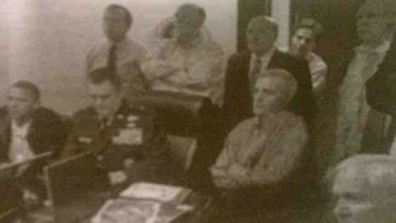
Here's a better look at the altered photo looks like:


(Der Zeitung, via FoxNews.com, used w/o permission)

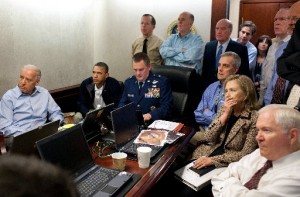
And here's what that picture looked like, as released by the White House:


(Hot Topics, SFGATE, San Francisco Chronicle, used w/o permission)

Before getting to my take on the situation, two excerpts from today's news and views.

First, from a source that seems quite certain about why the Brooklyn paper edited the two women out:
"Outrage after Hasidic paper removes Clinton from iconic photo"
Vlae Kershner, Hot Topics, SFGATE, San Francisco Chronicle (May 9, 2011)

"An ultra-Hasidic newspaper in Brooklyn stirred up outrage after digitally removing Secretary of State Hillary Clinton (and National Security team member Audrey Tomason) from the iconic photo of President Obama and others watching the raid on Osama Bin Laden's compound.

"The paper, Der Tzitung, has a policy against showing photos of women, considering them 'sexually suggestive.' Sure, that's the first thing readers would have thought when Golda Meir was Israeli prime minister...."
Where did the San Francisco Chronicle's blog learn that the Brooklyn paper considered photos of women 'sexually suggestive?' That's a good question - and one that's not answered in the post.

Another piece, written with a somewhat less certain point of view:
"Hasidic Newspaper Edits Clinton Out of Iconic Situation Room Photo"
FoxNews.com (May 9, 2011)

"A Hasidic newspaper apparently edited Secretary of State Hillary Clinton and one other female adviser out of the iconic photo showing President Obama and his security team watching the raid on Usama bin Laden's compound last weekend....

"...But the version of the photo that appeared in the Brooklyn newspaper Der Zeitung, an Orthodox Jewish publication, did not show Clinton, or Audrey Tomason, director for counterterrorism, who also was in the room.

"The Jerusalem Post, which published an article on the alteration, suggested that the Brooklyn newspaper edited the women out because of concerns about women in positions of power. Others suggested that claims of modesty barred the newspaper from showing images of women.

"The newspaper may also have violated the White House conditions for publication, which stipulates that the photo 'may not be manipulated in any way.'..."

Editing Women Out: My Take

I don't know why the Tzitung/Zeitung editors decided to remove the women from that photo. Their motive may be important - at least to the newspaper's readers - but I'm pretty sure that I'd have a difficult time sorting it out from a welter of claims and assumptions. I'm also pretty sure that the effort wouldn't be a good use of my time.

I am, on the other hand, fairly confident that:
  • Hasidic Jews in Brooklyn are unlikely to join forces with Al Qaeda
    • Although both groups may have similar values regarding women in society
      • Or they may not
  • "Different" doesn't mean "bad"
  • We're no longer living in the 1950s
All of the above are 'in my opinion,' of course.

If the Brooklyn paper's decision to violate terms of use for that photo in the interests of their notion of "modesty," I think I may understand their point of view. Note, please: "Think I may understand" does not mean "I approve of."

I remember the 'good old days' before the '60s, when attitudes toward women were decidedly different than they are now in America. Note, please, again: "Different" does not mean "better." I remember the 'good old days:' and they weren't really all that good, in my opinion.1

That said, it's my opinion that if the Brooklyn paper's editors had a problem with publishing a photo which included a woman - it would have been more prudent to exclude the photo entirely.

Living in a Big World

What really astounds me is what appears to be an assumption that doctoring a photo like that would go unnoticed. Brooklyn isn't all that isolated from the rest of America - and even folks who can't read Hebrew can recognized an obviously-faked photo.

I think that response to this blatantly-altered photo should serve as a wake-up call to folks in any of America's subcultures that we all live in a big, diverse world.

I also think that it's a good idea, whatever values a person or subculture has, to deal with the real world - not try to live a fantasy-land built around personal or traditional preferences. But that's just my opinion.

Somewhat-related posts:
News and views:

1 I'm a practicing Catholic, which makes a difference in how I see the world. I've discussed points relevant to this post, in another blog:

Thursday, February 10, 2011

Egypt, Iran: It Can't Happen Here?

This isn't a 'political' blog. Not in the sense that I cheer on one person or party - and jeer everybody else.

On the other hand, politics is sometimes involved in the war on terror - and I've got fairly well-defined ideas about what makes sense and what doesn't.

'Stability' isn't Everything

It's my opinion that it doesn't make sense to prop up a dictator who likes to call himself a "president" - and holds elections at intervals to support his claim. Not in the long run.

It's been done - America's support of Latin American dictators was a notorious point of contention about a half-century back. (As I recall, some of them were 'presidentes;' some were - in my view - a trifle more honest about their preferred title.)

I think I understand some of the motivation in those cases. It's comforting, if nothing else, to deal with a "stable" government. There may even be positive aspects to having one leader for a long time - as an alternative to 'presidente of the month' situations. I also don't think that the Cold War was a capitalist plot: and that's another topic.

In the short run, supporting those 'banana republics' may have been expedient.

In the long run, I think the policy was a mistake. A reputation for supporting petty dictators - and calling it 'defending democracy' - did little to bolster support for America among adolescents and young adults who were already dubious about 'the American dream.'

That was then. This is now.

Mubarak's Egypt is a "stable" country. Or was, until a few weeks ago.

Hosni Mubarak, by the way, has been president of Egypt since he got the job on October 14, 1981. (Egypt, World Factbook, CIA (last updated February 1, 2011)) Maybe he's holding out for an even thirty-year reign. Presidency. Whatever.

The Best Form of Government - is One that Works

I've discussed my views of autocracy and other ways folks have developed to manage themselves in another blog. (Apathetic Lemming of the North (February 5, 2011) Briefly, I think that an autocracy - one person, or a small group, making all the decisions for a country - could work. In theory. In practice, autocrats don't seem to have a particularly good record for running their domains sensibly.

An advantage I see in the system America has is that, in theory at any rate, a proposed course of action gets discussed by so many folks that their individual quirks tend to cancel each other out - leaving something that has a modest chance of not doing too much damage.

There are more upbeat ways of expressing that idea.

Even Autocrats Should Listen to Complaints

President Mubarak and his buddies don't, apparently, like being criticized. Not many people do, I should think.

But most of us aren't able to make folks who disagree with us disappear or die. Mubarak's outfit seems have a 'zero tolerance' approach to criticism.

If they'd been doing a perfect job of running Egypt for the past three (almost) decades, most Egyptians might be willing to put up with the occasional missing relative.

'A chicken in every pot and Uncle Benny in prison' might not make it as a political slogan here in America: but I think folks are willing to put up with quite a bit as long as the system is modestly functional.

From the looks of things, Egypt isn't enjoying boom times just now. Maybe it's not Mubarak's doing: I don't know. This doesn't seem to be the best epoch, economically, in quite a few places.
If it seems that I concentrated rather heavily on the United States in those 'economic' posts - you're right. That's the country I live in: and it's one of the major players, globally. Moving on.

The point is that Egypt, along with other parts of the world, seems to be going through economic hard times. Folks tend, I think, to get a trifle edgy when money's tight. Add that to a regime that's been making friends and relatives die or disappear for decades - and "edgy" could easily turn into "angry." In my opinion.

If only for the sake of good public relations: I think Mubarak and company would have been well-advised to make it look like they were willing to listen to complaints.

Hello, Information Age: Goodbye 'Orderly' Countries

I remember the 'good old days,' when most Americans relied on a few news editors, media executives, and publishers to tell them about what happened outside their circle of friends and acquaintances. Because we didn't have many other options.

From one point of view, it was a nice, orderly situation: Americans watched whatever was on the three major networks, plus PBS; and read whatever news editors and publishers decided was fit to print.

Things aren't quite so 'orderly' these days.

I haven't heard "divisive" used all that much lately - but I think it's a pretty good way of describing information that hasn't been approved by 'the right sort.' I also think that "divisive" isn't necessarily "bad." I've discussed this sort of thing before:

Change Hurts

I think many of the old-school information gatekeepers sincerely thought they were supporting 'freedom of speech' by deciding what the rest of us saw, heard, and read. However valid that assumption is, the America of my youth didn't last.

We got, in fairly rapid succession, and not necessarily in this order:
  • International direct-dial calling
  • Transatlantic real-time television broadcasts
  • Fax machines
  • Twitter
    • And a plethora of other online communities
Americans still, I think, rely on a few news editors, media executives, and publishers to tell them about what happened outside their circle of friends and acquaintances.

But now our 'circle of friends and acquaintances' can easily include folks all over the world.

For me, and others who don't mind finding out what someone besides old-school journalists and established authorities think: the Information Age is a great time to be alive.

The folks who used to have more control over what 'the masses' were allowed to know? I suspect they aren't quite so thrilled.

Which is, I think, part of why we're seeing recurring efforts to 'protect' us from the big, bad Internet. I think many - maybe most - folks who want to keep us from reading 'bad' things online sincerely feel that they're doing the right thing.

I also think that trying to control what others are allowed to learn is not a good idea - with a few exceptions. As I said when I started writing today's posts: it's not simple.

More of today's posts:
Related posts:
More:

Shutting Down Egypt's Internet: A Responsible Act?!!

I've been posting about the meltdown in Egypt in another blog: Apathetic Lemming of the North. That's because this blog is about the war on terror, or whatever we're supposed to call it these days, and not so much about over-age-in-grade permanent presidents. The 'terrorism' angle wasn't as definite as the 'freedom of speech' aspect - and the Lemming is very concerned about freedom of speech. Also interior design, cosmology, and - today - making shiny spheres from dirt. ("Dorodango!" (February 10, 2011)) It's a sort of 'eclectic' blog. Like the inside of my head - and that's yet another topic.

I've also been letting news articles about what's happening in Egypt and elsewhere pile up, until today I've got enough for a post here. Mostly about freedom of speech. Several posts, actually.

I've said this before: I think freedom of speech is important.

Very important.

That's why I was - "impressed" might be the word - by an assertion in this article:
"The Egyptian government shut down most of its country's internet not by phoning ISPs one at a time, but by simply throwing a switch in a crucial data center in Cairo.

"That according to a February presentation to the Department of Homeland Security's Infosec Technology Transition Council, obtained by Wired.com.

"The presentation - made by Bill Woodcock, research director of the Packet Clearing House - argues that the Egyptian Communications Ministry acted quite responsibly in the procedure it used to cut ties from the net, after the shutdown was ordered by Egypt's much-feared intelligence service.

" 'Most of the outage was effected through a breaker flipped in the Ramses exchange, and the rest was phone calls and arm-twisting,' the presentation says. 'Ramses exchange' refers to a central building in Cairo where Egyptian ISPs meet to trade traffic and connect outside of the country, a facility known as an Internet Exchange Point...."

"...Most media, including Wired.com, reported that government officials contacted individual ISPs and told them to shut down their networks, under threat of losing their communications licenses.

"But the document (embedded below) contradicts that narrative, providing new details on the outage - largely laying the blame on Egypt's internal security service, while describing the 'flip-the-switch' shutdown as a 'politically liberal' choice by the Egyptian communications ministry.

"That's because turning off the internet at the center exchange made it very easy to switch it back on, prevented surveillance, made it clear to everyone what had happened, and prevented spyware from being placed on the networks.

"Compare that to Tunisia, where Facebook login pages were manipulated - presumably by the government - to grab the passwords of Tunisian activists in order to delete their accounts and protest pages.

"The presentation suggests the weeklong shutdown had severe effects on Egypt's economy, in the short term from loss of commerce, and in the long term from a likely plummet in tourism, and an exodus of call centers from Egypt...."
(Threat Level, Wired (February 10, 2011))
In my considered opinion - I don't have enough information to have a considered opinion on just how "responsible" shutting Egypt's people off from the Internet was.

Or, rather, trying to shut them off. Google and Twitter came up with a workaround. (Apathetic Lemming of the North (January 31, 2011)

One thing that seems to be true about the Information Age is that it's not like the 'good old days.' Can't say that I'm sorry about that. That's because I lived during part of the 'good old days.' And have a pretty good memory. McCarthyism? Political correctness? I do not want to go back.

And that isn't another topic.

Finally, on the 'responsibility' displayed by Egypt's ISPs: under the circumstances, maybe letting the establishment cut Egypt's people off from the global community was the best they could do. Looks like it may be a bit rough on Egypt's tourist and tellecommunications industry: but so was having the same president since 1981. In my opinion.

More of today's posts:Related posts:

Today's World: Not Boring; Not Simple

I'm writing a serious of posts this evening - mostly about my take on what's been happening in Egypt, a little about events in Iran, and a lot about my take on freedom of speech. I'll be getting to all that in a bit.

First, a little about assumptions I make about the nature of reality. I haven't done this for a while in this blog. Please be patient: this shouldn't take long. (Famous last words?)

Nice is Nice, Real is Real

Essentially, I think it's a good idea to let folks express opinions - without fear of losing their jobs, freedoms, or lives. I even think that it'd be nice if we didn't need to have any secrets.

I could also think that it'd be nice if nobody every got sick, everybody was as handsome/beautiful as movie stars, and everybody had a satisfying, fulfilling career. Realistically, that's not gonna happen.

I'm not even sure that having a "career," in the contemporary American sense of the word, is all that desirable a goal. And that's another topic.

The point is, simple happens in some spy novels and political campaigns. The real world is - not-simple.

You Like Simple? Look Elsewhere

Things aren't simple. Not when human beings are involved. I've written that before. (September 18, 2009)

Information Gatekeepers

If you've been following this blog - thank you! And, more to the point of this post, you know what I mean by an information gatekeeper. I've written about that before too:
Briefly, information gatekeepers are the folks in a society who are in a position to decide what the rest get to learn. In America, that used to include news editors, media executives, teachers, librarians, and publishers.

Happily, many of those folks thought they believed in freedom of speech. Some followed through - and allowed those who didn't agree with them to get published. Others: well, I've discussed political correctness before, too. (January 7, 2010, November 10, 2009, February 19, 2008, for starters)

It's Not Always 'the Other Guy'

It's not always 'those liberals' who prefer to silence dissenting opinions. I remember the trailing edge of McCarthyism. I think that, instead of assuming that everybody who doesn't agree is bad - - - wait, I've written about that before, too.
Egypt, Iran, and dissent:
More:

Friday, July 30, 2010

WikiLeaks, Killing People Who don't Agree, and Living in the Real World

From today's news:
"U.S. worried more secret documents may be released"
Reuters (July 30, 2010)

"U.S. officials are worried about what other secret documents the whistle-blowing website WikiLeaks may possess and have tried to contact the group without success to avoid their release, the State Department said on Friday.

"The shadowy group publicly released more than 90,000 U.S. Afghan war records spanning a six-year period on Sunday. The group also is thought to be in possession of tens of thousands of U.S. diplomatic cables passed to it by an Army intelligence analyst, media reports have said.

" 'Do we have concerns about what might be out there? Yes, we do,' State Department spokesman P.J. Crowley told a briefing, adding that U.S. authorities have not specifically determined which documents may have been leaked to the organization...."
My take on the data dump / leak / whatever? It's not a good thing. I might not have chosen quite so colorful a phrase as some American officials have, but I'm in general agreement with this:
"...'BLOOD ON THEIR HANDS'

"Both Crowley and Gibbs expressed concern that the document dump might expose U.S. intelligence-gathering methods and place in jeopardy people who had assisted the United States.

" 'You have Taliban spokesmen in the region today saying they're combing through those documents to find people that are cooperating with American and international forces. They're looking through those for names. They said they know how to punish those people,' Gibbs said...."
(Reuters)

"The People have a Right to Know"

"The people have a right to know," and permutations on that phrase, have been around for decades. I associate it with the National Inquirer, probably because of that "Inquiring minds want to know" marketing campaign.

The idea that an informed populace is necessary is, I think, correct: at least, in a country where citizens can vote on issues and/or who their leaders will be. Which takes "the people have a right to know" out of the realm of "Diet of Doom" journalism and into a rather more serious area.

Censorship, Freedom of Speech, and Common Sense

The real world isn't particularly well-suited to simple solutions. Not when it gets to the nuts-and-bolts level.

I don't particularly like censorship. I've written about that before. Quite a lot, I see.

On the other hand, I'm aware that there are people in the world who are not nice. At all. Some of them flew airliners into skyscrapers almost 10 years ago, with regrettable results.

Today, quite a few folks sincerely believe that Americans - and anybody else who doesn't live up to their particular version of Islam - should either become their sort of Muslim, or become dead.

The rest of us, including quite a significant numbers of Muslims, would rather not live in a Taliban-style world.

That's where the trouble with these leaked documents comes in.

As I see it, the Taliban thinks that people who are identified in these documents should be dead. The people whose identities have been compromised probably don't agree.

That's the sort of conflict that would, ideally, be settled over a nice cup of tea.

We don't live in an ideal world, so that's not what will happen.

I'd like to believe that whoever has the as-yet-unreleased documents sincerely believed that "the people have a right to know," and had no clue that lives were at stake. And, that the individual will now realize that not-nice people will almost certainly do not-nice things if more secrets are leaked.

I don't think that's likely.

Wouldn't It be Nice, If Everyone was Nice?

We live in a not-nice world. The Taliban, Al Qaeda, and like-minded groups are quite willing to kill people whose ideas don't match theirs. They're not the only trigger-happy ideologues around, of course: but right now they're a major threat.

It'd be very nice if the Taliban's leaders and all the rest would suddenly decide that it isn't nice to kill people who aren't just like themselves - but I seriously doubt that's going to happen.

So, until everybody decides to be nice - we'll need to have secrets. Not many, I hope, but some.

Related post:

Thursday, July 22, 2010

Transparency: For the Right People, Apparently

This blog isn't political. Not in the sense that I consistently write that a Ms. Smith is the most intelligent woman in the universe, who by rights should have won every election she ran in - or that a Mr. Jones is a doo-doo-head who is unfit to serve as a human being. (more at June 21, 2009, and elsewhere)

This blog is concerned with the war on terror - whether that term is supposed to exist or not. (March 30, 2010) What America's government decides to do - or not do - about the real threat of people who want to kill us is determined, for the time being, by politicians.

As a result, I have to look at political matters from time to time.

Like this:
"Contrary to the Obama administration's promised commitment to open government, the Department of Homeland Security, in a highly irregular move, filtered hundreds of public records requests through political appointees, allowing them to examine what was being requested and delay releasing sensitive material, according to internal e-mails obtained by the Associated Press.

"The political appointees were allowed to vet records requests that were deemed politically sensitive and require career employees to provide them with information about who requested records — for example, where the requester lived and worked, whether the requester was a private citizen or journalist and, in the case of congressional representatives, whether they were Republican or Democrat.

"The DHS issued a directive to employees in July 2009 requiring a wide range of public records requests to pass through political appointees for vetting. These included any requests dealing with a 'controversial or sensitive subject' or pertaining to meetings involving prominent business leaders and elected officials. Requests from lawmakers, journalists, and activist and watchdog groups were also placed under this scrutiny.

"The reviewers included Homeland Secretary Janet Napolitano's top staff members, including her deputy chief of staff, senior department lawyer and deputy director of scheduling...."
(Threat Level, Wired)
I think it's a good idea to be careful about what information is released to which people. The old adage, 'loose lips sink ships,' may sound corny - but there's good sense in it. (May 11, 2010)

However, I think that deciding what information is "sensitive" should be in the hands of someone whose job security isn't dependent on keeping a politico happy.

I was impressed, positively, when candidate Barack Obama said that he would promote 'transparency' in government. It's a fundamentally sound idea.

The problem is, it has to be turned from a sound idea into an established practice.

From the Office of Deniability: No Information Was Withheld

Like that one-time favorite of Hollywood, the letter of pardon from the Governor, some information becomes less and less useful, the longer it's withheld.
"...Although the vetting did not prevent information that should have been released from getting released, the AP noted, it did cause numerous delays - sometimes lasting weeks - in releasing records to Congress, watchdog groups and reporters. The delays led some department officials to worry about potential lawsuits, according to one internal e-mail the AP obtained.

" 'All this article points out is that senior leadership had visibility into FOIA releases to enable the department to be as responsive as possible to requests from the press and other stakeholders, especially as it pertained to documents generated during the previous administration, DHS spokeswoman Amy Kudwa told Threat Level in an e-mail statement. She noted that the department, under the Obama administration, had reduced a FOIA backlog inherited from the Bush administration from 74,879 requests at the end of fiscal year 2008 to just 12,406 requests as of this January and had also reduced the typical processing time for requests.

"The e-mails obtained by the AP, however, reveal that political appointees were less interested in vetting record requests for these reasons than for determining — based on the kinds of requests coming in - what areas of the government might be under scrutiny. Knowing what records journalists were requesting might help the administration prepare a response in anticipation of a news story. For example, the e-mails show concern about making sure the department didn't release information about Obama's father without first coordinating with the White House...."
(Threat Level, Wired)
I was impressed that the DHS spokesperson mentioned the size of the backlog at one point during the previous administration, compared to the size under Obama's enlightened oversight - without saying how the size of the backlog compared to the number of requests. I've talked about using, and misusing, facts before.

Can't We Just Trust the Government?

There are systems of government in which 'the masses' don't have to know what's going on. Instructions come from the Emperor, or whatever the top level is called: and responsibility for folks at my level ends when we receive our instructions, and obey.

A system like that can work, but it's not the way America gets things done.

Our system requires an informed electorate. That's informed, not fed whatever our betters think we should know.

As the upcoming midterm elections will probably demonstrate once again, it's messy: but the system works.

And I rather like it.

Related posts:In the news:

Monday, July 19, 2010

Blogetery Shutdown, WordPress, Al Qaeda, the FBI, and C3PO

It made a memorable line in a famous movie:
"No! Shut them all down! Hurry!"
(C3PO, Star Wars Episode IV, via entertonement.com)
And, in context, C3PO's instructions to R2D2 were appropriate.

Ordering someone to 'shut them all down' isn't always a good idea, though.

Last Friday, I read about 73,000 WordPress blogs hosted by Blogetery going silent. I was - concerned. Particularly since, hyperventilating Tweets and blog posts notwithstanding: all those blogs apparently had been silenced.The least-unlikely explanation I ran into was that Blogetery had been involved in some sort of intellectual property rights infringement.

I wasn't going to suggest that terrorism was involved, one way or the other: there were enough wild rumors flying around as it was. So I missed my chance to write 'told you so.' Which is okay.

Earlier today, I read that the FBI had called for Blogetery's shutdown because one (1) blog hosted on their servers had terrorist-related materials on it.

So the feds shut down all 73,000?! That seemed - excessively zealous. Unless law enforcement had reason to suspect that someone on the Blogetery staff was the one who had planted the terrorist-related data - in which case the only safe thing to do would be to shut everything in Blogetery down, until technicians could go through the code and equipment.

Check Facts, THEN Issue Orders

Apparently, some hapless employee - misinterpreted? - what the FBI, or someone, had said, and told both Blogetery and the media that the FBI had said 'shut them all down.'
"...But [Burst.net chief technology officer Joe] Marr said a Burst.net employee erred in telling Blogetery's operator and members of the media that the FBI had ordered it to terminate Blogetery's service. He said Burst.net did that on its own...."
(CNET)
What still isn't clear is why old-school news media in America hadn't reported on the Blogetery shutdown. I suspect that my father's advice may apply here: "Never ascribe to malice, what can be explained by stupidity."

Or, in the case of old-school media, institutional inertia and a monumental level of cluelessness about Information-Age issues.

Conspiracy? I Rather Doubt It

The 'addled employee' explanation could be part of some sort of plot to silence somebody or other. Or to prove that America's federal government can silence critics, or to keep people from knowing the the mothership finally came for Elvis.

But I don't think so.

I also don't think that we know everything there is to know, about what happened to Blogetery. But I'm not as concerned as I was on Friday. The explanation first given on CNET is plausible, given how excitable people can get when the FBI, blogs, and terrorists are involved.

My guess is that somebody, somewhere along the line, overreacted - big time - and caused a whole lot of unnecessary excitement.

Or maybe not-so-unnecessary.

Cloud Computing and Solid Realities

I've briefly discussed cloud computing in another blog. I think the idea is attractive: and somewhere between impractical and dangerous right now.

The Blogetery shutdown shows, I think, how vulnerable data stored on someone else's server is.

About Blogetery and the missing blogs: I suggest reading that CNET article. Of the published reports I've read, it seems to be the best-researched and calm discussion of what we know to date.

Do I Trust America? The FBI?

I've made the point that, in my opinion, America isn't perfect. I am convinced that this country is run by human beings. Mistakes happen, and sometimes bad things are done on purpose.

But, on the whole, I think that America is a pretty good place to live. And, yes: I 'trust the government.' To the extent that I must assume that, on average, its institutions act in accord with a set of laws that are intended to prevent officials from doing serious harm to American citizens.

The CNET account describes what appears to be a legal operation of the FBI, done with judicial approval: in which some yahoo overreacted and added fodder for a new crop of conspiracy theories.

The FBIPressOffice, on Twitter, linked to the FBI's 'top 10 of the week' lists on Friday, July 16, and hasn't mentioned anything about the Blogetery situation since then.

Which I don't find too surprising, since the (real) issue is probably still under investigation.

I've put excerpts from four news articles after the links, interspersed with brief comments.

Related posts, aboutIn the news:
Excerpts:
"Blogging platform Blogetery.com was cut off by its hosting company last week after the authorities said al-Qaeda 'terrorist material' was found on one of its servers, its web host, BurstNET Technologies said Monday.

"Blogetery, a platform for some 70,000 blogs, was taken down by BurstNET after the Federal Bureau of Investigation asked BurstNET 'to provide information regarding ownership' of the server hosting Blogetery.com, BurstNET said in a statement.

"BurstNET shuttered Blogetery at its own discretion after concluding it was violating its 'Acceptable Use Policy.'..."
(Threat Level, Wired)
This is the most recently-published article I read today. The 'AUP' violation explanation makes sense, particularly since there seems to have been a pattern of bad behavior. Still: 73,000 blogs?
"The blogosphere and online message boards have been buzzing with speculation as to why blogging website Blogetery.com, which claims to have hosted more than 70,000 bloggers, was suddenly shut down last week.

"Was the site a haven for terrorists? Packed with how-to advice for bomb builders? Rife with child porn? And did the FBI really order the blogging site's host BurstNET to pull the plug?

"BurstNET officials on Monday attempted to set the record straight by issuing the following statement:

" 'On the evening of July 9, 2010, BurstNET received a notice of a critical nature from law enforcement officials, and was asked to provide information regarding ownership of the server hosting Blogetery.com. It was revealed that a link to terrorist material, including bomb-making instructions and an al-Qaeda "hit list", had been posted to the site. Upon review, BurstNET determined that the posted material, in addition to potentially inciting dangerous activities, specifically violated the BurstNET Acceptable Use Policy. This policy strictly prohibits the posting of 'terrorist propaganda, racist material, or bomb/weapon instructions". Due to this violation and the fact that the site had a history of previous abuse, BurstNET elected to immediately disable the system.'..."
(PCWorld)
That "was the site a haven" style reminds me of some of the more colorful journalism of the late 19th and 20th centuries - and that's another topic.

I'm presenting these excerpts in reverse chronological order, by the way: most recent to earliest.
"A popular website that hosted more than 70,000 bloggers was shut down suddenly last week after the FBI informed its chief technology officer that the site contained hit lists, bomb-making documents and links to Al Qaeda materials, it was reported on Monday.

"When the WordPress platform Blogetery.com went dead, the initial explanation from the site's host, Burst.net, was that 'a law-enforcement agency' had ordered it to shut down, citing a 'history of abuse.' The explanation caused a wave of conspiracy theories in the blogosphere.

"But according to a report on CNET Monday, Burst.net shut down Blogetery.com when it became spooked by a letter from the FBI, in which the bureau detailed the presence of terrorist materials among the blog posts...."
(FOXNews)
"Spooked" isn't quite the sort of stuffy prose that a more literary outlet might employ - but I think it fits what we know, to date.

Finally, what I regard as the must-read article, from CNET. There's more detail, after this excerpt:
"More details are surfacing about why Blogetery.com, a blogging platform that claimed to service more than 70,000 blogs, was mysteriously booted from the Internet by its Web-hosting company.

"The site was shut down after FBI agents informed executives of Burst.net, Blogetery's Web host, late on July 9 that links to al-Qaeda materials were found on Blogetery's servers, Joe Marr, chief technology officer for Burst.net, told CNET. Sources close to the investigation say that included in those materials were the names of American citizens targeted for assassination by al-Qaeda. Messages from Osama bin Laden and other leaders of the terrorist organization, as well as bomb-making tips, were also allegedly found on the server.

"But Marr said a Burst.net employee erred in telling Blogetery's operator and members of the media that the FBI had ordered it to terminate Blogetery's service. He said Burst.net did that on its own.

"This past weekend, reports surfaced that Blogetery was shut down by the federal government and suggested that it was likely due to copyright violations. On Sunday, CNET reported that the shutdown had nothing to do with copyright violations and that a similar service, Ipbfree.com, a platform for message boards, was shuttered within days of Blogetery. It is still unclear why Ipbfree was cut off...."
(CNET)

Monday, July 12, 2010

Banned in Britain: Savage and the Department of Unintended Consequences

I don't know enough about Michael Savage to have an informed opinion about what he's said in public in the United Kingdom.

Maybe he really is as dangerous as Hamas.

Or maybe he's just saying things that the established order in Britain don't want to hear.

If it's the latter, the United Kingdom has a bigger problem than Michael Savage.

Anybody I don't Like is a Commie!

In my 'good old days,' quite a few people were convinced that anybody they didn't approve of was a commie. Or at least a commie sympathizer. Or part of the red menace.

That's one of the reasons I'm not terribly nostalgic about the 'good old days.'

That was then, and now things are different. Sort of. Here in America, folks whose sympathies were for blacklisted physicists became the establishment. As a result, the wacky end of establishment supporters don't see commies everywhere: now it's fascists and racists and relevant stuff like that.

Different words, same old song.

Silencing the Opposition: Such a Tempting Idea

I think it's a very human thing, when you're in a position of influence, to keep people who don't agree with you from expressing their views.

I also think it's a very, very stupid idea.

Particularly these days, when "the masses" get their information from many sources: not just a few national broadcasting networks and a handful of newspapers. I've written about information gatekeepers before.
"Banned in Boston" as a Stamp of Approval
Decades back, "banned in Boston" showed up in entertainment news fairly often. Someone speculated that playwrights and movie makers tried to get Boston's painfully proper people to ban their work: for the free publicity. And as a sort of stamp of approval: showing that the playwright or director was 'bold' and 'outspoken.'
Dangerous Ideas, Maybe: But Dangerous to Whom?
I get - interested - when a national government tries to silence someone who doesn't agree with the current leaders.

I think it's good for Michael Savage, that he lives in the United Kingdom. In some countries, he wouldn't be banned - most likely, he'd just disappear. Or get killed by an 'unknown assailant.' (April 30, 2008)

As I said before, I don't know much about Michael Savage's statements. Maybe he really is dangerous.

Or maybe the British establishment isn't any more open to disagreeable ideas, than their American counterparts. If that's the case, I think their (apparent) effort to silence Mr. Savage may make his position stronger.

I could be wrong, but I don't think the British like their leaders to tell them how to think, any more than Americans do.

Here's what set me off today:
"New U.K. government bans Michael Savage"
WorldNetDaily (July 12, 2010)

"Conservative Party admin demands repudiation of 'violent' statements"

"The new Conservative Party-led government of Prime Minister David Cameron informed Michael Savage it will continue the ban on the top-rated talk-radio host's entry to the United Kingdom unless he repudiates statements made on his broadcasts that were deemed a threat to public security.

"The U.K. Border Agency told Savage through a letter from the treasury solicitor's office that his 'exclusion' from the U.K. that began last year under the Labour Partygovernment of Gordon Brown will continue 'in the absence of clear, convincing and public evidence' that he has 'repudiated his previous statements.'

"As WND reported, then–British Home Secretary Jacqui Smith announced May 5, 2009, that Savage was on a list of 16 people, along with terrorists and neo-Nazis, banned from entry because the government believed their views might provoke violence. Smith said it was 'important that people understand the sorts of values and sorts of standards that we have here, the fact that it's a privilege to come and the sort of things that mean you won't be welcome in this country.'..."

"...The U.K. ban-list includes Hamas terrorist leader Yunis Al-Astal, former Ku Klux Klan grand wizard Stephen Donald Black, neo-Nazi Erich Gliebe and radical American pastor Fred Phelps, known for his virulent anti-gay protests at funerals...."

"...An e-mail message dated Nov. 27, 2008, from an unnamed Home Office official, says, with regard to Savage, 'I can understand that disclosure of the decision would help provide a balance of types of exclusion cases.'

"Another e-mail points to complicity by other agencies and even former Prime Minister Brown.

" 'HO (Home Office) intend to include [Savage] in their quarterly stats ... Both the FS (foreign secretary) and PM (prime minister) are firmly behind listing and naming such people,' it reads.

"The e-mails include a message from an unnamed civil servant whose cautions were ignored.

" 'I think we could be accused of duplicity in naming him,' he wrote without explaining the reason.

"Smith's successor as home secretary, Alan Johnson, called the ban a terrible blunder and told the London Daily Mail he would scrap the policy of maintaining an enemies list. But Savage told WND two days later that according to his attorney, Johnson's announcement did not mean his name had been removed from the list...."

Postscript

Oh, my:
  • "...'...disclosure of the decision would help provide a balance of types of exclusion cases...."
  • "...'...Both the FS (foreign secretary) and PM (prime minister) are firmly behind listing and naming such people,'..."
  • "...'I think we could be accused of duplicity in naming him,'..."
In my opinion, it's a really bad idea for a nation's leaders to try silencing people whose ideas they don't like. We're not, quite, looking at thoughtcrime here: but I think it's a bad sign when national leaders appear to want uniform - and enforced - beliefs among their subjects.

Related posts:Related posts, on censorship, propaganda, and freedom of speech.

Thursday, December 31, 2009

News Stories You're Not Supposed to Know About

This post isn't about the War on Terror (which, apparently, no longer exists - officially (March 30, 2009)), so much. It's about what people - Americans in particular - are supposed to know about national and world events.

If you feel, right down to the bottom of your heart, that The New York Times really does print all the news that's fit to print (October 21, 2008), that Big Oil and the military-industrial complex control America, that the CIA blew up New York City's World Trade Center, and that America is to blame for whatever's wrong with the world: stop reading. You won't like this post.

Still with me? This is your last warning: If you really believe that FOXNews is part of some kind of plot, or at least is a mere tool of the Republican party, you're not going to like this post.

News That Wasn't Fit to Print, 2009

FOXNews put together a list of 9 stories that - as far as old-school traditional news media was concerned - were non-events that never happened.

To be fair, outlets like The Associated Press sent information out on the wires - but outfits like The New York Times and CBS news were free to feature the stories as top news, filler for the back page, or to ignore them entirely.

The list:
  • Van Jones
    • "White House Green Jobs adviser Van Jones resigned from his post in September after weeks of pressure over his radical past. A former self-avowed Marxist and anarchist, Jones signed a 2004 petition that suggested the U.S. government was involved in the Sept 11. terrorist attacks...."
  • ACORN Tapes
    • "Filmmakers James O'Keefe and Hannah Giles, posing as a pimp and a prostitute, went undercover to the offices of the community organizing group ACORN in the summer. They secretly videotaped employees instructing them in how to falsify tax forms and seek illegal benefits for 13 'very young' girls from El Salvador whom the pair said they wanted to import to work as child prostitutes...."
  • Science Czar John Holdren
    • "President Obama's 'science czar,' John Holdren, floated a number of lethal policies to shrink the human population -- including compulsory abortions and other Draconian measures -- in science textbooks he published in the 1970s...."
  • Climate-Gate
    • "Hackers broke into the servers at a prominent British climate research center and leaked years' worth of e-mails onto the Web, producing what some skeptics of man-made climate change said was 'smoking gun' evidence of collusion among climate scientists. One e-mail referenced a plan to 'hide the decline' in global temperatures, as another lamented the 'travesty' that temperatures had not increased over the past decade. Prominent climate scientists discussed blackballing skeptics and admitted to dumping data to avoid public scrutiny...."
  • Politicizing the NEA
    • "A senior official at the National Endowment for the Arts encouraged artists to promote President Obama's political agenda in a conference call he organized with the White House. The NEA's communications director Yosi Sergant eventually resigned in August amid accusations that the grant-making organization was becoming politicized...."
      • This is hardly news: ideological requirements for acceptance in American academia - NEA included - are part of the reason I left the racket, back in the eighties.
  • Chas Freeman
    • "Chas Freeman, the Obama administration's appointee to chair the National Intelligence Council, had major conflicts of interest with the Saudi and Chinese governments as a private citizen. He referred to Tibetan Buddhist protests against the communist government in China as a 'race riot,' and said the Chinese had been 'overly cautious' in killing hundreds of protesters in the Tiananmen Square massacre of 1989...."
  • Tea Party Protests
    • "In the wake of the bank bailouts and the federal stimulus package, some critics of the Obama administration's economic crisis plans urged citizens to mail tea bags to their congressmen as a form of protest, recalling the Boston Tea Party and unjust taxes imposed by the British before the American Revolution. The Tea Party movement grew to include massive protests, as tens of thousands of Americans joined in on Tax Day...."
  • Kevin Jennings, Safe Schools Czar
    • "President Obama's 'safe schools czar,' Kevin Jennings, is a former schoolteacher who advocated promoting homosexuality in schools and was forced to admit he had poorly handled an incident in which a student told him he was having sex with older men. Jennings has since been tied to a pornographic suggested reading list...."
  • Democratic Stimulus
    • "A December study from George Mason University showed that Democratic districts have received nearly twice as much stimulus money as Republican districts -- and the cash has been awarded without regard to how badly an area was suffering from job losses or income problems. Blue districts garnered the majority of the $787 stimulus package, getting an average of $439 million per district...."
    (FOXNews)
If you don't like the list - or find it a little unsettling - you can do what some of the self-described best and brightest in all the land do. Tell yourself that it's FOXNews, and that they always lie. Especially about the dear president.

Me? I don't think that news organizations lie. Not very often, and even less often when they're aware that what they're saying is false. That goes for The New York Times, FOXNews, CNN, and all the rest.

On the other hand, I know that news organizations filter the information they have, selecting what their editors think is important and rejecting the rest. Otherwise, we'd be flooded with everything from stories about jaywalkers, convenience store robberies and fossils in Kenya to weather reports from Poughkeepsie: with information about national events buried between them.

I think the problem that many old-school, traditional news editors have is that they live in a relatively small community. Although, in my opinion, Atlanta is becoming a major news media center: New York City, Washington D.C., and Los Angeles remain as the great centers of old-school journalism in America. With contemporary telecommunications and air travel, it isn't necessary for people living in these places to make contact with outsiders. Unconsciously, I think, they form a closely knit community of like-minded people.

Nothing wrong with that.

The problem, as I see it, is that editors often don't realize that their preconceptions and preferences about the world and how it should work aren't necessarily widely shared outside their little urban enclaves - and, in my opinion, are sometimes at odds with objective reality.

Being somewhat uncritical of improbable reports that fit their preconceptions can be downright embarrassing: like the time a major American newspaper printed a fake letter. (December 22, 2008)

Old-school, traditional news editors generally pass along reports on things that actually happened: quite possibly unaware of how their assumptions and biases affect which facts they select and which they reject. Sometimes, news media reports events that never happened. (August 7, 2007)

Don't Read the News: Study It

With traditional news media's track record for turning a blind eye to deficiencies in the workers' paradise and by-products of the Third Reich's efforts to establish lebensraum (October 21, 2008) it's hard to tell when news articles are tongue-in-cheek, and when they should be taken at face value. (October 30, 2009)

Which, together with the way that major events (in my opinion) are ignored if they don't fit in with what old-school journalists feel that the masses should be allowed to know, is why I don't read the news. I study it.

Related posts: In the news:

Monday, December 7, 2009

How to Shut Down the Internet - or - Dealing With Troublesome Ideas, and the People who Spread Them

Turns out, it's fairly easy to block people from the Internet. In some parts of the world. I ran into an article that describes how Iran was able to "shut down the 'net" today. Not the whole Internet, of course: just the parts in areas where the Ayatollahs' enforcers were doing something that involved tear gas and bullets.

Just exactly what happened isn't entirely clear: but Iran's leaders didn't let another "Neda" video get out.
"How to Shut Down the 'Net: A Guide for Repressive Regimes"
FOXNews (December 7, 2009)

" Facing student protests ahead of today's National Students Day — the anniversary of three student deaths in Tehran in 1953 — the state-owned Telecommunication Company of Iran (TCI) slowed or blocked completely access to the Internet for most of the state

"The Internet may be a worldwide superhighway, but it's all to easy to shut it down. Governments aiming to squelch free speech in don't even have to work hard to do so: It's all too easy to restrict the Internet and keep their people in the dark...."
The rest of the article is, I think, worth reading. But then, I'm one of those people who read articles in The New York Times, Reuters, Xinhua News Agency, and even - FOXNews.

There are quite a few ways of reacting to the article, including (adapted from another blog's post):
  1. Denial:
    • The article is on the FOXNews website, so it must be a lie
      • And probably some kind of conspiracy
  2. Defense:
    • Iran's leaders, as non-Western rulers with citizens who aren't unswervingly loyal
      • Has very understandable reasons for stamping out criticism
      • Shouldn't be judged harshly
        • If at all
      • Is simply reacting to Yankee imperialism
        • Which, in some circles, excuses almost anything
  3. Resignation:
    • That's just the way things are
      • And it's never going to change
  4. Interest:
    • So that's how it's done
Considering the myriad ways of the human mind, I'm sure there are many more alternative reactions.

Me? I go with the fourth alternative. I don't approve of the Ayatollah's government: even though it is a democracy, in the sense that they have elections: and replaced a monarchy. I grew up in America, a republic with a 'strong democratic tradition,' and think that a democracy is a workable form of government. But I don't think it's the only way that a country can be run - or even the only 'good' way to manage national affairs. (November 15, 2009, December 29, 2008) But I'm getting off-topic.

The point is, because of the way information technology is set up in Iran, and the sort of power the government has - legally - it's fairly easy for the Ayatollahs to black out parts of their domain.

Quite a few countries don't have the bewildering array of Internet Service Providers that America has - which simplifies the process of choosing an ISP - and which really helps the government, when the Supreme Leader, or whatever the big kahuna's title is, wants to lean on the local and regional ISPs.

From a technical point of view, filtering unwanted information is a fairly straightforward affair.
"...Keyword blocking prevents people from searching for such obviously dangerous words as 'freedom' and 'democracy.' Custom black lists also server to block content that specifically rankles the government. Is it unions, student protests or something else?

"When the government catches someone searching for these terms, they can automatically turn off their access for a period of time. "If a user happens upon a site or search result that has been flagged unacceptable, that user’s connection to the Internet can be dropped altogether for a specified period of time," notes PCMag.com's Lynn...."
The article is, I think, a fairly quick way to learn just how easy it is to control what people are allowed to read and see. Information technology like the Internet makes it possible for people around the world to communicate - but only as long as national leaders are willing to put up with the occasional embarrassments that go along with that sort of transparency.

I think that America enjoys a remarkable degree of freedom, and I'm one of those people who's willing to put up with the messy side of open communication. I don't like it, but that - again - is another topic. (See "Frosty the Pornman....," in another blog)

A history of (relatively) free exchange of ideas is no guarantee that Americans will be allowed to express themselves in the future. It hasn't been all that long, since a strange alliance of very serious people tried to "protect" Americans from the Internet. (March 9, 2008) Yes, it can happen here - and almost did.

Related posts: In the news: Related posts, on censorship, propaganda, and freedom of speech.

Unique, innovative candles


Visit us online:
Spiral Light CandleFind a Retailer
Spiral Light Candle Store

Blogroll

Note! Although I believe that these websites and blogs are useful resources for understanding the War on Terror, I do not necessarily agree with their opinions. 1 1 Given a recent misunderstanding of the phrase "useful resources," a clarification: I do not limit my reading to resources which support my views, or even to those which appear to be accurate. Reading opinions contrary to what I believed has been very useful at times: sometimes verifying my previous assumptions, sometimes encouraging me to change them.

Even resources which, in my opinion, are simply inaccurate are sometimes useful: these can give valuable insights into why some people or groups believe what they do.

In short, It is my opinion that some of the resources in this blogroll are neither accurate, nor unbiased. I do, however, believe that they are useful in understanding the War on Terror, the many versions of Islam, terrorism, and related topics.