
Showing posts with label nuclear weapons. Show all posts

Friday, April 5, 2013

North Korea Nuclear Attack: "Extremely Unlikely," But - - -

North Korea's new ruler may have the wisdom which told his father when to stop threatening, and accept the best available appeasement.

Or Kim Jong Un may not fully understand the power which he wields.

I don't know: and am very glad that someone else has to make 'go/no go' decisions for America's military. I'll get back to that.

Living with Uncertainty

Someone on the American president's national security staff said "it's extremely unlikely" that North Korea has a missile which could reach the United States with a nuclear warhead.1 I think he's right, but I also think a key word in the statement is "unlikely."
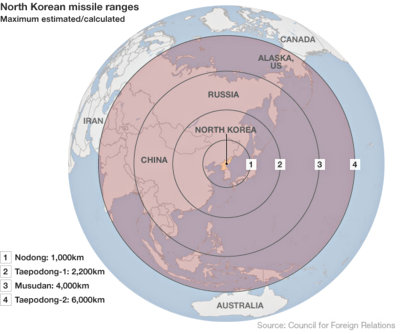

(from BBC News, used w/o permission)

North Korea wouldn't have to hit Los Angeles or Portland to reach the United States. Parts of Alaska and Hawaii are within range of that country's Taepodong missile.

So is quite a bit of Asia and the western Pacific, if Kim Jong Un decided to attack a "puppet group."

'Might Not,' 'May Not,' Could be,' and Experts

A missile attack needs more than a missile, though. North Korea would need a warhead: preferably, from Kim Jong Un's point of view, a nuclear weapon. His people have developed nuclear bombs: but may not have been able to make them small enough to fit in a missile.

On the other hand, maybe they have.

I'm not concerned for my immediate personal safety. I live near the center of the North American continent, well away from anything that might be a high-value target.

Besides, North Korea's long-range missiles might not be accurate enough to hit a particular target. The country may not have a nuclear bomb compact enough for a missile. Kim Jong Un could be bluffing.

That's a lot of "might not, "may not," and "could be."

What if the 'experts' are wrong?

Warm and Sunny With a Chance of Nuclear Attack

Let's say North Korea's military has a nuclear weapon which will reach Guam. It's a United States territory, not a state: but closer than Anchorage or Honolulu. It might look like a good place to punish 'imperialists.'

About 44,000 folks live in Dededo, Guam. It's got schools, libraries, and a shopping mall: hardly New York City, but ten times larger than the town I call home.


(from en.wikipedia.org/wiki/File:Micronesia_Mall1.JPG, used w/o permission)

Dededo covers quite a wide area, so a bomb as powerful as the one that hit Hiroshima might not kill everyone there. On the other hand, it would be an extremely unpleasant experience for survivors.


(from en.wikipedia.org/wiki/File:Hiroshima_Damage_Map.png, used w/o permission)

I suppose it could be argued that folks living in Dededo 'deserve' to be killed, since they are either 'imperialists' or in league with the United States.

I think that makes as much sense saying that God killed Haitians in 2010 for something (allegedly) done two centuries earlier: or that Yankee imperialists caused the quake.2

Decisions, Responsibility

As of Wednesday, April 3, a Terminal High Altitude Area Defense (THAAD) missile interceptor system is on its way to Guam. It's expensive, and might not stop an incoming missile attack.

But I think deploying THAAD makes sense. Strategic and tactical considerations aside, it would be nice if folks living in Guam had a little protection.

As I've said before, this isn't a 'political' blog, in the sense that I claim one person or group is always right, and everyone who disagrees is icky. I sometimes discuss political issues, since politics is a means by which some decisions are made.

I did not vote for the current American president, but think that some decisions made during this administration were correct: like sending a THAAD system to Guam.

War, in my considered opinion, is something to avoid. But sometimes using armed force is preferable to the alternative. One of the responsibilities of national authorities is defending their nation: even when force is necessary.3

I suppose Kim Jong Un may think that he is 'defending' his territory. I think he is wrong.

"International Authority" and Looking Ahead

Today, "there is no international authority with the necessary competence and power"4 to restrain the likes of Kim Jong Un or Al Qaeda. Eventually I hope that humanity develops something like Tennyson's "Federation of the world." Until that happens, we'll have to make do with nations like the United States - and North Korea - and international organizations like the United Nations and NATO.

I've discussed some of my hopes in other blogs.

Related posts:

1 Excerpts from news and views:
"North Korea lacks means for nuclear strike on U.S., experts say"
Mark Hosenball, Phil Stewart, Reuters (April 5, 2013)

"North Korea's explicit threats this week to strike the United States with nuclear weapons are rhetorical bluster, as the isolated nation does not yet have the means to make good on them, Western officials and security experts say.

"Pyongyang has slowly and steadily improved its missile capabilities in recent years and U.S. officials say its missiles may be capable of hitting outlying U.S. territories and states, including Guam, Alaska and Hawaii.

"Some private experts say even this view is alarmist. There is no evidence, the officials say, that North Korea has tested the complex art of miniaturizing a nuclear weapon to be placed on a long-range missile, a capability the United States, Russia, China and others achieved decades ago.

"In other words, North Korea might be able to hit some part of the United States, but not the mainland and not with a nuclear weapon.

"The threats against the United States by North Korea's young leader Kim Jong-un are 'probably all bluster,' said Gary Samore, until recently the top nuclear proliferation expert on President Barack Obama's national security staff.

" 'It's extremely unlikely they have a nuclear missile which could reach the United States,' said Samore.

"The North Koreans 'are not suicidal. They know that any kind of direct attack (on the United States) would be end of their country,' said Samore, now at Harvard University's Kennedy School.

"On Wednesday, North Korea's state-run KCNA news agency said its military had 'ratified' an attack involving 'cutting-edge smaller, lighter and diversified nuclear strike means,' an apparent reference to miniaturized nuclear weapons...."

"Korea crisis: UN's Ban warns of 'serious implications' "
BBC News (April 4, 2013)

"UN Secretary General Ban Ki-moon has appealed to North Korea to change course, saying it has "gone too far" in its rhetoric.

"He said he was concerned any 'unwanted crisis' on the Korean peninsula would have 'very serious implications'.

"The warning came hours after South Korea's foreign minister said the North had shifted a missile with 'considerable range' to its east coast.

"Pyongyang earlier renewed threats of a nuclear strike against the US.

"However, its missiles are not believed to be capable of carrying nuclear warheads.

"White House spokesman Jay Carney described the threats as 'regrettable but familiar', adding the US was taking 'all the necessary precautions'...."

"U.S. Military to Deploy Missile Defense Battery Amid Looming Budget Cuts"
Mike Gruss, Space News, via Space.com (April 4, 2013)

"The U.S. Defense Department plans to deploy a Terminal High Altitude Area Defense (THAAD) missile interceptor system to Guam in the coming weeks to defend the U.S. territory against a possible North Korean missile attack, the Pentagon announced Wednesday (April 3).

"In October, the THAAD system had its first-ever intercept of a medium-range missile. In recent weeks, North Korea has renounced the 1953 armistice that ended the Korean War, closed its borders to South Korean workers, severed a diplomatic hotline with Seoul and threatened to launch missiles at U.S. targets.

"Pyongyang has been steadily escalating its war rhetoric since a satellite launch in December and nuclear test in February drew widespread condemnation and tighter sanctions...."

2 Yes, they really said that:
3 There's a none-too-subtle distinction between indiscriminate violence and legitimate defense. As a practicing Catholic, I take Catechism of the Catholic Church, 2263-2267 and 2307-2317 seriously.

4 Catechism of the Catholic Church, 2308.

Tuesday, April 2, 2013

About North Korea, Power, Risks, and Leadership

North Korea's leader says that he'll restart a nuclear reactor.1 This is particularly troublesome, since Kim Jung Un seems intent on confronting 'imperialists.'

North Korea has, at most, a handful of nuclear weapons: and a production capacity of perhaps one per year. The current Kim also has missiles which could reach parts of the United States, as well as Japan, eastern Russia, and China.

I hope that, like his ancestors, the young leader has the wisdom to know when to stop threatening: and accept the best offer presented as appeasement.

Nuclear Threats and Diplomacy

As I said yesterday, this is a serious situation: and I do not think that the United States would be North Korea's biggest concern, no matter which nation the latest Kim attacked.

The United Nations Secretary-General says that "Nuclear threats are not a game." (BBC News) In the sense that they are not trivial, I'll agree: although in a sense all diplomacy is a sort of 'game,' which can be very useful in helping nations deal with issues.

The Quality of Leadership

Finally, I think it's a mistake to regard North Korea as an 'ordinary' nation. For one thing, I don't think there is any such thing. Each nation is a unique entity, with its own history, culture, and goals.

Nations can, however, be separated into categories. Some are obvious: like "large" or "small;" "new" or "old." Others, not so much: like "democracies," a term which I think has suffered from generations of over- and mis-application.

The quality of leadership is arguably more important than whether a nation's government is organized as a constitutional republic, a hereditary monarchy, a military junta, or whatever. (December 29, 2008)

Kim Jong Un runs a 'democratic people's republic,' a one-man dictatorship whose leader uses familiar 20th-century rhetoric. Despite the somewhat shopworn trappings, I think North Korea may be more of an old-style Asian kingdom: the real thing, not the Fu Manchu and Shangri-La variety.

As I've said before, I think any form of government can work: provided that there's good leadership. In the case of North Korea, I am particularly concerned, because we've got a young ruler who may not yet understand the profound risks which come with the power he wields.

Related posts:

1 Excerpts from the news:
"North Korea says it plans to restart shuttered nuclear reactor"
Jethro Mullen, CNN April 2, 2013)

"After weeks of hurling threats at the United States and its allies, North Korea announced Tuesday it will restart a nuclear reactor it had shut more than five years ago.

"The declaration demonstrates Kim Jong Un's commitment to the country's nuclear weapons program that the international community has tried without success to persuade it to abandon.

"The North's state-run Korean Central News Agency (KCNA) reported that the reclusive state's atomic energy department intends to 'readjust and restart all the nuclear facilities' at its main nuclear complex, in Yongbyon...."

"North Korea 'crisis gone too far' says UN's Ban Ki-moon"
BBC News (April 2, 2013)

"UN chief Ban Ki-moon has said the North Korea "crisis has gone too far" after Pyongyang announced plans to restart its main Yongbyon nuclear complex.

"Speaking at a news conference during a visit to Andorra, Mr Ban called for urgent talks with the North.

"The move by Pyongyang is the latest in a series of measures in the wake of its third nuclear test in February.

"North Korea has been angered by the resultant UN sanctions and joint US-South Korea annual military drills.

" 'Things must begin to calm down, there is no need for the DPRK [North Korea] to be on a collision course with the international community. Nuclear threats are not a game,' Mr Ban said.

"Earlier, a South Korean foreign ministry spokesman said that if true, the North Korean move - which includes reactivating a reactor mothballed for six years - would be 'highly regrettable'.

"Chinese foreign ministry spokesman Hong Lei called for restraint from all sides to resolve the 'complex and sensitive' situation.

"Weeks of rhetoric and almost daily threats by the North have raised tensions on the Korean Peninsula to their highest levels for years...."

Monday, May 14, 2012

Nukes, a Drawing, Iran, and Nowhere Near Enough Information

It's been about two thirds of a century since nuclear weapons were used in a war. I'm not happy about the people who died in Hiroshima and Nagasaki. On the other hand, I'm not going to do the conventional hand-wringing, and apologize for an action that hastened the end of World War II. I've been over this sort of thing before. (October 16, 2009)

I'm also not going to express regret that so many people didn't get killed in a protracted land war in Japan: surviving to have children in the years following that war. Myself, and a great many folks in Japan, included.

Good News, Bad News, and Iran

The good news is that problems do get resolved. The Soviet Union bowed out of history a little before the 20th century ended, leaving Russia and nations under Soviet control with - a new set of problems.

Some of the bad news is that on September 11, 2001, airliners hit New York City; the Pentagon; and, due to the heroism of Flight 93's passengers and crew, another airliner crashed before reaching its target. Thousands of people were killed that day. Considering how many could have not made it out of New York City's World Trade Center, that 'bad news' could have been much worse.

Then there's North Korea's nuclear weapons program; Syria's whatever-it-was that Israel hit; and Iran's nuclear program that we're supposed to believe has nothing at all to do with weapons development.

Nuclear Wannabes

As Al Qaeda demonstrated in 2001, quite a lot of damage can be done without using nuclear bombs. But if someone wanted to make most of a city disappear in a single bright flash, a fission bomb is probably the easiest way to get the job done.

Of those three nuclear wannabes, I think Iran is the most obviously serious threat. North Korea's got a new leader, but the last I heard it's the same dynasty: with the same monumental economic issues. Someone in North Korea might start believing their own propaganda, might have a working nuclear bomb, and might have a missile that could send it to Japan, Hawaii, Siberia, or Alaska: but I think the odds are low. Syria may not be as much of a mess as North Korea: but leadership there has problems, too.

Iran, on the other hand, has economic problems: but not, apparently, crippling ones. The Ayatollahs, Ahmadinejad, and others, may not be quite on the same page: but Iran does have a functioning government.

Ordinarily, I'd say that's good news: but since Iran also has a dubiously-innocuous nuclear program and a habit of blaming the Jews and the 'great Satan America' for problems? Iran's government might, maybe, decide to launch nukes instead of words one of these days.

Two Thirds of a Century: Never Again?

I hope that nuclear weapons never get used in warfare again. While I'm at it, I'll hope that war ends right now.

An end to war - forever - will require some major retooling of habits and attitudes. I think it's a good goal: but I also think we're a long, long, way from anything resembling Tennyson's "Federation of the world." I've discussed that sort of thing in another blog:
I hope I'm wrong about this: but my guess is that, sooner or later, someone with a nuclear bomb is going to decide that it should be used to kill people. Lots of people. Right now, one of the outfits that I think is least-unlikely to use a nuke against people is Iran's leadership.

Religious Crazies and Nukes

I don't have the conventional notion that all people with religious convictions are mass-murderers just waiting to go off. But Iran's leadership has the sort of 'criticizing me is attacking God' attitude it might take to launch a nuclear attack. I'm not making up that 'attacking God' thing, by the way:I noticed something in the news yesterday: it's an architectural rendering of a room with a whacking great machine that looks like part of a nuclear weapons testing system. That, and some vague - but plausible - information about a specific site in Iran is all that I've seen.

I really, sincerely, hope that whoever wins the American election this November has the good sense to realize that there are some folks with very dodgy attitudes out there: who may very soon have nuclear weapons and the means to deliver them to remote targets.

Here's what got me started:
"Drawing may provide insight into Iran's nuclear intentions"
Associated Press, via FoxNews.com (May 13, 2012)

"A drawing based on information from inside an Iranian military site shows an explosives containment chamber of the type needed for nuclear arms-related tests that U.N. inspectors suspect Tehran has conducted there. Iran denies such testing and has neither confirmed nor denied the existence of such a chamber.

"The computer-generated drawing was provided to The Associated Press by an official of a country tracking Iran's nuclear program who said it proves the structure exists, despite Tehran's refusal to acknowledge it.

" That official said the image is based on information from a person who had seen the chamber at the Parchin military site, adding that going into detail would endanger the life of that informant. The official comes from an IAEA member country that is severely critical of Iran's assertions that its nuclear activities are peaceful and asserts they are a springboard for making atomic arms.

"A former senior IAEA official said he believes the drawing is accurate. Olli Heinonen, until last year the U.N. nuclear agency's deputy director general in charge of the Iran file, said it was 'very similar' to a photo he recently saw that he believes to be the pressure chamber the IAEA suspects is at Parchin.

"He said even the colors of the computer-generated drawing matched that of the photo he had but declined to go into the origins of the photo to protect his source...."
Related posts:

Wednesday, February 22, 2012

Iran, International Nuclear Inspectors, and Russian Submarines

Iran's in the news again, or still. In a way, it's the same story we've been reading for years: U.N. inspectors aren't allowed to see sites involved in Iran's nuclear program.

International Inspectors and Business as Usual

This time, the Ayatollahs didn't want outsiders to see a "key military site." Can't say that I blame them, in a way. Iran's been insisting that its nuclear program doesn't involve weapons: or maybe that there is no nuclear program. Or that there is, and it's strictly for curing the sick and benevolent purposes like that.

Facts have a way of getting in the way of 'official' versions of reality. Whoever is running Iran at the moment probably realizes that international diplomacy will be easier, if the foreigners know as little as possible about what's actually happening in Iran.

There's nothing unusual about the situation, in a way. Iran's been giving Saudi Arabia stiff competition, in terms of making Islamic government look like a bad idea: and has been, ever since 1979. Sudan's rulers are serious contenders in that race: and that's another topic.

Russia, Submarines, and Cold War Stuff

I think one of the harder lessons for many folks to learn is that things change. Like the Cold War. When, from one point of view, the world was a battleground for a fairly simple confrontation:
  • 'The good guys' - America
    • Mom
    • Apple pie
    • The flag
  • 'The bad guys' - Russia Soviet Union and China
    • Slavery
    • Ugly clothes
    • Yellow peril
I'm oversimplifying the situation, of course. Another, equally-goofy, way of looking at the Cold War era was to see the world as divided between the oppressed proletariat and capitalistic warmongers.

Folks in Russia finally got tired of living in a workers' paradise, and China's leaders may be reevaluating their economic philosophies - yet more topics.

The point is, this isn't the late 20th century.

I think another hard lesson is that not everything is about 'me,' or 'us.' Take Russia's navy getting back in the habit of having submarines with ballistic missiles patrolling international waters. I've run into the opinion that it's intended as a response to - or provocation of - the American government.

Maybe that's true: but it occurs to me that Russian leaders may have something besides 'Yankee imperialism' on their minds this time. Iran's uncomfortably close to Russia, may start building nuclear weapons soon, and might reasonably be seen as a threat. Those submarines might be intended as a sort of reminder to the Ayatollahs that actions have consequences.

Which gets me back to Iran, a nuclear weapons program that we're supposed to believe doesn't exist, and one of today's less calming situations.

Religious Crazies with Nuclear Missiles?

I sincerely hope that Iran's goofy president doesn't represent what most of the Ayatollahs really think is true. There's some reason to believe that - yet again more topics:I don't think that today's world is 'the Cold War all over again.' Crossing out 'commies,' and writing in 'Muslims,' doesn't make sense. Neither does trying to apply the other alternatively-sane worldview I outlined earlier.

Like they say, 'it's complicated.'

One of my concerns is that Iran's leadership has been doing a very good job of looking like ideologues with control issues. Convictions of 'foreign spies' reminds me of the 'good old days' of the HUAC in this country: and political correctness a few decades after that.

I'm about as sure as I can be that all Muslims are not on the same page as the Ayatollahs, or Al Qaeda, or Sudan's touchy rulers.

But I'm very concerned that Iran's leadership might decide that it's time to smite the unbeliever - with nuclear weapons. Russia's immediate neighbors - and parts of Europe - could experience massive, sudden, urban renewal if that happens.

I'm not concerned because I think Muslims, or religious people in general, are likely to kill folks they don't like. It's because I think Iran's Ayatollahs may be to Islam what the KKK was to Christianity: a dangerous bunch of folks with a distorted set of beliefs.

Here's what got me started:
"Iran nuclear row: UN inspectors barred from Iran site"
BBC News (February 21, 2012)

"The UN nuclear watchdog says Iran has stopped a team of inspectors from visiting a key military site.

"The International Atomic Energy Agency (IAEA) says no deal was been reached on inspecting the Parchin site, south of Tehran, despite 'intensive efforts'.

"The inspectors had sought to clarify the 'possible military dimensions' of Iran's nuclear programme...."

"Iran Would Consider Pre-emptive Strike on Its Enemies, Fars Says"
Caroline Alexander, Business Week (February 21, 2012)

"Iran would consider taking pre-emptive action in response to threats, an Iranian military commander said, according to the state-run Fars news agency.

" 'We will no more wait to see enemy action against us,' Fars quoted Mohammad Hejazi, deputy head of the General Staff of the Iranian Armed Forces for Logistic and Industrial Research, as saying in an interview...."

"Russian SSBNs to Resume Patrols in International Waters in June 2012"
Naval Today (February 7, 2012)

"Russian nuclear-powered ballistic missile submarines will resume patrols in international waters in June 2012, said Russian Navy Commander-in-Chief Admiral Vladimir Vysotsky.

" 'On June 1 or a bit later, we will resume permanent patrols of nuclear strategic submarines in the World Ocean', said Vysotsky on Feb 3 at Navy command briefing...."

Somewhat-related posts:
In the news:
Background:
  • "Iran"
    World Factbook, CIA (last updated February 8, 2012)
  • "Saudi Arabia"
    World Factbook, CIA (last updated February 8, 2012)

Friday, March 18, 2011

Iran, Dubious Equipment, and a Nuclear Weapons Program that Doesn't Exist

Maybe it's all a big mistake. Maybe the equipment headed from China to Iran really isn't intended for a nuclear weapons program.

Maybe Iran really doesn't have a nuclear weapons program. The last I heard, that was still the official line.

Maybe Iran's rulers have facilities for making weapons-grade heavy metal, and maintain a stockpile of long-range nuclear-capable missiles, because they need to generate electricity.

Maybe.

I think Iran's ayatollahs are serious about wanting to 'defend' their particular flavor if Islam from the 'great Satan America.' And anybody else who doesn't agree with them. (December 31, 2007)

I also think that Iran's ayatollahs aren't the only outfit that doesn't like the idea of folks speaking their mind and being allowed to watch beer commercials. And that's another topic. Topics.

Here's what got me started:
"Malaysian police said Friday that they had found equipment they suspect could be used to make nuclear weapons smuggled on board a ship headed to Iran.

"National police chief Ismail Omar told The Associated Press that the cargo was seized from a Malaysian-registered ship traveling from China to Tehran while it was docked at a central Malaysia harbor. Authorities are investigating whether the equipment could be used to make nuclear weapons.

"Malaysian International Shipping Corp. confirmed in a statement to the AP that police confiscated two containers from the MV Bunga Raya Satu on March 8. It said a freight forwarder had declared the contents as 'goods used for liquid mixing or storage for pharmaceutical or chemical or food industry.'..."
(Associated Press, via FoxNews.com)
Related posts:In the news:

Friday, November 26, 2010

Stuxnet: Inhuman Secret Agent

Public Radio International calls Stuxnet a real threat. They could be right about that. Telegraph.co.uk calls it a virus.

Iran's government says that the nuclear weapons program they don't have - wasn't affected by Stuxnet. That's - unlikely.

Bombs? That's So 20th-Century

I've written about Iran's nuclear program before. While it's remotely possible that one of the world's leading producer of petroleum desperately needs nuclear power plants - which in turn require weapons-grade uranium - I think it's more likely that Iran's ayatollahs wanted nuclear bombs.

I think can see their point, in a way. Quite a few folks outside Iran don't act the way the ayatollahs want them to. Nuclear weapons might seem quite effective - either as an upgrade to their means for converting the unbeliever, or to incinerate folks who wouldn't cooperate.

That's not to say that I approve of the lot that's running Iran. "Understanding" isn't "approval."

I think it's very likely that's what Iran's nuclear program is intended to produce nuclear weapons. I also think that aging religious fanatics with nukes present a very serious threat to anyone within range of their missiles: which includes quite a lot of the Middle East, Russia, and a disturbing fraction of Europe.

If Iran Wanted Nukes, Wouldn't They Have Them By Now?

One of the problems with the notion that Iran wanted nuclear weapons was the way that predictions kept being wrong.

It was like Iran's nuclear program was slowing down.

In some circles, this would 'obviously' mean that the vast right-wing conspiracy, or some other mysterious force, had made up the whole 'Iranian nukes' idea. After all, if Iran wanted nukes, they'd have them by now - and since they don't have them, they didn't want them.

Looks like there was a 'conspiracy' involved. Sort of.

Also, apparently, a very, very sophisticated worm: a sort of Information Age secret agent.

Stuxnet: One Very Smart Worm

Stuxnet is, in a way, scary. I hope that whoever designed it has figured out a way of disabling the thing. I'll get back to that.

According to an article I read today, Stuxnet is a very, very sophisticated set of code: a worm that's designed to damage, but not destroy, particular machinery in Iran's nuclear program. Also not affect other systems it infects - and cover its tracks so effectively that Iranian counter-intelligence apparently assumed that people working on the project were damaging the equipment.

Some of those people were killed - others simply disappeared.

Moralizing While Cities Get Nuked?

I am not comfotable with the idea of (presumably) innocent people being killed by Iranian security, when the culprit is malicious code. Or, rather, whoever made Stuxnet.

On the other hand, I am not comfortable with the idea of people in Tel Aviv, Beirut, Stavropol, or some other city, getting vaporized because folks who could have stopped the Iranian nuclear program - didn't.

I know, by the way: A lot of the folks in the cities I mentioned are Muslims. I've gotten the impression that quite a few Muslims die because some other Muslim decided they're not doing Islam the 'right' way.

Stuxnet: No Skynet

Smart as Stuxnet is, I'm about as certain as I can be about anything that it won't wind up taking over the world, like The Terminator's Skynet.

On the other hand, like I said, I really hope that whoever designed Stuxnet has a way of disabling it - or that one of the many commercial anti-malware firms works out a method.

It looks like it was designed very carefully to perform one function - and only one function. On a particular computer system, in a particular place.

Still, anybody can make a mistake.

As to 'is it moral to use a worm like Stuxnet' to keep religious crazies from having nukes? If someone hadn't developed Stuxnet, the world's best and brightest might be discussion how if they'd just had a chance to talk with the ayatollahs, some city would still be on the map.

I'm inclined to think that "alive" is better than "dead," all other things being equal.

Here's a rather long set of excerpts from that article I mentioned:
"....--The worm also knew that the complex control system that ran the centrifuges was built by Siemans, the German manufacturer, and -- remarkably -- how that system worked as well and how to mask its activities from it.

"--Masking itself from the plant's security and other systems, the worm then ordered the centrifuges to rotate extremely fast, and then to slow down precipitously. This damaged the converter, the centrifuges and the bearings, and it corrupted the uranium in the tubes. It also left Iranian nuclear engineers wondering what was wrong, as computer checks showed no malfunctions in the operating system.

"Estimates are that this went on for more than a year, leaving the Iranian program in chaos. And as it did, the worm grew and adapted throughout the system. As new worms entered the system, they would meet and adapt and become increasingly sophisticated....

"...This went on until June of last year, when a Belarusan company working on the Iranian power plant in Beshehr discovered it in one of its machines. It quickly put out a notice on a Web network monitored by computer security experts around the world. Ordinarily these experts would immediately begin tracing the worm and dissecting it, looking for clues about its origin and other details.

"But that didn’t happen, because within minutes all the alert sites came under attack and were inoperative for 24 hours.

" 'I had to use e-mail to send notices but I couldn't reach everyone. Whoever made the worm had a full day to eliminate all traces of the worm that might lead us them,' Eric Byers, a computer security expert who has examined the Stuxnet. 'No hacker could have done that.'

"Experts, including inspectors from the International Atomic Energy Agency, say that, despite Iran's claims to the contrary, the worm was successful in its goal: causing confusion among Iran’s nuclear engineers and disabling their nuclear program.

"Because of the secrecy surrounding the Iranian program, no one can be certain of the full extent of the damage. But sources inside Iran and elsewhere say that the Iranian centrifuge program has been operating far below its capacity and that the uranium enrichment program had 'stagnated' during the time the worm penetrated the underground facility. Only 4,000 of the 9,000 centrifuges Iran was known to have were put into use. Some suspect that is because of the critical need to replace ones that were damaged.

"And the limited number of those in use dwindled to an estimated 3,700 as problems engulfed their operation. IAEA inspectors say the sabotage better explains the slowness of the program, which they had earlier attributed to poor equipment manufacturing and management problems. As Iranians struggled with the setbacks, they began searching for signs of sabotage. From inside Iran there have been unconfirmed reports that the head of the plant was fired shortly after the worm wended its way into the system and began creating technical problems, and that some scientists who were suspected of espionage disappeared or were executed. And counter intelligence agents began monitoring all communications between scientists at the site, creating a climate of fear and paranoia....

"...Speculation on the worm's origin initially focused on hackers or even companies trying to disrupt competitors. But as engineers tore apart the virus they learned not only the depth of the code, its complex targeting mechanism, (despite infecting more than 100,000 computers it has only done damage at Natanz,) the enormous amount of work that went into it—Microsoft estimated that it consumed 10,000 man days of labor-- and about what the worm knew, the clues narrowed the number of players that have the capabilities to create it to a handful.

" 'This is what nation-states build, if their only other option would be to go to war,' Joseph Wouk, an Israeli security expert wrote.

"Byers is more certain. 'It is a military weapon,' he said.

"And much of what the worm 'knew' could only have come from a consortium of Western intelligence agencies, experts who have examined the code now believe.

"Originally, all eyes turned toward Israel's intelligence agencies. Engineers examining the worm found 'clues' that hinted at Israel's involvement. In one case they found the word 'Myrtus' embedded in the code and argued that it was a reference to Esther, the biblical figure who saved the ancient Jewish state from the Persians. But computer experts say 'Myrtus' is more likely a common reference to 'My RTUS,' or remote terminal units.

"Langer argues that no single Western intelligence agency had the skills to pull this off alone. The most likely answer, he says, is that a consortium of intelligence agencies worked together to build the cyber bomb...."
(FOXNews)
Langer's picks are
  • The United States
    • Which has the technical skills needed
  • Germany
    • With access to Sieman's product design
  • Russia
    • Familar with
      • Iran's nuclear plant
      • Sieman's systems
He could be right about all that.

Then, there's this - I suppose you could call it a literary reference.
"There is one clue that was left in the code that may tell us all we need to know.

"Embedded in different section of the code is another common computer language reference, but this one is misspelled. Instead of saying 'DEADFOOT,' a term stolen from pilots meaning a failed engine, this one reads 'DEADFOO7.'

"Yes, OO7 has returned -- as a computer worm.

"Stuxnet. Shaken, not stirred."
(FOXNews)
Related posts:In the news:

Thursday, November 25, 2010

North Korea: Kim Jong Il and Son; Speculation

Dynasty? Succession?

What is this, some kind of historical novel? Or maybe another Star Wars story?

Nope: It's speculation about what's going on in North Korea.

The death toll for that shelling of a South Korean island is up to four now; Kim Jong Il is still alive, apparently; and odds are that Kim Jong-il ordered the hit himself. To make his son look good.

How that's supposed to work, I don't know. Maybe it's 'competence by association.' The younger Kim was (probably) with North Korea's leader, (most likely) touring the artillery base, shortly before North Korea whacked the South Koreans.

Dynasty, Succession, North Korea and Nukes

There was a time when territories were run somewhat along the lines of the Corleone family (Godfather and sequels). The system had its drawbacks, but it worked.

Quite a bit of how well it worked depended, I think, on who the "godfather" was. Except the monarch had some other title, back in the 'good old days.'

Then, colonists in North America got fed up with loopy tax regulations, among other things, and tipped the apple cart over.

"Democracy" was all the rage not long after that, and now the monarch of the (former) colonists is one of the few remaining on Earth.

Korea, Elections, The Godfather, and Names

North Korea isn't a monarchy. On paper.

Kim Jon Il is the chairman of the National Defense Commission, North Korea's "highest administrative authority." While I'm on the subject of names, "North Korea" is what folks here in North America call Kim Jon Il's domain.

The name folks over there use is "Choson-minjujuui-inmin-konghwaguk," or Choson, for short. I take it that's an effort to express 조선, as pronounced, in the version of the Latin alphabet that the English language uses. In South Korea, "Korea" is 한국, or "Hanguk:" Sort of.

Why don't they call it "Korea?" That's another topic. Bottom line is that folks who live in a particular area generally use the name that works in their language. My ancestral homelands, for example, are Norge and Eire, and I married someone whose ancestors came from Nederland and Deutschland. We both speak American English, so those aren't the words we generally use.

Back to Choson / North Korea

North Korea, The Godfather, and Elections

Kim Jong Il is an elected official. On paper. With nobody else to run against, it's no great surprise.

I've got a bit more respect for rulers in Kim Jong Il's position, when they don't pretend that they're where they are 'by the will of the people.'

Think of the (fictional) Corleone family in The Godfather. "Don" Vito Corleone comes off as a moderately decent autocrat, I gather. Consider what his image would be, if the Don had elections at intervals, with himself as the only candidate. And tried to present the Family as a democratic institution.

Anyway, Kim Jong Il insists that he's an elected official. Odds are that his son will make the same claim.

As for the guessing game on who ordered the shelling of that island, and why? That's yet another topic.

Feuding Warlords With Nukes

Back in the 'good old days,' a strong-willed warlord, or king, or whatever, could often keep warlord wannabes in check within his holdings.

If the warlord had good sense - and gave a rip about his domain - he'd select the biggest, strongest, toughest, smartest wannabe: while he still had a few years to go. The old warlord would make an effort to train the wannabe in the fine art of leadership. And make it clear that this particular wad of meat was his chosen successor. Then, when the old warlord died, there'd be a relatively short period of bloodshed while the new warlord demonstrated that he really wanted to carry out the old warlord's wishes.

It was a messy system, but it worked. European warlords worked out a system of hereditary succession that tended to reduce the amount of internal warfare.

But the kings didn't hold elections. They had other excuses for being where they were. 'Divine right' was a favorite for a while - and that's yet again another topic.

That was then.

I think what we've got in North Korea is a little like those colorful episodes where the old warlord is dying, and trying to get his successor in position to hack and slash his way to the throne.

Except this time, the warlord wannabes have nuclear weapons.

Think Macbeth - the Shakespeare story, not the real one. Except that Macbeth, Macduff, and Duncan all have a few nukes. And the incentive to use them.

Here's what set me off this morning:
Excerpt from:
"North Korean leader and son visited artillery site: reports"
Jeremy Laurence, editing by Raju Gopalakrishnan and Andrew Marshall, Reuters (November 25, 2010)

"North Korean leader Kim Jong-il and his son and successor Jong-un visited the artillery base from where shells were fired at a South Korean island just hours before the attack, South Korean media reported on Thursday.

"North Korea's attack on Yeonpyeong Island that killed two South Korean marines and two civilians on Tuesday was probably ordered by Kim Jong-il himself, the Joongang Daily quoted a well-informed government source as saying.

"Seoul government officials contacted by Reuters could not comment on the reports.

"The United States says it believes North Korea's actions were an isolated act tied to leadership changes in Pyongyang, and many experts say the North carried out the shelling to burnish the image of the inexperienced and little-known younger Kim.

"The ailing leader is desperate to give a lift to his youngest son, named as heir apparent to the family dynasty in September, but who has little clear support in the military...."
Related posst:

Wednesday, November 24, 2010

North Korea: Nukes, Missiles, and Underfed Soldiers

A regime like North Korea's has its strengths. Like being able to force large numbers of its subjects into military service. North Korea doesn't seem able to feed its soldiers all that well, or provide them with much of the sort of training that requires fuel or bullets: but boy, does Kim Jon Il's country have a lot of soldiers.

Which is a real concern for folks living in South Korea, among others.

Whether or not the under-fed, ill-equipped North Korean soldiers really believe the propaganda they're fed - it's likely that they believe that they'll be punished if the don't do what the nearest general tells them. Like fire on a South Korean naval ship, or set fire to civilian buildings.

Paranoia, No: Prudence, Yes

I've mentioned Frank Burns, the idiot patriot and quack doctor in the M*A*S*H television series. One of my favorite episodes included a vignette of Dr. Burns looking for land mines in his toothpaste.

That's crazy. It's also funny, and fiction.

This is the real world.

Sadly, no matter how many factually-challenged paranoiacs infested America of the 1950s, today's North Korea is a serious - and very real - problem for anyone within about 2,000 miles - give or take a few hundred.

North Korea's nuclear weapons probably aren't all that much. Last year, Russia confirmed that North Korea had tested a 20-kiloton nuclear bomb. (GlobalSecurity.org (May 25, 2009)) That's a little more powerful than the bomb that devastated Hiroshima, but not by all that much. (GlobalSecurity.org (November 14, 1996))

If North Korea decided to launch a nuclear warhead against, say, Tokyo, folks living on the other side of Mt. Odake might not be hurt a bit. Not directly, anyway. But it would still be a really bad day for Tokyo. And the rest of Japan - and the world.

That 'no man is an island' stuff isn't just poetry. We live in a very interconnected world, and what happens in one nation gets felt everywhere.

I have no reason to believe that someone in North Korea will think it's a good idea to obliterate part of a Japanese city. Or one in South Korea. I have little reason to think that someone won't, either.

It'd be nice if everybody would be nice: but the last several thousand years of recorded history don't suggest that 'being nice' is as common a practice as it should be.

North Korea, Scrambling for Power, and "Miscommunications"

As for North Korea: It looks like Kim Jong Il is - willingly or not - turning control of the country over to someone else. Given the sort of operation he's been running, there could be quite a scramble soon, as generals and other wannabe warlords make a grab for power.

Then there are rumors, mentioned in the following article, about "miscommunications or worse within the North's command-and-control structure."

It's the sort of thing that makes me glad to live over a thousand miles from the Pacific Ocean, deep in the heart of North America.
Excerpts from:
"North Korea's military aging but sizeable"
Tim Lister, CNN World (November 24, 2010)

"It's a bit like train-spotting but rather more serious. On October 10, Korea-watchers pored over live televised coverage of a massive military parade in Pyongyang, held to mark the 65th anniversary of North Korea's ruling party. Just like the Soviet parades of yore, it was a chance to see what military hardware the North might be showing off.

"The official news agency said the parade showed 'the will and might of Songun Korea to wipe out the enemy.' The hardware was accompanied by slogans such as 'Defeat the U.S. Military. U.S. soldiers are the Korean People's Army's enemy.' And besides the incredible synchronized goose-stepping, there were tanks and new missiles.

"Analysts paid special attention to the first public appearance of a road-mobile ballistic missile with a projected range of between 3,000 and 4,000 kilometers (roughly 1,900 to 2,400 miles), though reports of its existence had circulated for several years.....

"...North Korea's nuclear capability and ballistic missile technology are its trump card, to make up for its aging conventional forces and as a bargaining chip in negotiations. So that's what receives the bulk of funding and expertise. But despite economic stagnation, technological limitations and international sanctions, its conventional forces can't be discounted, if only because of their size.

"According to South Korean analysts, the North scraped together what little foreign exchange it had to buy $65 million of weapons from China, Russia and eastern Europe between 2002 and 2008. One example: It appears to have bought Chinese-made ZM-87 anti-personnel lasers, using one to 'illuminate' two U.S. Army Apache helicopters flying along the southern side of the Demilitarized Zone in 2003. None of the crew members was injured.

"China says it continues to be open to military collaboration with Pyongyang and last month welcomed a senior North Korean official to Beijing to 'enhance coordination of the two militaries.' China is thought to have supplied the North with multiple rocket launchers and spare parts for planes, among other equipment. Pyongyang has also turned to Iran and Egypt for military transfers.

"Much of the North's hardware is locally built using Chinese and Russian templates. It has begun deploying a new tank, called the P'okpoong (Storm), which is modeled on the Russian T-62 tank but hardly a match for modern U.S. battle tanks. It's not clear how many of these are in service, but Jane's Armed Forces Editor Alexander von Rosenbach says it is thought that only a few have been delivered -- and they lack devices like thermal imaging sights.

"Also on show at the October parade: a new surface-to-air missile similar to a Chinese model. Jane's concluded that it represented 'a major expansion in North Korea's air defense potential,' with a radar/guidance system that would be harder to jam. And although little is known about the size and scope of the North's artillery, the barrage fired this week at Yeonpyeong Island suggests that it can't be ignored.

"The North Korean regime has also devoted great resources to developing its navy, not with battleships but fast-attack vessels and an array of submarines. Jane's estimates that it has more than 400 surface vessels. And it is not hesitant to use its maritime forces, as demonstrated by the sinking of the 1,200-ton South Korean corvette Cheonan by a torpedo in March. But in a confrontation, the South Korean navy is likely to come off best, as happened in a firefight in 1999.

"The main weakness of the North's military is a chronic shortage of computers, modern command and control and electronic warfare assets -- in other words, much of what makes up the 21st-century battlefield. At the same time, South Korea has used its economic strength to modernize its armed forces: for example, building three $1 billion Aegis-class destroyers to counter ballistic missiles.

"The same applies in the air. North Korea's air force largely comprises aging Soviet MiG fighters (though it has some MiG 29s) .... In addition, the North's air force has suffered fuel shortages, and Jane's estimated that the North's fighter pilots may get as little as 25 flying hours per year. The North Koreans also have a large fleet of Russian-design biplanes that would be better suited to crop-spraying but could be used to drop special forces behind enemy lines in the event of conflict.

"To compensate for obsolescence, the North deploys boots on the ground in great numbers. Jane's estimates that its standing army numbers just over 1 million personnel, with reserves estimated at more than 7 million. But North Korean soldiers are poorly fed, according to analysts and reports from defectors, and rarely train due to scarcity of fuel and ammunition....

"...'With the ongoing leadership transition in North Korea, there have been rumors of discontent within the military, and the current actions may reflect miscommunications or worse within the North's command-and-control structure,' geopolitical risk analysis firm Stratfor says....

"...Short of a general assault, the North clearly has enough in its arsenal to cause damage and death to its adversary, as the torpedo attack in March and the barrage this week have shown. And it has thousands of artillery pieces close to the Demilitarized Zone, which is just 30 kilometers (18 miles) from Seoul. Recent events show that it is also quite ready to exploit the element of surprise...."
Related posts:

Sunday, August 22, 2010

Iran, an Unmanned Bomber, Nuclear Weapons, and No Simple Answers

In today's news:
"President Mahmoud Ahmadinejad has unveiled Iran's first domestically-built unmanned bomber aircraft, calling it an 'ambassador of death' to the country's enemies.

"The 4m-long drone aircraft can carry up to four cruise missiles and will have a range of 620 miles, according to a state TV report - but not far enough to reach arch-enemy Israel.

" 'The jet, as well as being an ambassador of death for the enemies of humanity, has a main message of peace and friendship,' Mr Ahmadinejad said at the inauguration ceremony in Tehran...."
(Press Association)
This carrier drone is impressive. On the other hand, Iran has had the X-55 LACM in its arsenal for years. (GlobalSecurity.org) That cruse missile has a range of 3,000 kilometers, or about 1,864 miles. America's comparatively safe from an attack using the X-55 LACM. Southern Russia? Not so much. I've written about that before.

Middle East: Where Pre-Industrial Cultures Face the Information Age

I've made the point before, that many people in the Middle East had been out of the loop for centuries - millennia in some cases. After the fall of the Persian and Roman Empires, with a few relatively brief exceptions, events in the rest of the world went on without troubling customs which had been old when Abraham moved out of Ur.

Then people in Europe and North America developed technologies that required petroleum. Lots of petroleum. Suddenly outsiders came, bringing strange new ideas with them.

The old-school cultures of the Middle East might have weathered that, but a few decades ago the Information Age started. I've managed to adjust to a world where I can communicate with people on the other side of the world: but I'm an American, and my ancestors had already gotten used to changing technologies.

It's not just technology, although today's infotech is affecting folks in the Middle East.

Again, my ancestors came from Europe and settled in America: where they learned how to deal with other folks who didn't have exactly the same set of cultural preferences. Without killing them.

I have some sympathy for the old-school folks, who were dragged from a comfortably insulated society of burqas and honor killings to a world of bikinis, beer and dog food commercials. It must be a terribly unsettling experience.

Andy Capp, Iran, and Nuclear Weapons

There's an old Andy Capp comic strip, where a police officer is repeating what Mr. Capp told him: something like 'I thought he was going to hit me, so I hit him back first.'

That's funny, I think.

That's not, as a rule, a philosophy which I think should be applied to international diplomacy.

It'd be nice if Iran really did use their new robot bomber strictly as a deterrent. Then they might feel a little safer from the Jews and the Great Satan America.

My concern is that they'll decide that someone in range of their various short-, medium-, and long-range weapons is a threat; or is insufficiently Islamic, or whatever: and have a shot at killing some of the offending parties.

From what shows up in the news from time to time, my guess is that I'm not the only one with that sort of concern.

Can America 'hit him back first?'

In strictly practical terms: probably. Almost certainly, in fact. And then there would be cries (self?) righteous indignation from most of the national governments whose bacon we kept from frying. Unless there wasn't much of Iran left, there would probably be attacks against everyone and anyone within reach.

Not a good situation.

The alternative isn't too pleasant to contemplate, either: but there's the chance that the Ayatollahs will finally mismanage their government into oblivion, and let someone else have a crack at running the country.

Stranger things have happened.

Related posts:In the news:

Sunday, April 18, 2010

Iran's Mighty Army, President Ahmadinejad, Nuclear Weapons and History

This hasn't been a particularly slow week for news:I think this is noteworthy, too:
"Iran is so powerful today that no country would dare attack it, President Mahmoud Ahmadinejad said Sunday during an annual army parade.

" 'Iran's army is so mighty today that no enemy can have a foul thought of invading Iran's territory,' the Iranian leader said, according to state media.

" 'Of course, Iran is a friend and brother of regional and independent nations and it wants peace, progress and security for all countries,' Ahmadinejad said.

"During the event near the mausoleum of the late Ayatollah Ruhollah Khomeini -- who ushered the Islamic Revolution into Iran more than 30 years ago -- several models of Iran's medium- and long-range missiles, including the Shahab 3, were on display...."

"...The United States and its allies should abandon policies designed to dominate the oil-rich nations of the Middle East, Ahmadinejad said, adding that reliance on arms was a sign of a country without culture.

"Iran, he said, is prepared to do all it can to counter nuclear weapons.

" 'One of the greatest treasons by those that monopolize nuclear weapons is to equalize nukes with nuclear energy,' Ahmadinejad said. 'The way to produce weapons is totally different than nuclear energy. And they know these very well, but they plan to talk about both these things in their own monopolized way.' "
(CNN)
Oddly enough, I think that President Ahmadinejad has a point: although I wouldn't describe efforts at slowing down the spread of nuclear weapons as "treason."

Wouldn't it be Nice, If Nukes Didn't Exist?

Here in America, a noticeable number of people apparently think that technology makes people do things: not the other way around. Search for things like "gun laws," "gun lobby" or "gun crime," and you may see what I mean. (December 23, 2007)

It's an attractive idea: just destroy all the guns and ban gunpowder, and everything would be hunky dory. I'm quite sure that, in a 'ban firearms' scenario, "gun crimes" would disappear.

But, depending on what America's 'right sort' got scared of first, soon we'd have to ban crossbows, swords, knives, steel, iron, bronze - you get the idea. (April 6, 2010)

Iran a Threat? Yes, Obviously

I think that Iran's current leadership is a serious threat to anybody within range of its missiles. By now that includes a disturbing fraction of Eurasia and Africa. (August 4, 2009) And the Ayatollahs haven't missed too many opportunities, in my view, to make it quite clear that they believe people should agree with them: or die.

Dealing With New Technology: Been There, Done That

On the other hand, I'm fairly sure that nuclear energy - reactors and weapons systems - is a genie that won't go back into the bottle. We'd better get used to living in a world where people can, with a certain amount of effort, use - or misuse - enormous amounts of energy.

Humanity has been through this sort of thing before. There was a time when arrows were the latest thing in super-weapons. What's different about today's situation is that things tend to move faster: and more of 'the masses' have a clue about what's going on.

Ignorance may be bliss: But I'd rather live now, than in any of the 'good old days' I've heard about. Certainly not the ones I remember. "Happy Days" wasn't.

One advantage we've got, that people a thousand or ten thousand years ago didn't have, is that there are well upwards of 6,000,000,000 of us. A fair percentage of that number have access to Internet connections. Which gives them access to quite a bit of raw information - some of it reliable, some more fiction than fact. They - we - can also communicate with each other. Fast.

Welcome to the Information Age

All national leaders may not have caught on yet, that they're not the only people who have viable ideas: but I think there's there's a vague sense developing, that this isn't the 19th century any more.

That's a pretty good start.

Individual Nations Can Deal With Iran

I don't have answers: not in any detail. But, in general: I think the sort of situation represented by Iran and Korea is one that individual nations can deal with.
But That May Not be a Good Idea
Which is a bit of a problem. I said, "can deal with," not "should deal with." In my view, the United Nations is a sort of practical joke: and a screwball prototype of what humanity may develop. In a century, or a millennium. My guess is that it'll take even longer: but I've been wrong before.

We've seen, recently, what a coalition of nations can achieve. Provided that there's one or two nations in the group with leaders who are willing to take charge. Not dictate: direct.

I realize that's a radical idea: nations cooperating with each other without a U.N. agency running the whole affair. But I think it's better than the 'solo' option.

I'm not necessarily talking about America 'going it alone,' mind you. A few years ago, Russian leaders made it fairly clear that they weren't too noble and self-sacrificing to use nuclear weapons against a threat. (January 25, 2008)

Personally, I'd rather see the 'Iranian nuclear weapons' issue settled without parts of Iran becoming radioactive ash. But today's heirs of the Czars and commissars may decide to be more proactive.

Related posts:In the news:

Tuesday, April 6, 2010

Obama Limits Nuclear Weapons: That's Nice

From today's news:
"Obama limits U.S. use of nuclear arms"
Reuters (April 6, 2010)
"The Obama administration unveiled a new policy Tuesday restricting U.S. use of nuclear weapons but sent a stern message to nuclear-defiant Iran and North Korea that they remain potential targets."
"Kicking off a hectic week for President Barack Obama's nuclear agenda, his aides rolled out a strategy review that renounced U.S. development of new atomic weapons and could herald further cuts in America's stockpile.

"The announcement, calling for reduced U.S. reliance on its nuclear deterrent, could build momentum before Obama signs a landmark arms control treaty with Russia in Prague Thursday and hosts a nuclear security summit in Washington next week.

"But Obama's revamped strategy is likely to draw criticism from conservatives who say his approach could compromise U.S. national security and disappoint liberals who wanted the president to go further on arms control.

"Under the revamped policy, the United States for the first time is forswearing use of atomic weapons against non-nuclear countries, a break with a Bush-era threat of nuclear retaliation in the event of a biological or chemical attack.

"But the new strategy comes with a major condition that the countries will be spared a U.S. nuclear response only if they are in compliance with the Nuclear Non-Proliferation Treaty. That loophole means Iran and North Korea would not be protected...."
That's very nice and civilized of President Obama.

I'm not surprised to hear Reuters opine that liberals - the contemporary American political variety, at any rate - are disappointed. Nuclear weapons are not nice. It would be nice if they didn't exist. From some points of view, anyway.

Does This Sort of - Thinking? - Sound Familiar?

For that matter, it would be nice if gunpowder didn't exist. Then those awful nasty guns wouldn't work and people wouldn't hurt each other.

Wait a minute.

Okay: we can keep assuming that technology makes people do things. Quite a lot of people were killed with steel weapons: like swords. If only there were no steel weapons, people would live in peace and harmony.

Something doesn't seem quite right here.

Maybe it isn't any particular sort of metal: it's metal itself.

That's it! Ban all metal weapons, and then we'll all be nice.

Meanwhile, in the World I'm Stuck With

I like to think that I'm a nice guy. I think it would be nice if everybody was nice.

That would be nice.

War isn't nice. Things get broken and people get killed. That isn't nice.

Quite a few things got broken, and quite a few people got killed when New York City's World Trade Center was destroyed. That wasn't nice, either.

I suppose the CIA could 'really' be the ones who blew up the WTC. They could have used radio waves from their invisible helicopters and forced those hijackers to do naughty things. Or maybe made all the people in southern Manhattan think they saw those airliners hit.

You can do quite a lot with radio waves from invisible helicopters.

Particularly if you're the shape-shifting space-alien lizard people who really run the world. (I'm not making that up.)

Terrorists Aren't Always Nice

I suppose it may be impossible for a nation to have complete control over all of its residents, and know exactly what's going on in every part of its territory.

That would explain why the (allegedly) oppressive United States government has trouble with alternatively-sensible militia groups now and again.

Let's some outfit with a name like "the Nation of United, Triumphant States" smuggled a suitcase nuke into Paris and imposed instant urban renewal on the Champs-Élysées. And that the NUTS operated mostly out of a compound in Minnesota's lake country.

That's a hypothetical situation, by the way.

I wouldn't like it at all, if the American government claimed that they couldn't do anything about the NUTS: and didn't think they were really there, anyway. I'd like it still less, if France lobbed a nuke back, and solved Washington's problem for them.

But I think I might understand France's position. Particularly if, a little later, a second nuke took out the Eiffel Tower and that warmonger Parc du Champs de Mars. (What can I say? It's named after an old god of war.)

That Would Never Happen

I like to think that the federal government I pay taxes to wouldn't be quite that suicidally inept. But you never know.

Situations like that can happen though. It looks like Pakistan's central government isn't exactly omnipotent, when it comes to places like the Swat Valley. Then there's the LeT.

Which "obviously" means that warmonger America is using wicked Pakistan to attack nice India. Or maybe it's one of the other ways around.

You want "obvious?" Read a spy novel.

Obama, Nukes, and Being Nice

As I said, I think it's nice that President Obama has changed American policy. Now, until things change again, we won't use nuclear weapons against nations that don't have them.

Or against non-governmental organizations operating within those nations.

I hope that the Taliban, Al Qaeda, and like-minded organizations are impressed, and decide to be nice, too.

Like I said: I hope so. Somehow, I don't think that's a likely outcome.

Related posts:

Unique, innovative candles


Visit us online:
Spiral Light CandleFind a Retailer
Spiral Light Candle Store

Blogroll

Note! Although I believe that these websites and blogs are useful resources for understanding the War on Terror, I do not necessarily agree with their opinions. 1 1 Given a recent misunderstanding of the phrase "useful resources," a clarification: I do not limit my reading to resources which support my views, or even to those which appear to be accurate. Reading opinions contrary to what I believed has been very useful at times: sometimes verifying my previous assumptions, sometimes encouraging me to change them.

Even resources which, in my opinion, are simply inaccurate are sometimes useful: these can give valuable insights into why some people or groups believe what they do.

In short, It is my opinion that some of the resources in this blogroll are neither accurate, nor unbiased. I do, however, believe that they are useful in understanding the War on Terror, the many versions of Islam, terrorism, and related topics.