Showing posts with label security. Show all posts

Monday, April 21, 2014

San Jose to Maui in a Wheel Well: Dumb Luck and Airport Security

First, the good news: the teen is alive, and apparently in good health.

Now, the not-so-good news: a 16-year-old walked or ran to an airliner at Mineta San Jose International Airport, climbed into a wheel well, and wasn't spotted until the flight arrived at Kahului Airport in Maui.

Incredible Good Luck

According to the news, at least one expert is skeptical about the account: although it's hard to see how or why someone would concoct the tale: along with the supporting evidence. My guess is that a teen actually got into the wheel well: and had what my culture calls incredible good luck. I put an excerpt from the San Jose Mercury News at the end of this post. 1

I'm inclined to agree with airport spokeswoman Rosemary Barnes: "No security program is 100 percent." (San Jose Mercury News)

That said, I sincerely hope that folks responsible for airport security will take a long, hard, look at what happened: and what would lower the odds of a repeat performance.

Aside from a desire to keep addled adolescents alive, I'd prefer that nobody be able to reach an airliner and sneak something on board. Distressing as inadvertently killing someone with too little common sense is: allowing someone to plant an explosive device, killing dozens to hundreds of folks, is worse. My opinion.

I'll grant that no system is perfect. Airports have long fence lines, this teen arrived at night: and apparently managed to cross the perimeter without getting spotted on a security camera: "...but that there is surveillance footage of 'an unidentified person walking on the airport ramp and approaching' the plane...." (San Jose Mercury News)

Bottom line? I'm very glad that I don't need to travel by air.

Poikilothermic Protection

A quick science lesson. Most of this will be review, unless you slept through high school biology. Some critters are poikilotherms: their body temperature goes up or down, generally in step with their environment. Humans aren't like that. We usually maintain a fairly steady internal temperature: or our bodies die trying. Once in a while, though, we survive drowning — or sneaking into a wheel well — when our bodies go into a sort of hibernation mode, using a lot less oxygen than usual.

In the news:
Somewhat-related posts:

1 Excerpt from the news:
"Stowaway: San Jose airport security scrutinized after boy's flight to Maui in plane's wheel well"
Mark Gomez and Robert Salonga, San Jose Mercury News (April 21, 2014)

"Authorities say a 16-year-old Santa Clara boy is 'lucky to be alive' after he ran away from home, clandestinely scaled a fence at Mineta San Jose International Airport, and hid inside the wheel well of a plane flying from California to Hawaii in a case that has shone a harsh spotlight on airport security beyond the terminals.

"And according to the FBI, the teen apparently chose his destination at random.

" 'He ran for the nearest plane. This was not a well planned thing,' said Special Agent Tom Simon, spokesman for the FBI's Honolulu office. 'Just a runaway kid with a bad idea.'...

"...That the boy apparently survived -- hours, unpressurized, at altitudes up to 38,000 feet -- literally puts him in rarefied air, as several similar stowaways in the past have died from frigid temperatures, lack of oxygen or being ejected from the plane as the landing gear is lowered.

"The last known person to survive as a stowaway in a flight at least that long was Fidel Maruhi, who in 2000 also hitched a ride in a wheel well from Tahiti to Los Angeles, a seven-plus-hour and 4,000-mile trip where the temperature dropped to nearly minus-50 degrees Fahrenheit. He also reportedly blacked out just after takeoff and survived despite his body temperature dropping to fatal levels....

"...[aviation consultant Jim] Nance went on to say that it would be rare for someone to remain conscious at peak-flight altitudes for more than a few seconds and prolonged exposure would lead to brain death. He also said that without protective gear, the odds of surviving the low temperatures and winds blowing through the wheel well are slim.

"Slim perhaps, but not impossible, according to Federal Aviation Administration study commissioned in 1996 to explore the rare cases when stowaways survived flights in wheel wells. For some of the survivors, the study stated, the cold temperatures caused them to become poikilothermic, akin to a hibernation state where the body's heart and respiratory rates decreased significantly to adjust to the environment...."

Sunday, December 1, 2013

"Displaced Aggression:" Terrorism, Culture, and Assumptions

This isn't, as I've said before, a "political" blog.

I don't claim that a particular party or person is always right, or wrong; or believe that major problems are always the result of commie plots, capitalistic greed, or what the 'other' party is doing.

That doesn't make me "moderate." I have a well-defined point of view, and definite opinions. I try to limit my opinions to matters where I have at least some data to work with.

Looking for Reasons

I've run into folks who don't seem to have any doubts about why terrorism is a problem. Depending on who you ask, it's the fault of Muslims, American imperialism, news media, religion in general, or not having the 'right' party in Congress. That's overly-simplified, of course, and doesn't include all possibilities.

I don't think it's quite that simple. Anything having to do with human beings isn't, generally.

I do think that some Muslims are terrorists. So are some Christians, and folks with no particularly strong religious views. That doesn't mean that religion makes people want to kill other people: or that having religious beliefs keeps folks from acting badly.

Sadly, angry people seem to want reasons for being angry: other than what's actually frustrating them. Religion, national identity, economic status, and ancestry can be convenient canvases for folks desperately in need of a 'big picture' for their feelings. My opinion.

Folks who still yearn for a worker's paradise, or who sincerely believe that American corporations are responsible for the world's woes are a familiar part of America's cultural landscape. I don't think they are potential terrorists - - - but I'm getting ahead of myself.

This excerpt from a CNN talk show got me started on today's post:
FEINSTEIN

"I think there is a real displaced aggression in this very fundamentalist, jihadist, Islamic community. And that is that the west is responsible for everything that goes wrong, and that the only thing that's going to solve this is Islamic Sharia law and the concept of the caliphate.

"And I see more groups, more fundamentalists, more jihadists more determined to kill to get to where they want to get. So, it's not an isolated phenomenon. You see these groups spread a web of connections. And this includes North Africa, it includes the Middle East, it includes other areas as well."
("Feinstein: 'Terror is up worldwide'," CNN's State of the Union with Candy Crowley transcript, CNN (December 1, 2013))

"Fundamentalists:" Accurate, But - - -

I don't like Feinstein's use of "fundamentalists" in this context. I think she's right, in the strictly dictionary meaning of the word fundamentalist: but in American culture that term can also refer to any Christian group or individual.

There are Christian fundamentalists, but not all Christians in America are fundamentalists. I'm Catholic, which by some Christian fundamentalist standards means that I'm not any sort of Christian, and that's not quite another topic. I've put links to posts in this and another blog near the end of this one, which may or may not be of interest.

Wrenching myself back to Feinstein, fundamentalists, and folks who kill other folks for 'religious' reasons -

Sincere, Maybe: Justified, No

I think many, but not all, of today's terrorists are folks who really believe that God wants them to kill 'unbelievers.' Many of these terrorists insist that they're the only true Muslims around: and are more likely to kill their neighbors for being insufficiently Islamic, than go to the trouble of killing Westerners.

Folks in Europe and on this side of the Atlantic aren't safe, as deaths before, during, and after 9/11 showed. That's partly because we live in a world where travel is fairly easy: and because an increasing number of folks in America are not WASPs and WASP wannabes.

This most certainly does not mean that I think America should repeat the grotesque mistake of rounding folks up for having the 'wrong' ancestors. I think I understand why FDR signed Public Law 100-383. I also think it was a mistake that took much too long to sort out.

Making 'looking like an Arab' an acceptable excuse for detaining someone makes as much sense as rounding up all the pale people in Oklahoma City, after the bombing. The folks who blew up the Alfred Murrah building apparently had ethnic and nationalistic motives: which doesn't make having European ancestors and living in America grounds for suspicion of terrorist tendencies.

Dealing With Difference

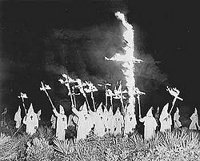
The Ku Klux Klan isn't the social and political force it once was in America, but a burning cross still occasionally shows up on the news. I think some iterations of the KKK are a useful example of how folks can use religion as a reason for hating outsiders.

That's more an indictment of human nature, I think, than a reason to distrust all spiritual beliefs.

Here's a sampling of how different folks express their religious beliefs:

From ''Klansmen: Guardians of Liberty'', 1926. Published by the Pillar of Fire Church in Zarephath, NJ. Copyright was not renewed.
(Pillar of Fire Church, via Wikipedia, used w/o permission)
"From ''Klansmen: Guardians of Liberty'', 1926. Published by the Pillar of Fire Church in Zarephath, NJ...."

New York, NY, September 28, 2001 -- A view of the recovery operation underway from a roof adjacent to the World Trade Center. Photo by Andrea Booher/ FEMA News Photo
(Andrea Booher/ FEMA News Photo, via Wikipedia, used w/o permission)
"...A view of the recovery operation underway from a roof adjacent to the World Trade Center. Photo by Andrea Booher/ FEMA News Photo." (September 28, 2001)


(From "The Pope and Children" (January 6, 2003), used w/o permission)
Some Catholic, carrying out standing orders: Matthew 25:31-46.

From the Days of Abram to Cable TV and Beer in One Generation

I've had personal experience with Christians who didn't distinguish between personal preference, cultural mores, and eternal principles. Folks who sincerely believe that God ordained that folks always act like the American middle class of the 1950s are more funny than dangerous: because they're not likely to kill you.

Other folks, equally convinced that God ordained that everyone should act they way they did in some village before they had Internet and cable: they don't always have inhibitions about enforcing their beliefs with an axe or a sword.

I'm strongly inclined to believe that we're looking at cultural values here, since many Muslims in places like Malaysia seem to have little trouble fitting into a global society. I doubt that every Muslim in Malaysia thinks the Petronas Towers were a good idea: but quite a few Americans of various beliefs are grumpy, too.

I do not think that feeling bad made it okay for white supremacists to kill people in Oklahoma City, any more than I think it's okay for folks to kill Americans because they miss the 'good old days.' I do think that we need to remember that some folks sincerely believe that killing others for being different.

Terrorists, whatever their motivation, are a real threat. Forgetting that, and 'defending' America against efforts to stop terrorists, is a bad idea.

So is forgetting that disagreeing with the government is not treason, too: and I've written about that before.

Related posts:

1 Excerpts from CNN's State of the Union with Candy Crowley transcript
CROWLEY
"The big question that's always asked, are we safer now than we were a year ago, two years ago? In general?"

FEINSTEIN
"I don't think so. I think terror is up worldwide, the statistics indicate that, the fatalities are way up. The numbers are way up. There are new bombs, very big bombs, trucks being reinforced for those bombs. There are bombs that go through magnatometers. The bomb maker is still alive. There are more groups that ever and there's huge malevolence out there."

CROWLEY
"So congressman, I have to say, that is not the answer I expected. I expected to hear, oh, we're safer. Do you agree?"

ROGERS
"Oh, I absolutely agree that we're not safer today for the same very reasons.

"So the pressure on our intelligence services to get it right to prevent an attack are enormous. And it's getting more difficult because we see the al Qaeda as we knew it before is metastasizing to something different, more affiliates than we've ever had before, meaning more groups that operated independently of al Qaeda have now joined al Qaeda around the world, all of them have at least some aspiration to commit an act of violence in the United States or against western targets all around the world.

"They've now switched to this notion that maybe smaller events are okay. So if you have more smaller events than bigger events, they think that might still lead to their objectives and their goals. That makes it exponentially harder for our intelligence services to stop an event like that."

...

CROWLEY
"So, one of the things that the senator said was that there is more hatred out there, more - and why is that?"

FEINSTEIN
"I think there is a real displaced aggression in this very fundamentalist, jihadist, Islamic community. And that is that the west is responsible for everything that goes wrong, and that the only thing that's going to solve this is Islamic Sharia law and the concept of the caliphate.

"And I see more groups, more fundamentalists, more jihadists more determined to kill to get to where they want to get. So, it's not an isolated phenomenon. You see these groups spread a web of connections. And this includes North Africa, it includes the Middle East, it includes other areas as well."

CROWLEY
"Lots of times we look at kind of some of these splinter groups going, yeah, but their interest is local."

ROGERS
"And here's the - but here's the concern of that. Now, remember, you have somewhere near 25 states that have some failed level of governance, meaning they can't secure large spaces of their own country. Those are always attractive for safe havens when it comes to any terrorist organization. And we're finding they're taking advantage of that.

"So you see what's happening in a place like Syria where you have a pooling of al Qaeda members and affiliates of al Qaeda in a way we've never seen before at the level of numbers that we have never seen before, and here's the scary part of this, some thousands of people showing up to participate in that in their mind jihadist effort are westerners, meaning they have western passports.

"A percentage of them have already gone home, including the United States, by the way, is included in that western number. We are very, very concerned that these folks who have western paper have gone there, participated in combat events, are trained, are further radicalized, now have the ability to go back in western countries.

"We know that those–"

...
("Feinstein: 'Terror is up worldwide'," CNN's State of the Union with Candy Crowley transcript, CNN (December 1, 2013))

Monday, August 5, 2013

Embassy Closings, Al Qaeda, and Looking Ahead

Embassy closings were in the weekend's news, but I decided to wait at least a day before starting this post. The State Department acting out of "an abundance of caution" is sensible. Jumping to conclusions based on what little I'd seen in the news, not so much.

So far the United States has closed 22 embassies, and issued a travel warning running through August.

England, Germany and France closed their embassies in Yemen on Sunday and Monday.

Canada apparently closed their embassies in Dhaka, Bangladesh.

England is pulling some of their embassy staff from the British embassy in Yemen.

This is a big deal: much more than something to keep folks reading late-summer news.1

Making Points, Making Sense

Taking one set of assumptions, and the fact that the countries with closed embassies are all 'Western,' I could rant about Western capitalistic imperialistic oppression.

Other knee-jerk reactions, coupled with the closed embassies being in Islamic countries, would let me denounce Muslims as being the cause of all problems from Detroit's bankruptcy to Palo Alto's looming parking shortage.

Or I could accuse the 'other' political party of everything from malfeasance in office to high treason.

If I took Frank J. Fleming's advice, I might even get taken seriously:
Since I'm more interested in making sense than making points with diehard followers of some intellectual preference, I'll do 'none of the above.'

Beware Malignant Virtue

I think there's probably a sort of Islamic connection behind the embassy closings and travel warning. The embassies are all in predominantly Muslim countries.

But I don't accuse all Muslims of being part of an Islamic conspiracy to take over the world: partly because many or most of Islamic terrorists' victims are Muslims.

As I've said before: I think Al Qaeda and like-minded outfits have the same sort of relation to Islam that the Ku Klux Klan has to Christianity. Folks with a sort of malignant virtue seem unable to sort out personal preference, cultural values, and eternal principles.

In the short run, executing your neighbors for wearing the 'wrong' clothes or playing soccer may feel good: and may even result in surviving neighbors being 'proper.'

After a while, though, I think folks become dissatisfied with that sort of rigid conformity: even if they had preferred the 'right' clothes and didn't play soccer. Even if the 'proper people' can't be voted out of office, totalitarian regimes don't seem to fare well in the long term. Afghanistan's Taliban was an example.

Looking Ahead

We'll have troubles, as we have for all of recorded history: but I'm cautiously hopeful about the next few centuries and beyond.

That's cautiously hopeful, not naively optimistic. Folks in Egypt are experiencing the sort of occasionally-lethal trouble that goes with changing a society.

Folks who cling desperately to ways of life that were ancient when Abram moved out of Ur won't be happy. Others who prefer being one of a privileged few who control their subjects' lives are almost certainly seeing the end of their era: and, possibly, their lives.

Societies are changing: fast. Too many of us have had a taste of freedom, and know that there's a world beyond our homeland's borders. Worse, for folks who like the status quo, Information Age technology makes communication easy, inexpensive, and nearly instantaneous.

Traditional information gatekeepers have lost control over what 'the Masses' are allowed to see. That's one reason that I'm very concerned about misguided responses to real online threats: and that's another topic.

Related posts:
In the news:

1 Excerpts from the news:
"U.S. extends embassy closures after intercepted al Qaeda message"
Barbara Starr. Chris Lawrence and Holly Yan, CNN (August 5, 2013)

"What started as an unprecedented move to close almost two dozen diplomatic posts for a day has broadened to week-long closures for most of them as the United States mulls the threat of a possible attack.

"A trio of factors prompted officials to extend most of its embassy and consulate closures until Saturday: an intercepted message among senior al Qaeda operatives, the end of Ramadan, and concerns over several major prison breaks in the region.

"Originally, officials decided to close 22 embassies and consulates this past Sunday -- a day when they would normally be open for business.

"But Sunday afternoon, the State Department extended embassy and consulate closures in 15 of the locations through Saturday, and added four other posts -- all in Africa -- to the list. This brings the total to 19...."

"US to extend some embassy closures over security concerns"
BBC News (August 5, 2013)
"The US says it will keep a number of embassies in north Africa and the Middle East closed until Saturday, due to a possible militant threat.

"Twenty-one US embassies and consulates closed on Sunday.

"The state department in Washington said the extended closures were 'out of an abundance of caution', and not a reaction to a new threat.

"The UK said its embassy in Yemen would stay closed until the Muslim festival of Eid on Thursday.

"The decision to close the embassies comes as the US government battles to defend recently disclosed surveillance programmes that have stirred deep privacy concerns.

"Security at US diplomatic facilities also remains a concern following last year's attack on the US consulate in Benghazi, Libya, where the US ambassador and three other Americans were killed.

"While details of the threats are unspecified, the BBC's David Willis, in Washington, says members of Congress who have been briefed about the intelligence seem to agree it amounts to one of the most serious in recent years - all pointing to the possibility of a major attack, possibly to coincide with the end of the holy month of Ramadan, which ends this week.

"Al-Qaeda

"A state department global travel alert, issued on Friday, is in force until the end of August.

"The department said the potential for an al-Qaeda-inspired attack was particularly strong in the Middle East and North Africa.

"Al-Qaeda's affiliate in Yemen, al-Qaeda in the Arabian Peninsula (AQAP), has tried to carry out several high-profile attacks in recent years, including one on Christmas Day in 2009 when a man attempted to blow up a trans-Atlantic jet over Detroit, using explosives sewn into his underwear.

"Months earlier, the group tried to kill the Saudi intelligence chief with a bomb on the attacker's body.

"The UK Foreign Office had earlier announced it would shut its mission in the Yemeni capital, Sanaa, until Tuesday.

"Meanwhile, US diplomatic missions in Algiers, Kabul and Baghdad are among those which will reopen on Monday, Washington said.

"But its diplomatic posts in Abu Dhabi, Amman, Cairo, Riyadh, Dhahran, Jeddah, Doha, Dubai, Kuwait, Manama, Muscat, Sanaa and Tripoli will remain closed until Saturday.

"The US state department also added African missions in Antananarivo, Bujumbura, Djibouti, Khartoum, Kigali and Port Louis to the list, meaning a total of 19 US embassies will remain closed this week.

"Embassies closed on Sunday, a working day in the Muslim world, included Amman, Cairo, Riyadh and Dhaka...."

"19 US posts to remain closed this week, as lawmakers say terror threat 'specific' and 'serious'"
FoxNews.com (August 5, 2013)

"The State Department has announced that it will keep 19 embassies and consulates in the Middle East and Africa closed throughout the week 'out of an abundance of caution' in the wake of terror threats that shut them down.

"Posts in Abu Dhabi, Amman, Cairo, Riyadh, Dhahran, Jeddah, Doha, Dubai, Kuwait, Manama, Muscat, Sanaa, Tripoli, Antanarivo, Bujumbura, Djibouti, Khartoum, Kigali and Port Louis have been instructed to close for normal operations from Monday through Saturday, department spokeswoman Jen Psaki said.

"The State Department also said some of those embassies were already going to be closed in accordance with local customs marking the end of the Islamic holy month of Ramadan.

"Those authorized to reopen Monday are in Dhaka, Algiers, Nouakchott, Kabul, Herat, Mazar el Sharif, Baghdad, Basrah and Erbil.

"Capitol Hill lawmakers, including top-ranking members of intelligence committees, on Sunday described the terror threat that closed 22 U.S. embassies and consulates across the Muslim region as the most serious one since before the 9/11 attacks and related to specific act or plot.

"Florida Republican Rep. Tom Rooney, a member of the House Intelligence Committee, told Fox News that U.S. intelligence agents detected a 'very specific' threat and suggested they have known about it for at least several weeks.

"He was among several congressional lawmakers Sunday who said the threat was gleaned from so-called 'chatter' from phone lines, computer outlets, websites and other communication outlets.

"Rooney also said the information is not what intelligence committee members 'see on our regular briefings.'

"The Obama administration's decision Friday to close the U.S. outposts Sunday came the same day as the State Department issued a worldwide travel alert.

"Rooney suggested Sunday the travel warning will not be lifted soon.

" 'If I had plans to travel to certain places in the Middle East, I would probably go ahead and cancel them,' he said.

"Rooney's comments followed Georgia Sen. Saxby Chambliss, the top Republican on the Senate Intelligence Committee, telling NBC's 'Meet the Press' that the threats are 'very reminiscent of what we saw pre-9/11.'

"He also described the threats as 'the most serious … I've seen in a number of years.'

"Sources confirmed with Fox News the chatter was picked up over the past two weeks and exceeds anything in the past decade. They also said the extraordinary volume of chatter was preceded by months of 'absolute quietness.'

"The sources said the chatter included Al Qaeda leader Ayman al-Zawahiri demanding that key leaders of the terror network in the Arabian Peninsula step up their activities in the wake of recent killings of top terrorists.

"A Mideast diplomat said al-Zawahiri's 'pressuring' of Al Qaeda in the Arabian Peninsula to launch new terrorist attacks on American and other Western targets is 'unprecedented.'

"The sources also said the U.S. outpost closings and the travel alert were prompted in part by a series of recent Al Qaeda-led prison breaks that have freed hundreds of operatives over the last month, including one this weekend in Aleppo, Syria. Other recent breaks have been orchestrated in Iraq, Libya and Pakistan and Abu Ghraib, in Afghanistan.

"Maryland Rep. C.A. Dutch Ruppersberger, the top Democrat on the House Intelligence Committee, also said the intercepted threats came from 'high-level people' in Al Qaeda in the Arabian Peninsula.

"He told ABC's 'This Week' the information was about a 'major attack.'...

"...The administration's announcements Friday said the Al Qaeda network might target either U.S. government or private American interests.

"The intelligence intercepts also prompted Britain, Germany and France to close their embassies in Yemen on Sunday and Monday. British authorities said some embassy staff in Yemen had been withdrawn 'due to security concerns.'

"Canada also announced it was closing its embassy in Dhaka, Bangladesh."

Wednesday, March 20, 2013

South Korea Computers Crash, Causing Coffee Cash Crisis

"South Korean banks and media report computer network crash, causing speculation of North Korea cyberattack"
Associated Press, via FoxNews.com (March 20, 2013)

"Computer networks at major South Korean banks and top TV broadcasters crashed simultaneously Wednesday, paralyzing bank machines across the country and prompting speculation of a cyberattack by North Korea.

"Screens went blank at 2 p.m., the state-run Korea Information Security Agency said, and more than six hours later some systems were still down...."
Since the United States and South Korea do joint military drills, which annoys North Kora's government, it's possible that North Korea is behind the attack. Then again, maybe not.

United Nations imposed sanctions on North Korea after last month's nuclear test, which gives the North another motive for scrambling South Korean computers.

The good news is that South Korea's government agencies, power plants, and transportation systems weren't affected.

The bad news is that this outage was a cyberattack, not the result of glitchy software or a squirrel's fiery annihilation in a power line's transformer.

Coffee Cash Crisis at Starbucks

South Korea's economy is one of the world's top 20. I doubt that being plunged into a cash-only world for a few hours will do much damage. On the other hand, I'm glad that I wasn't on coffee break in Seol when the ATMs died.
"...Some customers were unable to use the debit or credit cards that many rely on more than cash. At one Starbucks in downtown Seoul, customers were asked to pay for their coffee in cash, and lines formed outside disabled bank machines...."
(Associated Press, via FoxNews.com)

Cyberattack: or Really Bad Luck?

Machines break down sometimes. South Korean might have just been unlucky. Very unlucky.

In this case, so many systems going down at the same time seems - - - improbable.

I'm sincerely glad that I don't have the task of figuring out what happened in South Korea. Sorting through technical data may be much easier than separating accurate eyewitness reports from flights of fancy.
"...'It's got to be a hacking attack,' Lim Jong-in, dean of Korea University's Graduate School of Information Security. 'Such simultaneous shutdowns cannot be caused by technical glitches.'

"The Korea Information Security Agency had reported that an image of skulls and a hacking claim had popped up on some of the computers that shut down, but later said those who reported the skulls did not work for the five companies whose computers suffered massive outages. KISA was investigating the skull images as well...."
(Associated Press, via FoxNews.com)

Speculation and Denial

A Korea Communications Commission official said that destructive code might have been spread from servers sending automatic updates and virus patches for security software. The key word is 'might.' Right now, so soon after the event, I'd be very surprised if investigators had traced the problems to their source.

That said, I think it's reasonable to assume that the outage wasn't an accident. North Korea's leadership apparently denies that they're running an Internet warfare unit. Maybe so, but that outfit is still churning out cold-war-style variations on the old 'capitalistic imperialistic warmonger' rhetoric.

The effect their policies have on North Korea's citizens being what it is, I'm not surprised: distracting folks from bread-and-butter issues might seem expedient, and that's another topic.

Back to the dean of Korea University's Graduate School of Information Security:

"Likely," "Probable," and Motive

"...Lim said he believes hackers in China were likely culprits in the outage in Pyongyang, but that North Korea was probably responsible for Wednesday's attack.

" 'Hackers attack media companies usually because of a political desire to cause confusion in society,' he said. 'Political attacks on South Korea come from North Koreans.'..."
(Associated Press, via FoxNews.com)
I'm inclined to agree with dean Lim: someone probably wanted to mess with South Korean media to "cause confusion in society." Or frustration, anyway.

Consequences of today's attack might be a bit more serious than a few frazzled Starbucks customers. I don't think it's unreasonable to think that losing several hours of productivity, directly from out-of-service machines and indirectly from folks being a bit off their game after a disrupted schedule, might have at least a tiny effect on South Korea's economy.

More seriously, South Korea's servers are part of the Internet - so problems there could spread.

Not a Weekend Project

Whoever arranged for today's outage put a lot of effort into it. And, although it doesn't look like investigators know who the attacks planners were: this does seem to be an attack, the first of several.
"...Orchestrating the mass shutdown of the networks of major companies would have taken at least one to six months of planning and coordination, said Kwon Seok-chul, chief executive officer of Seoul-based cyber security firm Cuvepia Inc.

"Kwon, who analyzed personal computers at one of the three broadcasters shut down Wednesday, said he hasn't yet seen signs that the malware was distributed by North Korea.

" 'But hackers left indications in computer files that mean this could be the first of many attacks,' he said.

"Lim said tracking the source of the outage would take months."
(Associated Press, via FoxNews.com)

Coffee Breaks and Power Grids

I like living in the Information Age, but the benefits of fast global communication and continent-spanning power grids come with new problems.

The The Great Northeast Blackout of 1965 only affected 30,000,000 folks. About 100,000,000 people living in Java and Bali lost power in 2005, and back-to-back power failures in India last year set a new record: the July 30 and 31, 2012, events affected 620,000,000 people.

Since coordinating generators and transmission lines on today's scale involves software, 'throwing a monkey wrench' into the system can be done from the other side of the world.

Most of the serious discussion of 'cyberthreats' has focused on hacking into computers that control power grids, or ones holding secure information.

At least as disquieting, I think, is what could happen if someone managed to get into prescription formula databases, or got control of life support systems in a hospital.

Pleasant dreams.

Related posts:

Wednesday, February 6, 2013

Hack Attack: Good News, Bad news, Security, and Freedom

First, the good news. This could have been a lot worse:
"Sophisticated cyber-attack hits Energy Department, China possible suspect"
FoxNews.com (February 4, 2013)

"The Energy Department has been hit by a major cyber-attack, which resulted in the personal information of several hundred employees being compromised and could have been aimed at obtaining other sensitive information, The Washington Free Beacon reports.

"FBI agents are investigating the attacks, which happened two weeks ago, at the Washington-based headquarters. Fourteen computer servers and 20 workstations reportedly were penetrated during the attack....
It looks like the Energy Department's hack attack is about as serious matter as what happened to Sony Playstation back in 2011. (Apathetic Lemming of the North (April 26, 2011) Individuals were affected, and the organization had a public relations headache: but that's as far as the trouble went.

Apparently hackers got information about Energy Department employees. That could be serious for the individuals involved, if folks who steal identities for fun and profit get it. Identity theft is a real problem, and a bit off-topic for this blog.

Politics, Editorial Views, and Motive

I'm not familiar with the Washington Free Beacon, but understand that it's editorial stance is "conservative." That might explain why the service was interested in posting this article: but doesn't mean that the hack attack didn't happen.

Another Employer's Personnel Files Hacked: So What?

The Energy Department handles information that's a tad more important than usernames and passwords for online games. They're interested in solar energy, wind farms, nuclear weapons, and other energy-related tech. (More at energy.gov)

I don't share the reflexive revulsion toward nuclear weapons, and unquestioning enthusiasm over solar power, expressed by some of my contemporaries. On the other hand, on the whole I'd rather have some technical details of America's nuclear weapons stay where it's supposed to be.

Back to that article:
"...While no classified information was compromised, the Free Beacon reports there are indications the hackers could have been seeking access to such data. Chinese hackers may be suspects, as the department is a known target of Beijing -- according to the Free Beacon, the sophistication of the attack indicates the involvement of a foreign government.

"The department includes the National Nuclear Security Administration, which maintains nuclear weapons.

" 'It's a continuing story of negligence,' former Energy Department security official Ed McCallum told the Free Beacon, explaining that the department continues to have security problems despite controlling some of the most 'sophisticated military and intelligence technology the country owns.'..."
(FoxNews.com)
Mr. McCallum might simply be an irate ex-employee, out to make trouble for his former boss, he may be an irate ex-employee who's legitimately concerned about a clueless former boss, or maybe there's another explanation for what he said.

Old-School Skills, Information Age Issues

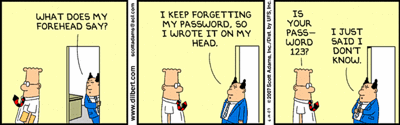
I think it's quite possible that whoever's making decisions at the Energy Department is well-meaning Washington bureaucrat: who is very good at managing paperwork; diligent in pursuing greater intradepartmental communication; and clueless about the Internet. Folks in top leadership positions tend to be a bit on the old side, and less than familiar with information technology:
Clueless management is funny - in the comics.

Dilbert.com

In the real world, having a boss who doesn't understand why keeping a network safe from hackers could be a big problem.

Being 'Protected'

I think it would be nice if everybody could share information about anything, and do so without being concerned about anyone's safety. I also think it would be nice if everybody would be nice: but that's not the way the world is.

Reality being what it is, there is a need for secrets: and weapons, and that's almost another topic. Folks who decided to kill several thousand people on September 11, 2001, were not nice. What's happened since strongly indicates that outfits like Al Qaeda and the Taliban are still determined to behave badly.

Sadly, they're not the only ones who threaten the safety of the rest of us.

China isn't the same country it was a half-century back: but its leadership still seems to be unwilling to accept folks whose ideas don't follow the 'party line.' China isn't alone, of course. It's easy to see disagreement as a threat.


I'm concerned about threats from outside America. I'm also concerned about Americans who want to 'protect' us from ideas they don't like. And that is another topic. (March 9, 2008)

Related posts:

Monday, August 15, 2011

Stealth Helicopter, Pakistan, China, and Getting a Grip

If you've been on the planet recently, you probably know that:
  • An American stealth helicopter was shot town in Pakistan
  • Someone in Pakistan held on to the wreckage
    • And showed it to Chinese specialists
On the whole, I'd be a bit happier if Pakistan's national government had collected the wreckage and turned it over to the American military.

I'd also be a bit happier if Pakistan had a national government that seemed to control more than a few parts of the capital city - if that.

As it is, I'm not even convinced that Pakistan's government gave the folks from China access to the wreckage. I don't doubt that someone with enough muscle to grab and hold the helicopter made a deal with China's national government. What I'm not entirely clear about is whether that person is someone in Pakistan's nominal national government, a military commander, someone in Pakistan's spy racket, or a local of the "tribal leader" variety.

Security, Pakistan, and Getting a Grip

I think - hope - that eventually folks in Pakistan will develop a national government that's functional and relatively benign. Until that happens, my take on the situation is that they're stuck with a motley assortment of civilian officials, warlords of various sorts, and the sort of family-based leadership that's existed in the area since the day when Abram moved out of Ur.

Apparently America's operation to get bin Laden had to use a stealth helicopter because Pakistan's alleged government had:
  • A proven track record of leaking information to the Al Qaeda leader
  • Somehow managed to ignore bin Laden's headquarters, which was
    • Large
    • Slightly fortified
    • In a city near the capital
Quite a few Pakistani VIPs seem to have their skivvies in knots over not being allowed to go about the usual routine of passing information on to their alleged enemies - intentionally or otherwise.

Can't say that I blame them, in a way. It must have been a little embarrassing when America's leadership let folks know why Pakistan's bosses were kept in the dark.

Now there's some very secret military technology in the hands of whoever managed to grab it most recently. In a country that's got nuclear weapons and feuding warlords. Plus a spy agency that's apparently a real-world example of America's liberal view of the CIA.

Here's what I think:
  • Can Pakistan's national government be trusted?
    • No
    • It's a trick question
      • I'm not convinced Pakistan has a functional national government
  • Should the stealth helicopter wreckage be returned to America?
    • Yes
    • But that won't happen until one or more conditions are met
      • Pakistan gets a working national government
      • Whoever holds the wreckage gets an incentive to let go
      • Another stealth mission takes care of the problem
      • Something else happens
  • Now that Chinese specialists have seen the wreckage, will chaos be loosed up on the world?
    • Probably not

Some Secrets are Best Kept - Secret

I'm accepting the idea that the materials and other tech that went into making that helicopter stealthy is something that should be kept secret. And that it would be better for Americans - and anybody who's interested in personal freedom - if the wreckage was back with America's military.

What I don't know is how hard it would be to reverse-engineer the 'stealth technology.' And I don't know if anybody with the necessary knowledge has had the sort of access to the helicopter wreckage that would allow them to copy the tech.

I'll grant that my opinion may be influenced by my not being a news editor with advertising space to sell - and that isn't another topic.

It'd be nice if military secrets weren't necessary, and everybody would decide to be nice - but that's not likely to happen. Not soon. In my opinion.

Meanwhile, I think it makes sense to keep some aspects of America's military force a secret. Just as I think it makes sense to not let someone holed up in a building know how the police plan to rescue his hostages - and, if possible, him.

No, I'd rather that America not be 'the world's policeman.' On the other hand, I don't think the world would be better off without a country that's able to put together a coalition of nations - and that's yet again one more topic.

Two Op-Eds, Two Views

Here's what got me started on this post:
"Did Pakistan sell out America?"
Patrick M. Cronin, CNN (August 15, 2011)

"The strategic partnership between the United States and Pakistan appears once again to be careening toward the brink of self-destruction. Reports that Pakistan may have given Chinese engineers direct access to the remnants of an American Black Hawk stealth helicopter left behind in the May raid on Osama bin Laden, are the latest in a series of blows to the relationship...."

"If China Saw U.S. Stealth Copter, It's No Big Deal"
Noah Shachtman, Danger Room, Wired (August 15, 2011)

"By now, everyone with an internet connection has seen pictures of the stealthy helicopter used in the raid to take out Osama bin Laden. So, if the Pakistani government provided Chinese engineers with a closer look at the 'Airwolf,' as the copter was nicknamed in some military circles, it's not necessarily a security disaster. The potential problems would only start if the Chinese took samples from the modified Black Hawk...."
The CNN op-ed isn't nearly as jittery as the headline might imply - and the Danger Room article isn't as careless as the headline's words.

Another example of why it's a good idea to read past the lead paragraph. More topics.

China and High Tech: Why Worry?

I don't "worry" about China having America's military secrets. Not in the sense of obsessively brooding on the 'yellow peril,' or frantically digging a fallout shelter in the back yard.

I am concerned, since China's national leadership doesn't have a particularly good track record for playing well with others.

There have been too many disturbing events over the years: from Chinese servers 'just happening' to host hack attacks on everything from American corporate websites to the Pentagon's files; to "mobsters" gunned down after criticizing the government.

Eventually, I think China will regain its historic role as a major economic force in the world, and one of the great centers of culture. Right now, I'm not convinced that China's political leaders have quite gotten over the Cold War. Or the idea that world conquest is a good idea.

Not that China is the only source of trouble in the world - and that's yet again another topic.

A Competent International Authority - Someday

Back to that 'world's policeman' idea again. I think America is, like it or not, one of the few nations around that's able to organize an effective resistance to dangerous national leaders.

My guess is that eventually the world will have a secular authority that's global, and able to deal with the occasional wannabe world conqueror, or corrupt official, or whatever. I also think that folks who like the status quo, with its fairly constant warfare and dead "mobsters," can rest easy. Tennyson's "Federation of the World" is centuries away. At least. My opinion.

I've discussed this sort of thing before, here and in another blog:
"...We're a very long way from having an "international authority with the necessary competence and power" to simply arrest someone like Saddam Hussein...."
(A Catholic Citizen in America (June 16, 2011))

Pacifists, Warmongers, and Me

As the name of that blog indicates, I'm Catholic. Despite what you may have heard, that doesn't mean that I'm
  • Conservative
  • Liberal
  • Intolerant
  • Backward
  • A Satan-worshiper
  • Un-American
  • Whatever
I'm also not a pacifist. Or, oddly enough, a warmonger. And I'm certainly not "moderate" in the sleazily political sense of the word. I think war is not nice. Things get broken and people get killed. Unhappily, there are some not-nice people in the world who aren't inclined to let others go about their lives. If these not-nice people aren't stopped, eventually a lot of things will get broken, and many people will get killed. Since we don't have an "international authority with the necessary competence and power" to stop these not-nice people, it's up to neighbors, national governments, and the occasional international coalition, to deal with them. Ideally, the Saddam Husseins of the world are restrained without war. Sometimes that's simply not possible:As I've said before, I admire sincere, dedicated pacifists. And I think they will thrive. As long as there are non-pacifists to protect them. Somewhat-related posts, getting a grip about: News and views:

Tuesday, June 14, 2011

What Sony, Nintendo, and Congress, have In Common


Correction (June 15, 2011)
Editing this post, I moved the AP/FoxNews quote explaining the title to the footnote 1. That quote is now where it belongs, in the body of the post. Oops.
(a tip of the hat to Brigid)
Looks like the U.S. Senate's website was hacked. That's the bad news.

The good news is that it's the Senate's public site, and apparently nothing sensitive was lost or stolen.

Some not-so-good news is that part of the problem seems to be inside the Senate:
"...The vulnerability was traced to a part of the Senate site that is maintained by an individual Senate office, which Bradford did not name. Each senator and committee maintains its own presence on Senate.gov and may not adequately protect the site, she [the Senate's Deputy Sergeant-at-Arms Martina Bradford] said...."
(Associated Press, via FoxNews.com)
This hack attack isn't China's doing - a group of hackers called Lulz Security says they're responsible. I suppose they could be fronting for China - or the CIA - or shape-shifting, space-alien lizard men, but I don't think that's likely.

Lulz Security's stated motives are pretty clear, and part of a familiar pattern:
"...'We don't like the US government very much,' the website wrote atop the file. 'Their sites aren't very secure.

" 'In an attempt to help them fix their issues ... this is a small, just-for-kicks release of some internal data from Senate.gov,' the site added. 'Is this an act of war, gentlemen? Problem?'..."
(Associated Press, via FoxNews.com)
Lulz Security doesn't just hack into the U.S. government, apparently:
"...The group has claimed credit for hacking into the systems of Sony and Nintendo and for defacing the PBS website after the public television broadcaster aired a documentary seen as critical of WikiLeaks founder Julian Assange...."
(Associated Press, via FoxNews.com)
I put more from that article at the end of this post.1

I'm no adoring fan of the United States Congress. On consideration, I'd rather live in America than anywhere else - and I think our form of government, on the whole, works adequately well. But I also wish that members of congress would display common sense more consistently. I've discussed hyperventilating rhetoric before - in and out of Congress. (June 11, 2011)

Other congressional deficiencies - I've been over that in another blog:That's partly about the Wiener debacle, so if you think Representative Wiener is the best thing that ever happened to New York state, you probably won't like the post.

Now, about the latest hack and getting a grip.

Briefly:
  • This hack is
    • Embarrassing
    • Not, apparently, a serious threat
    • A useful wake-up call
      • Maybe
  • One Senate office dropped the (security) ball
    • Spear phishing?
    • Something else?
  • Cyberwar?
    • Probably not
  • Alternatively-responsible?
    • Yes
      • In my opinion
  • Ideology isn't an excuse for bad behavior
    • In my opinion
I've written about that sort of thing before.

Related posts:In the news:
1 From yesterday's news:
"A band of computer hackers who pride themselves on attacking vulnerable networks for fun accessed a Senate server that supports the chamber's public website but did not breach other files, a Capitol Hill law enforcement official said Monday. The hackers said the release was a 'just for kicks' attempt to help the government 'fix their issues.'

" 'Although this intrusion is inconvenient, it does not compromise the security of the Senate's network, its members or staff,' Senate Deputy Sergeant-at-Arms Martina Bradford said in a statement.

"A hacking cooperative that goes by Lulz Security claimed that it had added a Senate file to its list of successful, high-profile intrusions at a time when governments and corporations are on high guard for cyber intrusions...."

"...'We don't like the US government very much,' the website wrote atop the file. "Their sites aren't very secure.

" 'In an attempt to help them fix their issues ... this is a small, just-for-kicks release of some internal data from Senate.gov,' the site added. 'Is this an act of war, gentlemen? Problem?'..."
(Associated Press, via FoxNews.com (June 13, 2011))

Saturday, June 4, 2011

Gmail, China, Knee-Jerk Response, and the Information Age

I ran into a news item last night. The focus was on U.S. Defense Secretary Robert Gates, his Chinese counterpart General Liang Guanglie, and what Gates said about China-United States relations. The two men were at an Asia-Pacific annual security conference ("talkfest" is how the article put it): called the Shangri-La Dialogue, of all things.

The latest hack attack coming from servers in China came up, briefly.

Hackers and Imperialist Capitalist Aggressor Warmonger Running Dogs

Times change. I haven't heard diplomatic boilerplate like "capitalist aggressor" for quite a while. Being away from college probably helps, but I think many folks have realized that it's not the 19th century any more, and class struggle just isn't what it used to be. And that's another topic.

Some things haven't changed so much, though.

First, about the latest hack attack:
"There is a lot of talk--and diplomatic tension--this week related to reports that attacks originating from China have breached Google Gmail accounts, including those of senior US government officials. The focus is on e-mail, and whether or not e-mail accounts were hacked, but a breached Gmail account is a much bigger prize than just the e-mail account it is attached to.

"Google claims that the spear phishing attacks that targeted Gmail accounts of White House staff, and successfully exposed accounts of senior US government officials, high-ranking military personnel, and political activists, originated from China. China denies any state-sponsored involvement in the attacks, and the FBI is investigating...."
(PCWorld Business Center)1
I think it's possible that Google and China's leaders are right. I think it's very likely that Google traced the hack attack to servers in China: although I'll admit that Google could, in principle, be faking the attack's source. I don't think that's likely, but is is possible.

As for China's response to news that their servers hosted a hack attack? Again?

According to China's military, it is the work of Yankee imperialists. That's not quite the way they put it, but that's the basic idea:
"...A new irritant was introduced this week, with allegations that computer hackers in China had compromised the personal Gmail accounts of several hundred people, including U.S. government officials, military personnel and political activists.

"The Chinese military tried to direct the spotlight off those allegations Friday, with accusations that the U.S. is launching a global 'Internet war' to bring down Arab and other governments.

"The FBI said it was investigating Google's allegations, but no official government email accounts have been compromised. Google said all the hacking victims have been notified and their accounts have been secured.....
(Associated Press, via Foxnews.com2) [emphasis mine]
Again, China's line seems to be that "the U.S. is launching a global 'Internet war' to bring down Arab and other governments."

That's probably good enough for folks who believe that the CIA blew up New York City's World Trade Center. After all these decades, though, it sounds like the same tired old 'American aggressor warmonger' stuff that cluttered the news in my youth.

A Country's Servers aren't a Country's Government

Since China is one of the world's more tightly-managed countries, in my opinion, I find it a little hard to believe that hackers have just happened to use Chinese servers for hack attacks - for years - and that the country's leadership doesn't know it's happening and can't stop it anyway.

Still, it's possible.

Particularly since I can easily imagine that it's in China's interests to get access to networks in other countries, for either espionage or sabotage, and blame Yankee imperialism.

China's response may simply be knee-jerk xenophobia: the sort of thing that had right-wing loonies blaming whatever they didn't like on the commies, back in 'the good old days.' I remember the real "Happy Days," by the way - and don't, ever, want to go back.

Or, the folks running China may not be the ones who planned and executed all those hack attacks. China's leaders may be aware that the attacks come from servers in their country - and not be able to stop whoever's behind the hacking. If that's the case, they may simply be embarrassed: and desperately want the problem to belong to someone else.

I think it's a good idea to remember that a national government doesn't necessarily control everything that happens within its borders: no matter how much the leaders want to.

Real Threat, Proportional Response

It's entirely possible that no one person or organization is behind attacks on the World Bank, Gmail, Sony, and all the rest. I think it's quite possible that there is no one motive behind the hacking.

My understanding is that there's a hot - if unethical and illegal - market for the sort of data that has quite possibly been stolen. That would make the hacks a new version of burglary. And, most likely, a private-sector effort.

Governments have their own motives.

What's happened in Tunisia, Egypt, Bahrain, Syria, Libya, and elsewhere shows what can happen when old-school leaders lose control of their subjects. My guess is that Iran's rulers are developing a 'just us' intranet to keep the 'Arab spring' from spreading east. The Ayatollahs have nice-sounding motives: they want to 'protect' Iranians from foreign influences.

In my opinion, Iran's leadership isn't the only outfit that's scared of the Information Age. And for good reason. I've gone over that before:I think it's likely that some folks have idealistic reasons for hacking into corporate and government networks. Sometimes I even sympathize - a little - with the ideas they support. Like freedom of information. Which is emphatically not the same as thinking that what they're actually doing is right.

In a way, it's a sort of 'with friends like these, who needs enemies?' situation. A case in point:
"A hacker group has claimed responsibility for defacing the PBS.org website, the Fox.com site, and the Sony network, posting images of defaced websites and stolen databases and emails to its website....

"...Pike linked the hacker group Lulz to Anonymous, the 'hacktivist' collective that -- in the name of the freedom of information -- has hacked numerous websites, wrestled with security firms and made public a decrypted version of the cyberworm that crippled Iran's nuclear power program...."
(Jeremy A. Kaplan, FoxNews.com (June 2, 2011))
According to the article, Pike's considering turning himself in, before law enforcement shows up with a warrant. That's a good idea, in my opinion. Blaming Yankee imperialism may still work as an excuse in diplomacy: but American law enforcement is, in my experience, more interested in facts than finger-pointing.

As I said before, I think it's possible that a server in China could have been used for hack attacks, without the Chinese government being involved.

Determining how likely that is - and whether that's what's actually been happening - is a job I'm profoundly grateful belongs to someone else.

If it turns out that the Beijing bosses are responsible for the hack attacks, I suspect and hope that America's leaders will try to sort the mess out diplomatically. Not because I think the folks who are still occupying Tibet are a bunch of really nice guys who are just misunderstood. It's a matter of proportional response, and how many folks who weren't responsible could get hurt or killed in a military operation.

If the North American power grid goes down this winter? That's something else. (June 1, 2011)

China, Assumptions, and Living in the Information Age

I've been criticized for not having the proper attitude toward China: and not being politely silent.3 It's a familiar reaction. Commie-hunters acted that way in the McCarthy era (January 9, 2010); professors did the same, a few decades later; and I'm don't think trying to impose ideological purity is a good idea - no matter whose ideas are being shoved down my throat.

I also think it's a bad idea to assume that 'foreigners,' 'commies,' 'the military-industrial complex,' 'Big cheese,' or any other standard-issue bad guys are 'really behind' any particular issue. (January 14, 2009)

Finally, I think that these are trying times for old-school autocrats: and anybody who had a privileged position before information technology made it possible for folks to share ideas - without permission from their 'betters.'

I like the comparatively open marketplace of ideas we have today: but then, I don't mind people having access to dangerous technology. Like LP gas, guns, or computers. (June 27, 2008)

Related posts:
News and views:

1 Excerpt from news and views:
"Putting a positive spin on a sometimes stormy relationship, U.S. Defense Secretary Robert Gates said Friday that military ties with China are 'on a more positive trajectory' but need further strengthening....

"...The main elements of friction remain, however. China still claims control of waters the U.S. considers international. Chinese ambition for influence in Southeast Asia and elsewhere still makes smaller nations uneasy, while Beijing dislikes the heavy U.S. naval presence in Asian waters and builds up its military with weaponry only logically intended for use against the U.S.

"A new irritant was introduced this week, with allegations that computer hackers in China had compromised the personal Gmail accounts of several hundred people, including U.S. government officials, military personnel and political activists.

"The Chinese military tried to direct the spotlight off those allegations Friday, with accusations that the U.S. is launching a global 'Internet war' to bring down Arab and other governments.

"The FBI said it was investigating Google's allegations, but no official government email accounts have been compromised. Google said all the hacking victims have been notified and their accounts have been secured.....

"...Gates and Liang met on the sidelines of the Shangri-La Dialogue, an annual security talkfest attended by defense officials from across the Asia-Pacific region. On Saturday Gates was delivering an address to the conference before continuing an around-the-world journey that is his final trip before retiring June 30...."
(Associated Press via FoxNews.com)
1Excerpts from news and views:
"There is a lot of talk--and diplomatic tension--this week related to reports that attacks originating from China have breached Google Gmail accounts, including those of senior US government officials. The focus is on e-mail, and whether or not e-mail accounts were hacked, but a breached Gmail account is a much bigger prize than just the e-mail account it is attached to.

"Google claims that the spear phishing attacks that targeted Gmail accounts of White House staff, and successfully exposed accounts of senior US government officials, high-ranking military personnel, and political activists, originated from China. China denies any state-sponsored involvement in the attacks, and the FBI is investigating.

"The Gmail e-mail accounts are getting all of the attention. Catalin Cosoi, head of the BitDefender Online Threats Lab, notes in a blog post, 'Just as in the previous attack against the Gmail service, we can assume that cyber-criminals went after sensitive documents the users might have inadvertently forwarded from their business inboxes.'

"But, it would be more accurate to say that Google accounts are being targeted or compromised--not just Gmail. Depending on the extent the hacked account relies on Google, there is potentially much more at stake than just the documents that might be forwarded as a file attachments from Gmail. There is no differentiation between hacking a Gmail account, and hacking the rest of the diverse array of Google services....

"...If the victim actually uses Google Docs, the attacker will have access to all documents, spreadsheets, presentations, forms, and drawings stored online by the victim--not just the ones that might have been included as a file attachment in an e-mail.

"Accessing Google Maps could yield valuable information as well. Most users enter a home address as the default location to save time when searching for driving directions....

"...It is up to Google, and China, and the FBI to get to the bottom of whether the compromised accounts are a state-sponsored act of international espionage, or just the work of run-of-the-mill spear phishing cyber-criminals. But, regardless of who is behind the attack, or what the underlying motives are, there is more than just e-mail at stake."
(PCWorld Business Center)
2 Excerpt from news and views:
"Putting a positive spin on a sometimes stormy relationship, U.S. Defense Secretary Robert Gates said Friday that military ties with China are 'on a more positive trajectory' but need further strengthening....

"...The main elements of friction remain, however. China still claims control of waters the U.S. considers international. Chinese ambition for influence in Southeast Asia and elsewhere still makes smaller nations uneasy, while Beijing dislikes the heavy U.S. naval presence in Asian waters and builds up its military with weaponry only logically intended for use against the U.S.

"A new irritant was introduced this week, with allegations that computer hackers in China had compromised the personal Gmail accounts of several hundred people, including U.S. government officials, military personnel and political activists.

"The Chinese military tried to direct the spotlight off those allegations Friday, with accusations that the U.S. is launching a global 'Internet war' to bring down Arab and other governments.

"The FBI said it was investigating Google's allegations, but no official government email accounts have been compromised. Google said all the hacking victims have been notified and their accounts have been secured.....

"...Gates and Liang met on the sidelines of the Shangri-La Dialogue, an annual security talkfest attended by defense officials from across the Asia-Pacific region. On Saturday Gates was delivering an address to the conference before continuing an around-the-world journey that is his final trip before retiring June 30...."
(Associated Press via FoxNews.com)
3 Comments from "Tibet: Fifty Years of Chinese Liberation, and Counting" (March 10, 2009):
"Anonymous said...

"If you are outside of Tibet, just leave Tibet alone, let Tibetan live by themselves, please love your land where you live and shut up. If Dalai was right, a pig could fly.
"March 10, 2009 3:45 PM

"Brian, aka Nanoc, aka Norski said...

"Anonymous,

"If 'Tibetan live by themselves' I might. However, since Tibet was invaded about fifty years ago, and Chinese troops are now stationed to keep the Han shopkeepers safe and Tibetans in line, and quite a number of Tibetans don't like the situation: I will not 'shut up.'

"Kudos, though, at being comparatively civil about it. Particularly in comparison with what may have been another of the throng of Anonymouses out there, responding to 'Today's Main Event: Protesters vs. the Olympic Torch in San Francisco' (April 9, 2008).

"That Anonymous's comment, in full:
"Anonymous said...

"Don't pretend that you know a lot about history. Tibet is still a An English TRANSLATION name as same as Xizang. Now that you don't like China, you can call Xiazang any name you want.
"Suggest you goto a library to read a little more about Tibet then comment on this "Independence", though suggesting going to library is often a mother's duty.
"April 26, 2008 7:54 PM
"March 10, 2009 6:05 PM
"Politics and the Future said...

"China is not my focus in the war on terror only in my economic studies is it a bigger focus for me.

"But I do have to say one thing, with a growing nation could China become a new superpower? could they develop weapons of mass destruction? I know I know I sound like a conspiratist but I'm not. I am only asking.
"I believe they are going to gain more power both militarily and economically.

"March 10, 2009 6:59 PM

"Anonymous said...

"Please pay more attention to your own business. Never lavish your sympathy on Dalai. If you turn blind eyes to the truth and still whitewash a serf owner as your spiritual leader, I would say nothing any more. What do you think if you know those old noble owner picked serfs' eyes and striped their skin for punishment ? They asked serf to take their shit as medicine. How do you feel about it? These only happened several decades ago under Dalai's rule in Tibet. Where is your conscience. How could you depict it as a shangrila? Please look back to the documentary which your western media took before 1990's. If you think you are god and don't need to read, I go.

"March 10, 2009 8:04 PM

"Brian, aka Nanoc, aka Norski said...

"Anonymous #2, or maybe the same Anonymous,

I know that Tibet isn't Shangri-La (Lost Horizon is a pretty good movie, though - so is Star Wars). Live
[!] isn't the movies.

"I do, though, seem to have hit a nerve.

"Apparently, one is not supposed to discuss, or mention, the liberation of Tibet - except in glowing terms.

"Anybody interested in the Chinese side of this issue could do a lot worse than reading that op-ed I linked to.

"This isn't just about the Dalai Lama, by the way: the new overlords of Tibet may not be that big an improvement over the monks they displaced.
"March 10, 2009 8:11 PM

"Brian, aka Nanoc, aka Norski said...

"Politics and the Future,

"I think I followed that comment.

"China's nuclear weapons program began, as far as can be determined, in the mid-1950s. At this time, they almost certainly have hundreds, but not thousands, of nuclear bombs in their stockpile. Chinese leaders have repeatedly pledged to not use nuclear weapons first in a confrontation. ("Weapons of Mass Destruction (WMD) - Nuclear Weapons" GlobalSecurity.org)

"I'm inclined to believe Chinese leaders on this point. After the debacle we call the Cultural Revolution, Chinese leadership has shown few to no suicidal tendencies.

"(North Korea with nukes is a whole different ball of wax.)

"Not that I have unwavering confidence in the good will of the Chinese government.

"For those looking for something to be concerned about, there's China's secret submarine base (no kidding): "Forget the Olympics For Now: China's Secret Submarine Base is Serious" (May 2, 2008)
"March 12, 2009 12:48 PM"
(Comments from "Tibet: Fifty Years of Chinese Liberation, and Counting" (March 10, 2009))

Unique, innovative candles


Visit us online:
Spiral Light Candle  • Find a Retailer
• Spiral Light Candle Store

Blogroll

Note! Although I believe that these websites and blogs are useful resources for understanding the War on Terror, I do not necessarily agree with their opinions. 1 1 Given a recent misunderstanding of the phrase "useful resources," a clarification: I do not limit my reading to resources which support my views, or even to those which appear to be accurate. Reading opinions contrary to what I believed has been very useful at times: sometimes verifying my previous assumptions, sometimes encouraging me to change them.

Even resources which, in my opinion, are simply inaccurate are sometimes useful: these can give valuable insights into why some people or groups believe what they do.

In short, It is my opinion that some of the resources in this blogroll are neither accurate, nor unbiased. I do, however, believe that they are useful in understanding the War on Terror, the many versions of Islam, terrorism, and related topics.