Showing posts with label coalition. Show all posts

Friday, September 26, 2014

The Islamic State: Air Strikes, Diplomacy, and Remembering Sargon of Akkad

I've said it before: war is not nice. Things get broken. People die.

But sometimes it's better than the alternative.


(From U.S. Central Command / Reuters, used w/o permission.)
("A still image taken from video provided by the U.S. Central Command shows a damaged building at an Islamic State compound near the northern Syrian town of Ar Raqqah, following an air strike. "
(Reuters))
"French, U.S. planes strike Islamic State, Britain to join coalition"
Arshad Mohammed, Tom Perry; Reuters (September 25, 2014)

"French fighter jets struck Islamic State targets in Iraq on Thursday, and the United States hit them in Syria, as a U.S.-led coalition to fight the militants gained momentum with an announcement that Britain would join.

"The French strikes were a prompt answer to the beheading of a French tourist in Algeria by militants, who said the killing was punishment for Paris' decision last week to become the first European country to join the U.S.-led bombing campaign.

"In the United States, FBI Director James Comey said Washington had identified the masked Islamic State militant in videos with a knife at the beheading of two American hostages in recent weeks. Those acts helped galvanize Washington's bombing campaign.

" 'I'm not going to tell you who I believe it is,' Comey told reporters. He said he knew the person's nationality, but declined to give further details...."
The Reuters article goes on to say that "a European government source familiar with the investigation said the accent indicated the man was from London and likely from a community of immigrants."

There's more, about "credible intelligence that Islamic State networks in Iraq were plotting to attack U.S. and French subway trains" and a growing coalition of nations. Apparently quite a number of Arab nations have already joined, with European leaders a bit slow to get with the program.

I don't know whether the Europeans are following the 'my end of the boat isn't sinking' philosophy, aren't sure how their constituency will react, or haven't sobered up yet.

Either way, my guess is that quite a few European governments will decide that, on the whole, getting their butts saved by a U.S.-led coalition is better than losing their heads under an Islamic State in their home territory.

I'd like to believe that there's a chance for a peaceful resolution to the current mess. The folks running The "Islamic State" are human, and in principle could decide that their best course of action is negotiating: followed by pursuing their goals in a less violent way.

Given humanity's record, that outcome does not seem likely.

Making Mistakes, Making Sense


I run into folks who feel that the world's problems are cause by Islam; others who feel the same way about Christianity, and some who say that all religion causes trouble.

Considering how the first two lots act, I have some sympathy for the latter. But I think 'all of the above' make the mistake of overgeneralization.

Some Christians behave badly. So do some Muslims. But some of us have our heads screwed on straight, and understand our faith. A case in point, from the Reuters article:
"...More than 120 Islamic scholars from around the world, including many of the most senior figures in Sunni Islam, issued an open letter denouncing Islamic State. Challenging the group with theological arguments, they described its interpretation of the faith as 'a great wrong and an offense to Islam, to Muslims and to the entire world.'

"'You have misinterpreted Islam into a religion of harshness, brutality, torture and murder,' said the letter, signed by figures from across the Muslim world from Indonesia to Morocco. "
(Arshad Mohammed, Tom Perry; Reuters)
I'm not a Muslim, by the way. I'm a Catholic: which in some American circles is just as bad.

I'm assuming that the "Islamic State" mentioned in the Reuters article is another name for ISIS, (Islamic State of Iraq and the Levant). I've discussed that lot in another blog:

Unhappy About Change


Apparently ISIS, the folks who killed James Foley, aren't happy with today's world. They seem to yearn for the 'good old days,' when they believe Islam measured up to their standards and preferences. They're probably quite sincere: and certainly willing to kill anyone who doesn't agree with them.

Victims of their zeal include  Shia Muslims, Druze, Mandeans, Shabaks, Yazidis, and Christians. You'll find more about ISIS at "Islamic State of Iraq and the Levant." (Wikipedia)

Folks being unhappy about change isn't a uniquely Muslim experience.

I run into Catholics who seem convinced that we should return to the 'good old days' — as they remember them. Catholics who yearn for yesteryear occasionally get together and form their own little micro-church, but don't seem inclined to kill outsiders.

I'd say 'Christians are better than that:' but realize that now and then some of us go rogue.

The nearest thing America has had to ISIS are groups like the Ku Klux Klan: folks who seem convinced that they're 'protecting' America from 'foreigners' and our 'evil' ways.
(A Catholic Citizen in America (August 24, 2014))

Taking the Long View: and Hope


I think today's conflict between the Islamic State/ISIS and everyone who like living in the 21st century will most likely end violently. I am also quite certain that it will end.

Even if the Islamic State endures the end of this conflict, and stays in control of Subartu, they won't stay in control. Sargon of Akkad conquered Subartu about 43 centuries back. Then he died, his empire fell, and the territory has changed hands quite a few times since.

Change happens. How change happens depends on what we do.

I hope that humanity will eventually cobble together an international authority "with the necessary competence and power" to end war and settle disputes with justice and mercy.1
"...Till the war-drum throbbed no longer, and the battle-flags were furl'd
In the Parliament of man, the Federation of the world.


"There the common sense of most shall hold a fretful realm in awe,
And the kindly earth shall slumber, lapt in universal law....
"
("Locksley Hall," Alfred, Lord Tennyson)
Those were among my favorite lines of poetry in my youth. A half-century later, they still are; although I've learned to temper my hope with patience.

Cobbling together a globe-spanning 'Council of Humanity' will, I think, take generations. Centuries. But I think it will be worth the effort. And that's another topic.

Related posts:

1 ("Gaudium et Spes," 79; Pope Paul VI (December 7, 1965)

I remember the trailing edge of McCarthyism, and the 'good old days' when America's establishment was run by WASPs: so I understand why some folks fear a "world government" almost as much as they fear commies, Republicans, foreigners, or right-wing extremists.

But I also think that government of some sort is necessary, and that humanity may eventually find a way to settle disputes without mass homicide. As for fears that 'the government' will take away freedom: that is a reasonable concern. How some folks react to that concern is — another matter.

I am a Catholic, so my faith requires that I respect and defend the freedom of everyone.

More of my take on government and freedom:

Sunday, April 18, 2010

Iran's Mighty Army, President Ahmadinejad, Nuclear Weapons and History

This hasn't been a particularly slow week for news:I think this is noteworthy, too:
"Iran is so powerful today that no country would dare attack it, President Mahmoud Ahmadinejad said Sunday during an annual army parade.

" 'Iran's army is so mighty today that no enemy can have a foul thought of invading Iran's territory,' the Iranian leader said, according to state media.

" 'Of course, Iran is a friend and brother of regional and independent nations and it wants peace, progress and security for all countries,' Ahmadinejad said.

"During the event near the mausoleum of the late Ayatollah Ruhollah Khomeini -- who ushered the Islamic Revolution into Iran more than 30 years ago -- several models of Iran's medium- and long-range missiles, including the Shahab 3, were on display...."

"...The United States and its allies should abandon policies designed to dominate the oil-rich nations of the Middle East, Ahmadinejad said, adding that reliance on arms was a sign of a country without culture.

"Iran, he said, is prepared to do all it can to counter nuclear weapons.

" 'One of the greatest treasons by those that monopolize nuclear weapons is to equalize nukes with nuclear energy,' Ahmadinejad said. 'The way to produce weapons is totally different than nuclear energy. And they know these very well, but they plan to talk about both these things in their own monopolized way.' "
(CNN)
Oddly enough, I think that President Ahmadinejad has a point: although I wouldn't describe efforts at slowing down the spread of nuclear weapons as "treason."

Wouldn't it be Nice, If Nukes Didn't Exist?

Here in America, a noticeable number of people apparently think that technology makes people do things: not the other way around. Search for things like "gun laws," "gun lobby" or "gun crime," and you may see what I mean. (December 23, 2007)

It's an attractive idea: just destroy all the guns and ban gunpowder, and everything would be hunky dory. I'm quite sure that, in a 'ban firearms' scenario, "gun crimes" would disappear.

But, depending on what America's 'right sort' got scared of first, soon we'd have to ban crossbows, swords, knives, steel, iron, bronze - you get the idea. (April 6, 2010)

Iran a Threat? Yes, Obviously

I think that Iran's current leadership is a serious threat to anybody within range of its missiles. By now that includes a disturbing fraction of Eurasia and Africa. (August 4, 2009) And the Ayatollahs haven't missed too many opportunities, in my view, to make it quite clear that they believe people should agree with them: or die.

Dealing With New Technology: Been There, Done That

On the other hand, I'm fairly sure that nuclear energy - reactors and weapons systems - is a genie that won't go back into the bottle. We'd better get used to living in a world where people can, with a certain amount of effort, use - or misuse - enormous amounts of energy.

Humanity has been through this sort of thing before. There was a time when arrows were the latest thing in super-weapons. What's different about today's situation is that things tend to move faster: and more of 'the masses' have a clue about what's going on.

Ignorance may be bliss: But I'd rather live now, than in any of the 'good old days' I've heard about. Certainly not the ones I remember. "Happy Days" wasn't.

One advantage we've got, that people a thousand or ten thousand years ago didn't have, is that there are well upwards of 6,000,000,000 of us. A fair percentage of that number have access to Internet connections. Which gives them access to quite a bit of raw information - some of it reliable, some more fiction than fact. They - we - can also communicate with each other. Fast.

Welcome to the Information Age

All national leaders may not have caught on yet, that they're not the only people who have viable ideas: but I think there's there's a vague sense developing, that this isn't the 19th century any more.

That's a pretty good start.

Individual Nations Can Deal With Iran

I don't have answers: not in any detail. But, in general: I think the sort of situation represented by Iran and Korea is one that individual nations can deal with.
But That May Not be a Good Idea
Which is a bit of a problem. I said, "can deal with," not "should deal with." In my view, the United Nations is a sort of practical joke: and a screwball prototype of what humanity may develop. In a century, or a millennium. My guess is that it'll take even longer: but I've been wrong before.

We've seen, recently, what a coalition of nations can achieve. Provided that there's one or two nations in the group with leaders who are willing to take charge. Not dictate: direct.

I realize that's a radical idea: nations cooperating with each other without a U.N. agency running the whole affair. But I think it's better than the 'solo' option.

I'm not necessarily talking about America 'going it alone,' mind you. A few years ago, Russian leaders made it fairly clear that they weren't too noble and self-sacrificing to use nuclear weapons against a threat. (January 25, 2008)

Personally, I'd rather see the 'Iranian nuclear weapons' issue settled without parts of Iran becoming radioactive ash. But today's heirs of the Czars and commissars may decide to be more proactive.

Related posts:In the news:

Sunday, March 7, 2010

Iraq, Elections, the Usual News, and Kids With Inky Fingers

An election happened in Iraq, in early 2009. You've read about the violence: traditional news services have seen to that with their usual efficiency.

This, you may not have read about:
"Defying instructions by the Baghdad Operations Command (BOC) not to take children to the voting centers, some of the young ones went, but only to color their fingers with the indelible voting ink in imitation of their elders.

" 'My five-year-old protested staying at home and insisted on coming with us to the ballot centers, not giving much interest to other kids’ plans to play football in the streets that were empty of cars due to the traffic ban,' Umm Ahmed, a local resident of the New Baghdad area, told Aswat al-Iraq news agency.

"Voting centers in Baghdad and other 13 provinces started at 07:00 a.m. Baghdad local time to receive eligible voters who are electing their candidates to occupy all 440 seats in local councils amidst blanket security measures.

"Umm Ahmed pointed out that her son colored his fingers with the voting ink to pompously boast among his peers that he was the only kid in the family who was allowed to cast his vote...."
(Aswat al Iraq, English language edition)
Offhand, I'd say we won: particularly if the leaders that Iraqis vote in tell American/coalition forces to leave their country.

My guess is that they're no more foolish than another selection of humanity - and whatever they say, they won't do anything unless they're sure they can hold their country together without outside help. If Iraq's new leaders tell the foreigners to go home, I figure that means they've got situations well in hand.

And if it turns out they're wrong, we'll still be here.

Related posts:In the news:
A tip of the hat to mstoneman, on Twitter, for the heads-up on Iraqi kids with inky fingers.

Saturday, August 16, 2008

Russia and Georgia is America and Iraq: Everybody Knows That!

I heard one of the talking heads on a business show say, in passing, that America couldn't complain about Russia's invasion of Georgia, because America invaded Iraq.

He even paraphrased "everybody knows."

His assumption isn't as crazy as it seems. At least, quite a few people agree with him. Their line of reasoning seems to be this:
  • America invaded Iraq
  • Based on intelligence about WMD programs in Iraq
    • Which was, apparently, wrong
  • So America was wrong to unilaterally invade Iraq
You can't argue with logic like that.

My guess is that what's stirred up this month's 'invasion of Iraq was based on lies' enthusiasm is the upcoming American presidential election, exacerbated by a new book. I know: That last item is almost five years old. The point is, this assumption of faked intelligence is nothing new. It may even, to some extent, be true.

Or, we could be looking at Monday morning quarterbacking on a massive scale.

Why the Coalition Invaded Iraq

It's easy now, years after a brutal tyrant has been deposed, to say that the invasion of Iraq was a mistake. Particularly since no weapons of mass destruction have been found. So far.

However, back then, leaders from a significant fraction of the world's nations saw credible evidence that Saddam Hussein was developing, or already had, biological weapons: and was developing nuclear weapons. Quite a number of Kurds had found out, the hard way, that Hussein had chemical weapons: and a willingness to use them.

Those leaders had choices:
  1. Wait and see
    • What's the worst that can happen?
      • A few cities get vaporized
      • A plague or two sweeps a few countries
  2. Act before
    • Hiroshima and Nagasaki have company
    • We find out what biological warfare on a grand scale is like
America, and the rest of the coalition, decided to take option 2.

The intelligence may have been wrong.
We See No WMD, So There Are No WMD?
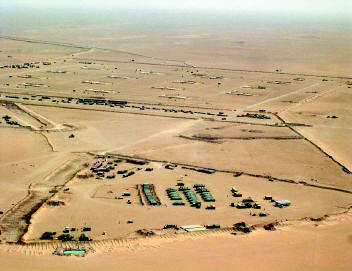
Or, it may have been correct. Iraq is a big country: much larger than Massachusetts or Maryland. A lot of it is desert. A comparison may be useful:

I grew up on the edge of North Dakota, a state which has miles and miles of miles and miles. Trucks and snowmobiles stranded between towns generally get found: but the drivers want to be found.


(from U.S. Geological Survey, North Dakota Water Science Center, used without permission)
That photo is of Edmore, a town in one of the cozier parts of North Dakota. Most of the state isn't that densely populated.

The next photo shows a very large petroleum terminal in Iraq. I'm quite sure that if railroad-car-size containers with weapons of mass destruction inside were hidden inside that terminal, coalition forces would have found them by now.


(from U.S. Army Quartermaster Center and School, used without permission)
'Okay, men: there are a dozen cargo containers buried out there. Go find them!'

Whether containers buried somewhere in the lands beyond the horizon would have been found by now is another question.

Why Russia Invaded Georgia

Russia had a pretty good reason for invading Georgia.
  • Some people in two northern provinces of Georgia said they wanted to be part of Russia
  • Some of them were acting violently
  • Georgia moved troops into one of the provinces
Russia, naturally, rolled troops and tanks in, destroyed Georgian military supplies, sank or took much of the Georgian navy, took over a major highway, and the Georgian city of Gori.

It seems to me that there are some none-too-subtle differences between Russia's invasion of Georgia, and the coalition's invasion of Iraq. Or, as it's usually called, America's unilateral invasion of Iraq.

An Expert Wrote a Book

As I said earlier, some of this month's 'Bush Lied' talk seems to stem from a recently-publicized book: "The Way of the World: A Story of Truth and Hope in an Age of Extremism" by Ron Suskind.

Ron Suskind is a Pulitzer Prize winning journalist. That's impressive, but it doesn't make him right. Janet Cooke won a Pulitzer Prize, too.

Suskind could be right, "that in 2003 the White House ordered the CIA to forge and disseminate false intelligence documents linking al-Qaeda and Iraq." (Democracy Now!)

It's possible that America has been embroiled in a web of lies and deceit, and that "America's" invasion of Iraq was just like Russia's invasion of Georgia. But I don't think it's likely.

Any more than I think it's likely that the Ames strain of anthrax was really developed in a secret slave-labor lab under Crawford, Texas.

Thursday, June 12, 2008

Afghanistan-Pakistan Border Skirmish: Diplomatic Protests and Videotape

Everybody agrees that there was a skirmish near the Afghanistan-Pakistan border: specifically, near the Gorparai post in the Mohmand frontier region.

At that point, the agreement ends.

"...Pakistan has lodged a strong diplomatic protest, saying the bombing of the Gorparai post in the Mohmand frontier region on Tuesday was a 'completely unprovoked and cowardly act.'... " ("US releases video of clash along Afghan border" (Yahoo! News (June 12, 2008)).

American national security adviser Stephen Hadley said that "U.S. officials 'have not been able to corroborate' claims by Pakistani officials that a U.S. skirmish with militants along the Afghan-Pakistani border killed 11 Pakistani troops." (Yahoo! News)

I don't know how the diplomatic wrangle will come out, but there's something new in the mix this time: videotape.

"To support its version, the coalition on Thursday took the unusual step of releasing excerpts of a video shot by a surveillance drone circling above the mountainous battle zone." (Yahoo! News)

There's more:
  • "The grainy, monochrome images show about a half-dozen men firing small arms and rocket-propelled grenades from a ridge at coalition troops off-camera in the valley below.
  • "According to the voiceover in the video, the ridge is in Afghanistan's Kunar province, about 200 yards from the Pakistan border and close to the Gorparai checkpoint.
  • "Neither the checkpoint nor any other structures are visible in the video excerpts.
  • "The voiceover says the coalition forces were on a reconnaissance mission and returned fire as they tried to break contact and move to a point where a helicopter could pluck them to safety.
  • "The video shows the "anti-Afghan militants" moving to a position identified as inside Pakistan and the impact of a bomb which the voiceover says killed two of them.
  • "The survivors then fled into a ravine, where three more bombs were dropped, nearly three hours after the clash began. The voiceover said all the militants were killed.
  • "One of the bombs fell off screen, and U.S. officials said about a dozen bombs were dropped in all...."
    (Yahoo! News)
Later, the article quotes national security adviser Hadley: "...'One of the problems is that it is still not exactly clear what happened,' he said. 'The reports quite frankly, even from sources within the United States, are conflicting.'

"Hadley said that the U.S. believes there was an operation on the Afghan side of the border by 'anti-coalition forces' that threatened coalition personnel. The forces then went 'back into Pakistan' and the coalition fighters 'tracked and struck those forces.' "

What makes this incident stand out from run-of-the-mill diplomatic spats is the drone overhead, recording images. I remember back when dashcams were put on police cars, and video playback of baseball and other games started. Umpires were worried, as I recall, that the videotape would show them making wrong calls. That happened from time to time, but the umps were surprised at how often they got it right.

Before drones and videotape, incidents like the one at the Aghan-Pakistani border got sorted out based on witnesses and written records. That's still going to be important, but now it's possible for us to see at least part of what happened.

As camera-carrying drones and other remote sensing technology is used more, I think that some people will be as surprised as the umpires.

Of course, the Pakistani diplomats and the coalition leaders could both be right. I get the impression that, the way things work in that part of the world, the "anti-coalition forces" may have been the Pakistani troops.

Saturday, March 22, 2008

Nero Was Working for the Christians: Who Knew?

A post in this blog, " 'Inside Islam: Faith vs. Fanatics:' Arizona" got a very interesting comment today.

The gist of it is that the Crusades were bad, and the "Jews were kicked out of Israel by the Romans in the name of Christianity." (In about 70 AD - who knew?!)

And, of course, the Christian attack on Muslims is done by: "Murderers in uniform. Terrorists in uniform. Rapists in uniform. Then these blood-sucking hindus."

It's interesting reading, from several points of view.

Quite seriously: I think this is an excellent insight into the alternatively-factual history and view of current events which many people, Islamic and otherwise, use as a basis for decisions.

Also, I think that the comment is a good example of emotion overcoming reason.

Related posts, on "Who Knew? Assertions and Assumptions from All Over"

Wednesday, December 19, 2007

U.N. Security Council Okays Another Year in Iraq

The headline is "UN Security Council Votes to Extend U.S.-Led Force in Iraq for 1 Year," and the lead paragraph is "The U.N. Security Council voted unanimously Tuesday to extend the U.S.-led multinational force in Iraq for one year, a move that Iraq's prime minister said would be his nation's "final request" for help."

This vote gives the multinational force of 160,000 troops authority to operate in Iraq through 2008.

And I expect to hear more about America "going it alone" in the presidential campaign. I've written about this sort of thing before:

Friday, December 14, 2007

Here Come the Weird Words: Election's Coming Up!

Although I've got well-defined opinions about how, and why, American foreign and domestic policy should be run, "Another War-on-Terror Blog" isn't a political blog.

However, since politicians are the ones who decide whether or not America acts sensibly, there are times when I'll write about politics and politicians.

This is one of those times.

One of the people who want to be president got in the news. Mike Huckabee's "America's Priorities in the War on Terror" was published in the January-February issue of "Foreign Affairs."

And, the Associated Press distributed a news article on Huckabee and his article.

The headline:

"(AP) Huckabee Sees WH 'Bunker Mentality'"

Lead paragraph and quotes:

"Mike Huckabee, who has joked about his lack of foreign policy experience, is criticizing the Bush administration's efforts, denouncing a go-it-alone 'arrogant bunker mentality' and questioning decisions on Iraq."

" 'Much like a top high school student, if [the United States] is modest about its abilities and achievements, if it is generous in helping others, it is loved. But if it attempts to dominate others, it is despised,' he writes in the January/February issue of Foreign Affairs."

"... 'The Bush administration's arrogant bunker mentality has been counterproductive at home and abroad. My administration will recognize that the United States' main fight today does not pit us against the world but pits the world against the terrorists.' "

Let's take a look at Huckabee's article.

Here's my summary of the main points on the first page - and my comments:
  • The Bush administration should have done more to "explain Islamic jihadism to the American people."
    Fair enough - but think about what would happen to a politician who started talking openly about Islam, Middle Eastern Culture, and unpleasant realities like the burqa and honor killings
  • America should find an alternative to terrorism that Middle Eastern leaders and people will accept.
    A fine goal - although I suspect that attempts to change the sincerely-held beliefs over there would be attacked as cultural imperialism, or something of the sort.
  • If America uses force, this country should use overwhelming force.
    That makes sense to me - but then, I'm one of those people who believe that tyrannical dictators, serial killers, and other people who live by alternative ethical standards, aren't nice, and don't respond well to perceived weakness.
If you're an American, and plan to vote next November, I suggest that you read the rest of his article.

Particularly since "going it alone" doesn't appear anywhere in Huckabee's article.

(It's almost a dead certainty that "going it alone" is going to surface again, before the election's over. I posted a reality check on the "unilateral" actions of America a few months ago. As I recall, America was out of control and "going it alone," because the French government didn't approve of American foreign policy.)

Now that "going it alone" has risen to the surface, much in the manner of a drowned muskrat, it probably won't be long before "quagmire" pops up, too.

What's the point of all this?

For whatever reason, news articles often aren't particularly complete discussions of the events and issues they touch on. And sometimes, they aren't particularly accurate: or use words like "going it alone" or "communist sympathizer" to affect the reader's reactions.

Reading the news is an important part of a citizen's duty in countries where people vote. But it's not enough.

Analyzing what news outlets decide to publish is important, too. That, and going to the original sources of information when possible.

I wrote about more about words, reality, and politics in "Watch for Weird Words: Election's Coming Up!" (August 9, 2007).

Friday, December 7, 2007

NBC Spikes Ads Thanking Troops: URL at End too "Controversial"

UPDATE

about 24 hours after I posted this, NBC changed its corporate mind.

Now NBC says:
""We have reviewed and changed our ad standards guidelines and made the decision that our policy will apply to content only and not to a referenced Web site. Based on these amended standards the Freedom's Watch ad will begin to run as early as Sunday."
Following: Friday's post
NBC won't show two ads thanking American troops, because of a controversial URL that's at the end of each. The ads are part of a publicity campaign by Freedom's Watch, a conservative group. Freedom's Watch mission statement begins,

"Freedom’s Watch was formed to promote the common good and general welfare of the American people by supporting mainstream conservative public policies. We engage in grassroots lobbying, education and information campaigns, and issue advocacy to further our goals and objectives. We also seek to create coalitions and collaborate with like-minded groups and individuals to further our common goals. Freedom’s Watch provides a credible conservative voice and strong leadership on pressing domestic and international issues to keep America strong, safe, and prosperous."

Having spent so much of my life in colleges and universities, I understand how controversial the idea of trying to "keep America strong, safe, and prosperous" is.

I can certainly understand why NBC might want to steer clear of a commercial referring to the Freedom's Watch website. As the "Star Tribune" of Minneapolis and St. Paul put it, "NBC has rejected an advertisement that asks viewers to remember and thank U.S. troops during the holiday season because it refers to the sponsor's Web site, which the network said was too political."

Fair enough.

Providing that NBC does not think that "controversial" and "conservative" mean the same thing.

I don't watch enough of the old alphabet-soup alphabet soup networks to know how many advertisements NBC airs for the Sierra Club, MoveOn, PAC for a Change, and other organizations that are trying to make a difference.

I suspect that the three I mentioned aren't "controversial" by NBC's standards, but I could be wrong.

Freedom's Watch has a well-defined opinion as to why NBC rejected their ads, and discusses it on their home page.

You won't see these controversial ads on NBC, but they're available on YouTube - Controversial ad, thanking American troops, and another 'thank you,' with even more American military uniforms: and a Boy Scout!

Two parting thoughts:
  1. I love the Internet! Without this relatively unfiltered information channel, we'd most likely never have heard of NBC's rejection of Freedom's Watch advertising. Or, for that matter, of Freedom's Watch.
  2. Keeping track of NBC advertising, watching for for 'non-controversial' ads. It's not a project I'm going to take on, but I'd appreciate knowing if or when someone does an objective study.

Monday, October 29, 2007

"Cowboy Diplomacy" and
"Live Long and Prosper"

"Cowboy diplomacy" galloped into the news again. One candidate assured the throng that they would see no more cowboy diplomacy, should that candidate be voted into the oval office.

Now, a disclaimer of sorts.

"Another War-on-Terror Blog" is not a political blog. However, since the War on Terror and politics do sometimes collide, I can't avoid the topic entirely.

I make no claim to be unbiased. I don't believe that America is the cause of the global crisis of the month. I do enjoy living in a society where I'm not expected to put my wife under a burqa, or kill my children if they besmirch the family honor.

That said, here's the meat of this post.

I think that individuals matter. Particularly individuals who are in a position to make decisions.

"Cowboy diplomacy" has been used to describe the dangerous, big, rough way that President Bush has conducted international affairs. The Texas-raised president isn't even a lawyer. Unlike most of the better sort in Washington, this Texan went to Harvard: Harvard Business School.

Since words and phrases have specific meanings, I decided to look up just what "cowboy diplomacy" meant.

The "Cowboy diplomacy" article in Wikipedia is one of those with references: and an "orphaned" one, with "few or no other articles" linking to it.

According to Wikipedia, cowboy diplomacy is "a term used by critics to describe the resolution of international conflicts through brash risk-taking, intimidation, military deployment, or a combination of such tactics."

The term's current incarnation is as a quote from the wit and wisdom of Captain Jean-Luc Picard of the USS Enterprise-D. Specifically, in the "Unification, Part II" episode of Star Trek: The Next Generation, an American television series.

Back in the real world, American President Bush has caused much alarm and despondency - and anger - at his failure to follow time-honored standards of leadership. Instead of
  • Directing diplomats to discuss the arrangement of tables at meetings (anybody remember Vietnam?)
  • Forming study committees to investigate how to engage in dialog with all members of the international community regarding the complex issues
  • Carefully considering the opinions of leaders in the international community: particularly the French
Instead, the current president has taken what many believe is a reckless approach.
  • Making brash remarks like
  • Unilaterally going it alone in attacking terror-supporting nations (the "uni" in unilaterally" must not mean "one" - a couple dozen nations have been involved in the 'coalition of the willing' at one point or another)
  • Stubbornly refusing to let the seasoned wisdom of the international community - particularly France - determine American policy
I can see how the president seems to be a dangerous man.

On the other hand, I think that the conventional wisdom of avoiding armed conflict at all costs, or at least deferring it until someone else's watch, is dangerous, too.

America is a little over a year away from presidential elections. I expect to hear the phrase "cowboy diplomacy," coupled with an assurance that, should this or that candidate be elected, there will be no more such direct action.

There's a time and a place for seemingly endless rounds of meetings, resolutions, and declarations.

I also think that there is a place for taking action. And, I would prefer that the action take place before another 9/11 slips past law enforcement and the diplomatic corps.

Finally presidents practicing "cowboy diplomacy" predate the starship Enterprise by at least a generation. "The sources of international brutality, wherever they exist, must be absolutely and finally broken down. . . . We are going to win the war, and we are going to win the peace that follows." (Franklin Delano Roosevelt, December 9, 1941)

(see "Watch for Weird Words: Election's Coming Up!")

Related posts, on Individuals and the War on Terror.

Sunday, October 14, 2007

'All the News We Want to Print:' Iraq War Reality Check Missed

Americans know what's happening in Iraq: car bombings, atrocities, car bombings, futility, and car bombings. Admittedly, that's an exaggeration: but not by much.

News media certainly do not simply repeat each other: writing, as it were, from one playbook; as may be seen in this selection of lead paragraphs.
  • ABC News: "The White House insists progress is being made in Iraq despite the former top US commander there describing the war as a nightmare."
  • Bloomberg: "Retired Army Lieutenant General Ricardo Sanchez, who led U.S. forces in Iraq during the Abu Ghraib prisoner-abuse scandal, criticized American leaders for placing partisan gain at home above victory abroad and consigning America to a 'nightmare with no end in sight.'"
  • CBS: "The U.S. mission in Iraq is a 'nightmare with no end in sight' because of political misjudgments after the fall of Saddam Hussein that continue today, a former chief of U.S.-led forces said Friday."
  • Fox: "The former top commander of coalition forces in Iraq may have called U.S. efforts there catastrophically flawed and unrealistically optimistic, but much of the criticism of the media by Lt. Gen. Ricardo Sanchez has been left unreported."
  • MSNBC.com: "A 'failure of the national political leadership' is responsible for the 'nightmare' of the Iraq war, retired Lt. Gen. Ricardo Sanchez said Friday."
  • USA Today: "The former U.S. commander in Iraq, retired Lt. Gen. Ricardo Sanchez, has delivered a withering indictment of the the White House's handling of the war, telling a gathering of military journalists that 'America is living a nightmare with no end in sight.'"
And, in the English-speaking world outside America, there is even more diversity:The Sydney Morning Herald also reported that Downer said, "With the greatest of respect, General (David) Petraeus, the general in charge there, our military people in Iraq, our diplomats on the ground there, people like me who have actually been there in recent times, talked to people, looked at the situation, are likely to know a fair bit about this, not just playing a political game or trying to make a rhetorical point."

My hat's off to the news media, for reporting a former military commander's criticism of America's political leadership. That's the sort of reporting that help keep politicos relatively honest and diligent.

On the other hand, I'd be more impressed if one cable news network didn't scoop everyone else about the rest of what General Sanchez had to say.

General Sanchez, speaking at the Military Reporters and Editors Association (MREA), targeted
  • Congress
  • The State Department
  • The National Security Council
  • The Pentagon
  • General David Petraeus, the current Iraq commander
General Sanchez may have missed some potential targets of criticism, but bear in mind that he had limited time.

Besides the usual suspects in Washington politics, General Sanchez said that reporters were guilty of "unscrupulous reporting, solely focused on supporting an agenda and preconceived notions of the U.S. military."

He didn't name a specific company, but Sanchez said that the political agendas of "parent media organizations" directing news coverage of the war sometimes put U.S. soldiers in lethal situations.

This criticism of the press shows up only on Fox News. That news organization released quite a bit of General Sanchez' remarks to MREA to the general public.

"What is clear to me is that you are perpetuating the corrosive partisan politics that is destroying our country and killing our service members who are at war. My assessment is that your profession, to some, has strayed from these ethical standards and allowed external agendas to manipulate what the American public sees on TV, reads in newspapers and what they see on the Web," Sanchez said.

Fox News reports the current score of car bombings, just like any other news service, but I wish they weren't the only one to mention, let alone quote, General Sanchez' scathing criticism of the news media.

Thursday, October 4, 2007

America, Al Qaeda, and the Taliban: Who's on Your Side?

Good for Poland. Jaroslaw Kaczynski, that country's prime minister, said Poland would not retreat "in the face of terrorists."

That declaration came after Poland's ambassador to Iraq was burned over 20% of his body. Not seriously, and he's expected to live, but it was unpleasant. The ambassador's convoy was hit with three bombs and gunfire in what the Iraqi Foreign Ministry called a "criminal assassination attempt" aimed at "damaging the strong relations between Iraq and Poland."

Meanwhile, Naif Jassim Mohammed, an Iraqi lawmaker and part of Iraq's biggest Sunni bloc, seems to have been at a meeting of suspected Al Qaeda in Iraq fighters. Then U.S. and Iraqi troops detained him.

And, south of Baghdad, the town of Iskandariyah needs a new mayor. Their old one was blown up, along with four of his bodyguards, on his way to work. Mayor Abbas Hassan Hamza was a member of Prime Minister Nouri al-Maliki's Dawa Party.

On the other side of Baghdad, Sheik Muawiya Naji Jbara died after a roadside bomb went off next to his convoy. The Sheik had been on his way to support anti-Al Qaeda fighters southwest of Samarra. Sheik Muawiya Naji Jbara was the head of the Salahuddin Tribal Awakening Council.

Back in America, while Iraqis are dying to get their country sorted out, almost one in five people in one party think the world will be better off if America loses the war in Iraq. My guess is that they think Iraqis are being killed because Yankees are there, and that the unpleasantness would stop if American and other coalition forces left.

I'm pretty sure that Al Qaeda, particularly Al Aqeda in Iraq, would be happy to see the coalition go. And that the same could be said for some of the people in Afghanistan.

Afghanistan is part of the world where rape victims are killed, by their relatives, because they brought shame on their families. The idea of honor killings seems odd to many Americans, but it's a sincerely-held belief for many in and around the Middle East.

Release of "The Kite Runner," has been delayed to December 14 while Zekiria Ebrahimi, Ahmad Khan Mahmidzada and Ali Danish Bakhty Ari, three boys appearing in the film, are evacuated from Kabul. It's a reasonable precaution, in a country where rape victims are killed.

Actually, I think that the possibility that the boys whose rape is depicted in the film might be killed demonstrates that Middle Eastern cultures and beliefs are much more egalitarian that thought.

Although the subjects of honor killings are generally thought of as female, it's clear that people of either sex can be killed to un-shame a family.

That's a fine example of equal rights.

So what?

The war on terror is about a conflict between two radically opposed cultures.
  • One defends freedom, allowing people a considerable range of choice in how they live their lives. This is the side that America leads.
  • The other kills rape victims, and recently hung a teenage boy because he had American dollars. The boy had been in the Helmand province of southern Afghanistan. Helmand leads Afghani provinces in violence, and is a major poppy producer. A district police chief said, "The Taliban warned villagers that they would face the same punishment if they were caught with dollars."
Personally, I'd rather live here in America, in what Ward Churchill, late of Colorado University, called a "fascist state".

At least here, he gets paid for saying things like that, instead of paying with his life.

Related posts, on censorship, propaganda, and freedom of speech.

Tuesday, September 25, 2007

Killer Crusaders Bait, Murder, Innocent Iraqis!

Enraged by No WMD, American Killers Bait and Shoot!

Expect headlines like this: maybe not quite as tabloid-like, but with the same essential message.

Yesterday I posted "Of Snipers, Bait, and Really Stupid Ideas," about a reprehensibly stupid and self-destructive program that came to light during the murder trial of three GIs.

Allegedly, there is a mysterious group of snipers, aided by the U.S. military's Asymmetric Warfare Group, that has snipers drop ordinance in public places, and shoots Iraqis who pick it up.

I neither believed nor disbelieved the story at the time, accepting it as possible. Stupid, wrong, but possible.

True or not, this is a wonderful opportunity for propagandists.

In fact, from one point of view, it would be better if there were no such baiting program. That way, when the Army doesn't reveal the program and stop it, that will be "proof" of a cover-up.

Today, Jaguar b. p. posted a comment on the "Of Snipers..." post. It's worth repeating here:

"So it turns out that this war is less about 'religious fanatics who want their beliefs to rule the world," and more about the Crusaders bait-sniping Iraqis over invisible WMD"

I understand the sentiment.
  • Three rogue GIs who allegedly planted evidence on the bodies of Iraqis they had killed are in trouble.
  • A story about a wicked sniper program comes out: probably to bolster a 'but everybody's doing it' defense.
  • The Washington Post publishes a story about the program.
Which proves, apparently, that the U.S. military is composed of Crusaders out to kill innocent Iraqis.

The other shoe is beginning to drop.

It looks like the Washington Post is the paper that broke this story. The Washington Post article, "U.S. Aims To Lure Insurgents With 'Bait'," the Post tells where it got the information. Emphasis in the quotes is mine.

"In documents obtained by The Washington Post from family members of the accused soldiers, Didier said members of the U.S. military's Asymmetric Warfare Group visited his unit in January and later passed along ammunition boxes filled with the 'drop items' to be used 'to disrupt the AIF [Anti-Iraq Forces] attempts at harming Coalition Forces and give us the upper hand in a fight.'"

Didier is the commander of three snipers accused of planting weapons on Iraqis they had killed.

Aside from being immoral, that's illegal.

Paul Boyce, an Army spokesman, said, "The accused are charged with murder and wrongfully placing weapons on the remains of Iraqi nationals. There are no classified programs that authorize the murder of local nationals and the use of 'drop weapons' to make killings appear legally justified."

He also said, that "to prevent the enemy from learning about our tactics, techniques and training procedures, we don't discuss specific methods targeting enemy combatants." Given rules like that, he can't confirm or deny the existence of the alleged bait program.

That's enough of a topic for an article in the Washington Post and other news outlets.

BBC article is titled, "US forces 'lure Iraqis with bait'." The BBC article says "The classified programme is described in statements disclosed by lawyers for three US soldiers accused of planting evidence on Iraqis they had killed.

"It is unclear how widely the tactic may have been used in Iraq or how many people may have died as a result of it."

So, deep below the headlines, we learn that this shadowy legion of baiting snipers is a plot that's documented by "investigative documents" that come from either lawyers defending the accused soldiers, or relatives of the accused soldiers.

These documents seem to show that the soldiers' commander said, "'Baiting is putting an object out there that we know they will use, with the intention of destroying the enemy,' he said a sworn statement. 'Basically, we would put an item out there and watch it. If someone found the item, picked it up and attempted to leave with the item, we would engage the individual as I saw this as a sign they would use the item against U.S. Forces.'"

What struck me about the officer's statement was how conditional it was. In three sentences, he uses "would" twice. In context, I'd say that there's a good chance that he's describing a hypothetical situation. We don't know, of course, since the Washington Post decided not to clarify the point.

I'm sure that this story will receive wide attention. There are a great many people who would love to see the U.S. military's reputation be damaged, and this story is just the tool for the job.

Tuesday, September 4, 2007

It's Not Both Sides: It's All Sides

In a week, it will be September 11: six years after airliners crashed into New York's World Trade Center, the Pentagon, and a field in Pennsylvania.

I may come up with something reflective and thoughtful when that date comes around, but for now I'll just take a quick run through today's headlines.

"Chinese military hacked into Pentagon" Financial Times (September 3, 2007). The Pentagon had to shut down part of its network recently. Apparently the data that was compromised wasn't particularly important. And, the attack came from computers in China. "Current and former officials have told the Financial Times an internal investigation has revealed that the incursion came from the People’s Liberation Army," the London news outfit reported. "These hacking attacks go on everyday but this was a more complicated attack with more sophisticated technology that broke through the current firewalls," another news service reported. The Chinese government denies having anything to do with the Pentagon attack, and on a hack attack on German government computers earlier.

China isn't involved in the jihad against the west: or if it is, it's showing it in a very strange way. The Online Times reports that "Beijing’s 'war on terror' hides brutal crackdown on Muslims" (July 22, 2007). The article focused on the late Ismail Semed, "a Muslim and a political activist." He confessed to "attempting to split the motherland," after being encouraged with torture.

China's western holdings include Uighur Muslims, a Turkic people who would just as soon not be part of China's regime. Chinese authorities were quiet about killing unruly Uighurs until 9/11 and the "war on terror" gave them an excuse for their anti-Muslim actions.

Please note: 9/11 didn't make the Chinese government start killing Muslims. It gave them a polite excuse for doing what they'd been doing for years.

The conflicts of the early 21st century are not a simple, two-sided confrontation.
  • Fanatic Muslims are killing westerners, Muslims who aren't Islamic their way, and anyone else they don't approve of
  • China is killing Muslims who don't want to be Chinese on the Chinese government's terms
  • Russia is flying long-range bomber patrols over the Atlantic, and, according to President Putin, putting money into their aircraft industry, because "Russia ... faces the task of maintaining supremacy in producing military aircraft," according to CNN.com / World, which quoted Reuters
  • America and a coalition of other nations have attacked nations which harbor the Islamic fanatics
Whatever else can be said about today's world: it's not boring. There are at least three, probably more, major powers at work.

"Budget Cut Will Delay Anti-Missile Laser" Yahoo! Finance (September 4, 2007). A flight test of the airliner-based Airborne Laser (ABL) system last week went very well. ABL system development is running behind schedule and over budget.

A big reason for the delay and expense is that "jitter," vibration that's part of a 747's normal flight, interferes with the precision aiming needed: and is harder to deal with than expected.

The Senate and House Armed Services committees, acting with the responsibility and wisdom that we've come to expect, cut the president's proposed fiscal 2008 ABL budget of $549 million. So far, the House Armed Services committee wants to cut the budget by $250 million. The Senate Armed Services Committee wants to cut $200 million from the ABL program.

With any luck, nobody will try to shoot down an American airliner until the system is finally ready. What astonishes me about the congressional decision is that those people often use civilian airliners themselves. You'd think that they'd be more concerned about airplanes blowing up with people inside, when they could be some of the people.

Thursday, August 23, 2007

"Peace For Our Time," or Peace?

The unclassified part of the National Intelligence Estimate released today is coming out in bits and pieces in the news.

The Jerusalem Post concentrated mostly on what the report had to say about Iran, in "US reports bleak political situation in Iran" (August 23, 2007).

The Associated Press article says that:
  • Iran will keep developing its nuclear program, which may or may not be producing nuclear weapons
  • Iran will continue to "cause problems" in Iraq
  • Hezbollah, a Shiite Muslim extremist group, will still be backed by Iranian money and weapons
  • Ayatollah Ali Khamenei will continue to be Iran's Supreme Leader
I haven't been keeping score, but at least four Iranian-Americans have been arrested by Iran for alleged espionage. The U.S. government has warned American citizens against traveling in Iran.

"Intelligence Assessment Suggests Now Is Not Time to Change Mission in Iraq," on FoxNews.com, paid more attention to what the report had to say about Iraq.

It's not all bad news, but it's not all good, either:
  • Iraqi military forces are okay, but they still need coalition support for major operations
  • Political and security troubles in Iraq are driven by
    • Shia insecurity about keeping the political power they have
    • A general Sunni unwillingness to accept the post-Saddam Iraq where they aren't the top power
    • Fighting between groups within sectarian communities
    • Extremists trying to make the fighting worse
  • Civilians are still getting hurt
  • Sunni Arab groups and individuals are getting fed up with al Qaeda in Iraq, and are resisting or working against AQI
There's more, of course. Fox News put a .pdf copy of the report online.

The report's authors say that stopping Coalition forces from focusing on fighting terrorists and stabilizing Iraq, and making them a combat support service for the Iraqi forces, "would erode security gains achieved thus far."

I would love to have "peace for our time." The violence in Iraq, in Afghanistan, and everywhere else that al Qaeda and other Islamic fanatics are at work, is terrible. I wish that it would stop.

But wishing doesn't make it so.

Like it or not, there are people who earnestly believe that their god is telling them to conduct a jihad against the people their leaders don't approve of.

And, it's been going on for at least 30 years. The Ayatollahs who run Iran are the same bunch that took over the U.S. Embassy, back in the seventies.

There's no reason to believe that Abu Sayyaf, al-Qaeda, Hamas, Hezbollah, Jemaah Islamiyah, Lashkar-e-Jhangvi, Tehreek-e-Nafaz-e-Shariat-e-Mohammadi, or any of the other people who think they're on a sacred mission, will stop because America and other coalition troops stop trying so hard in Iraq.

"We make war that we may live in peace."

To people who grew up in the sixties, or who are still living then, that sounds crazy. But Aristotle was no lunatic, and leaders who don't let terrorists do what they will may not be, either.

Thursday, August 9, 2007

Watch for Weird Words: Election's Coming Up!

Given Vice President Cheney's statements in 2001 and 2004 that he would never run for president, this will probably be the first presidential election since 1928 without an incumbent running in the primaries for president, and the first since 1952 without an incumbent in the general election.

That may explain why so many ambitious politicos in both major parties are swarming around their party's nomination so early, and so excitedly.

I try to keep this blog as non-political as possible, but until the election is over, I'm likely to bring up issues that I believe are both important, and touch on the war on terror.

With so many passionately-held beliefs in play, odd things are likely to be said, and believed.

It's already happened. America was "going it alone" and being "unilateral" for quite a while, until someone bothered to see how many nations were involved in the coalition involved in Iraq as of August, 2006:
  • Albania
  • Armenia
  • Australia
  • Azerbaijan
  • Bosnia-Herzegovina
  • Bulgaria
  • Czech Republic
  • Denmark
  • El Salvador
  • Estonia
  • Fiji (though UNAMI)
  • Georgia
  • Hungary (through NATO or UNAMI, and may never have sent troops before 'withdrawing' them in 2004)
  • Iceland (through NATO, a training mission)
  • Japan
  • Kazakhstan
  • Latvia
  • Lithuania
  • Macedonia
  • Moldova
  • Mongolia
  • Poland
  • Portugal
  • Romania
  • Singapore
  • Slovenia (through NATO, a training mission)
  • South Korea
  • Turkey (through NATO, a training mission)
  • the Ukraine
  • the United Kingdom
As more Americans became aware of how many nations were involved in America's "unilateral" action, the 'u-word' faded from use.

"Quagmire" was very, very popular a few years ago, and still is in occasional use I was waiting for some politico or pundit to cry out against so many draftees dying in the rice paddies of Iraq. I've used that crack before. Twice before, in fact. Better give it a rest.

I hope that people with think with their brain instead of their endocrine system, and will make decisions based on fact, not on catchwords.

Monday, July 23, 2007

U.S. Masses Not the Only Ones Fed Up About Iraq

"Sickened by the group’s barbarity, Iraqi insurgents are giving information to coalition forces" is how a Times reporter summed up the situation in Dura, Iraq, and other places in the country.

Dozens of Al-Qaeda members in Dura have gotten "Fed up with being part of a group that cuts off a person’s face with piano wire to teach others a lesson," according to the article.

"They are turning. We are talking to people who we believe have worked for al-Qaeda in Iraq and want to reconcile and have peace," commander of the units that oversee the area said.

One paragraph in the article illustrates a point which I believe is important.

"The increased presence of US forces in Doura, however, is encouraging insiders to overcome their fear and divulge what they know. Convoys of US soldiers are working the rubble-strewn streets day and night, knocking on doors, speaking to locals and following up leads on possible insurgent hideouts."

From a certain point of view, this illustrates the very real danger of victory, if U.S. troops remain in Iraq after April 1 of next year.

Another post on this general topic: The Senate, Military Funding, and Iraq

Thursday, July 12, 2007

Iraq, Congress, and the Initial Benchmark Assessment Report

Or, Snatching Defeat from the Jaws of Victory
Or, There's Nothing so Lovely as Surrender in April.

As usual, Iraq is in the news.

According to what I read in the news, the Malachi government in Iraq got a "satisfactory" rating on only 8 of 18 "benchmarks", mixed reviews for 2 more, and for the 8 remaining, in an interim report: the Initial Benchmark Assessment Report.

The report I read had a different count:
  • 9 benchmarks met: (i), (iv), (viii), (ix), (xii), (xiii), (xiv), (xvi), (xvii)
  • 7 benchmarks not met: (ii),(iii), (vii), (x), (xi), (xv), (xviii)
  • 2 benchmarks with a mixture of achieved and unachieved goals: (v), (vi).)
Here's the report, in pdf and html format, from the White House.

The current administration, trying to help leaders in Iraq set up a working government after over 30 years of a selfish tyrant's mismanagement, decided to increase the number of U.S. troops in Iraq. These soldiers were going to wage war on al Qaeda in Iraq, and anyone else who wanted to overthrow or disrupt the Iraqi government.

This has been called a "troop surge." Actually, the current strategy is called "the New Way Forward."

The last deployment of the U.S. troops involved in the "surge" arrived in Iraq just a few weeks ago.

According to the White House report, this "strategy -- the New Way Forward -- recognizes that the fulfillment of commitments by both the U.S. and Iraqi Governments will be necessary to achieving our common goal: a democratic Iraq that can govern, defend, and sustain itself, and be an ally in the War on Terror."

There's already progress. Limited progress, but progress.

The report says, "Tough fighting should be expected through the summer as Coalition and Iraqi Forces seek to seize the initiative from early gains and shape conditions for longer-term stabilization. These combined operations -- named Operation Phantom Thunder -- were launched on June 15, 2007, after the total complement of surge forces arrived in Iraq. The full surge in this respect has only just begun."

With a three-week-old major offensive showing limited progress, together with efforts at political reconciliation at the national, provincial, and local level, Iraq has a chance at getting a working government. A good chance, according to the White House.

Faced with the imminent threat of military and political success in Iraq, the United States House of Representatives acted with a decisiveness seldom seen on Capitol Hill.

A headline in the Washington Post says it well: House passes bill to withdraw troops from Iraq.

The measure, which passed a few hours ago, would have the Pentagon start withdrawing troops within four months, with all but a token force of 10,000 out of Iraq by April 1 of next year. The skeleton crew left behind would "train Iraqi soldiers, conduct counter-terrorism operations and protect U.S. diplomats."

al Qaeda and all the others who don't like U.S. efforts to help Iraq have been reassured by the House of Representatives. If they hunker down and survive until April of next year, they can enjoy a victory that will make the evacuation of Saigon, back in 1975, look like a tea party. Come to think of it, Saigon fell in late April, 1975, roughly April 27-30.

About the slow political progress in Iraq, the report says that there is "increasing concern among Iraqi political leaders that the United States may not have a long term-commitment to Iraq."

In other words, the Iraqis who are trying to put their country back together were worried that U.S. political leaders would do exactly what they did do.

The House of Representatives' notion of peacemaking goes to the Senate next. What they'll do, with 2008 elections coming up, is anyone's guess.

I sincerely hope that this nation's leaders are not putting polls and their own campaign plans above the good of the people who live in this country.

Whatever Congress decides, and whatever their motives, the odds are that they'll get to have their elections in 2008. November is only 7 months after April.

*-*-*-*-*

My academic and business experience has taught me that it's best to read original documents: not what someone says the original documents say. The only place, aside from the White House website, that I found a link to the White House report was the Fox Newsarticle.

Here's my summary of what the "Initial Benchmark Assessment Report" of July 12, 2007, says about the benchmarks.

The report itself is useful, if somewhat tedious, reading. (Available at the White House site, in pdf and html format).

  • (i) Forming a Constitutional Review Committee and then completing the constitutional review.
    * satisfactory progress

  • (ii) Enacting and implementing legislation on de-Ba’athification reform.
    * unsatisfactory

  • (iii) Enacting and implementing legislation to ensure the equitable distribution of hydrocarbon resources to the people of Iraq without regard to the sect or ethnicity of recipients, and enacting and implementing legislation to ensure that the energy resources of Iraq benefit Sunni Arabs, Shi’a Arabs, Kurds, and other Iraqi citizens in an equitable manner.
    * unsatisfactory, but it is too early to tell whether the Government of Iraq will enact and implement legislation to ensure the equitable distribution of hydrocarbon resources to all Iraqis.

  • (iv) Enacting and implementing legislation on procedures to form semi-autonomous regions.
    * satisfactory progress

  • (v) Enacting and implementing legislation establishing an Independent High Electoral Commission, provincial elections law, provincial council authorities, and a date for provincial elections.
    * Multiple components to this benchmark, each deserving its own assessment:

    • Establishing the IHEC Commission:
      * satisfactory progress

    • Elections Law:
      * unsatisfactory progress

    • Provincial Council Authorities:
      * unsatisfactory progress

    • Provincial Elections Date:
      * unsatisfactory progress

  • (vi) Enacting and implementing legislation addressing amnesty.
    * hard to say -- prerequisites for a successful general amnesty are not present; however, in the current security environment, it is not clear that such action should be a near-term Iraqi goal

  • (vii) Enacting and implementing legislation establishing a strong militia disarmament program to ensure that such security forces are accountable only to the central government and loyal to the constitution of Iraq.
    * prerequisites ... are not present.

  • (viii) Establishing supporting political, media, economic, and services committees in support of the Baghdad Security Plan.
    * satisfactory progress

  • (ix) Providing three trained and ready Iraqi brigades to support Baghdad operations.
    * satisfactory progress

  • (x) Providing Iraqi commanders with all authorities to execute this plan and to make tactical and operational decisions in consultation with U.S. Commanders without political intervention to include the authority to pursue all extremists including Sunni insurgents and Shiite militias.
    * unsatisfactory progress

  • (xi) Ensuring that Iraqi Security Forces are providing even-handed enforcement of the law.
    * unsatisfactory progress

  • (xii) Ensuring that, as Prime Minister Maliki was quoted by President Bush as saying, "the Baghdad Security Plan will not provide a safe haven for any outlaws, regardless of [their] sectarian or political affiliation."
    * satisfactory progress

  • (xiii) Reducing the level of sectarian violence in Iraq and eliminating militia control of local security.
    * satisfactory progress

  • (xiv) Establishing all of the planned joint security stations in neighborhoods across Baghdad.
    * satisfactory progress

  • (xv) Increasing the number of Iraqi security forces units capable of operating independently.
    * unsatisfactory progress

  • (xvi) Ensuring that the rights of minority political parties in the Iraqi legislature are protected.
    * satisfactory progress

  • (xvii) Allocating and spending $10 billion in Iraqi revenues for reconstruction projects, including delivery of essential services, on an equitable basis.
    * satisfactory progress

  • (xviii) Ensuring that Iraq’s political authorities are not undermining or making false accusations against members of the ISF.
    * unsatisfactory progress

Unique, innovative candles


Visit us online:
Spiral Light Candle  • Find a Retailer
• Spiral Light Candle Store

Blogroll

Note! Although I believe that these websites and blogs are useful resources for understanding the War on Terror, I do not necessarily agree with their opinions. 1 1 Given a recent misunderstanding of the phrase "useful resources," a clarification: I do not limit my reading to resources which support my views, or even to those which appear to be accurate. Reading opinions contrary to what I believed has been very useful at times: sometimes verifying my previous assumptions, sometimes encouraging me to change them.

Even resources which, in my opinion, are simply inaccurate are sometimes useful: these can give valuable insights into why some people or groups believe what they do.

In short, It is my opinion that some of the resources in this blogroll are neither accurate, nor unbiased. I do, however, believe that they are useful in understanding the War on Terror, the many versions of Islam, terrorism, and related topics.