
Showing posts with label Constitution. Show all posts

Thursday, July 3, 2008

United States of America: 232 Years in the Freedom Business

(updated July 4, 2008)

I'm relieved that American courts are finally sorting out the mess created when the federal government broke all those treaties with Indian nations in the nineteenth century.

On the other hand, I cannot approve of the way that America acquired Hawaii.

And there is, in my opinion, no excuse for how the Confederate States of America were treated by the Reconstruction's carpetbaggers, following the War Between the States.

America Isn't Perfect

The country that was launched 232 years ago today, with the signing of the Declaration of Independence, is on it's second constitution. The first one, the Articles of Confederation, didn't work. The second constitution is doing a bit better. It's now the oldest written constitution that's still being used.

Even so, the Constitution isn't perfect. Over the centuries, the Constitution has been amended twenty seven times. One amendment, the eighteenth, was repealed by another, the twenty first. The latest one, ratified in 1992, limits congressional pay raises.

I'm pretty sure that, given time, there will be more amendments.

As I said, the Constitution isn't perfect.

Neither is the country whose government the Constitution defines.

Even so, I am proud to be an American.

I know: that sounds corny. Or worse.

A fellow in an online community had the poor judgment to say "be proud, America!" when the Phoenix lander successfully touched down on Mars. He was roundly chastised for singling out the American contribution to this international effort. One of the opening salvos was "Hmmm, 'be proud America', perhaps you should do some more reading and you'll discover this mission is actually a joint venture that includes Canada, Denmark, Switzerland, Germany and Finland."

From a 'sophisticated' point of view, there must be something wrong with me. I'm proud to be an American. I don't avoid mentioning American accomplishments. I don't wring my hands over how awful this country is. I don't complain about how terrible it is that people come here to enjoy its freedom and opportunity.

Which gets me back to the title of this post.

For almost two and a third centuries, America has been in the freedom business.

Yes. I know. America isn't perfect. Our freedom isn't perfect. Never has been. I know that slavery was one aspect of the War Between the States. It's quite true that indentured servants were not always well treated. For that matter, neither were my Irish ancestors.

But America is still a free country. An American citizen can, with remarkably few limits, harangue against officials: elected or otherwise. He or she can publish papers bitterly railing against the American military.

Or, as American citizens, we can make better use of our time (in my opinion), and look for a better job, move to another town or city, or set up our own business. If we're smart, a little 'lucky,' and persistent, the odds are that eventually we'll hit a winning combination.



Success isn't guaranteed, of course, but it's possible. And, allowed.

Freedom has even become an American export. Around the world, since 1776, kings and emperors have, to a great extent, been replaced by presidents. Again, none of these newer democracies are perfect. Some are very far from perfect.

The point is, there is an effort, in many parts of the world, to let the people of a country have a greater say in what that country's government does - and in what they're allowed to do.

Although there were philosophical movements at work in the eighteenth century that helped start this trend, I like to think that the United States of America helped.

For one thing, this country has been proof that a free country can exist, and thrive.
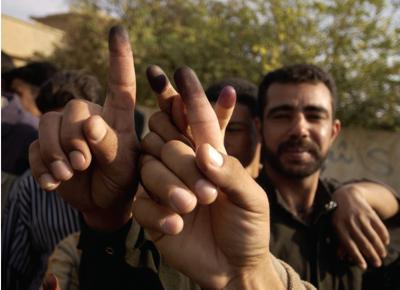
(USAF Photo by TSgt Andy Dunaway, from "On Point II," page 421, used w/o permission)
"Figure 105. Iraqi men proudly show their inked-stained fingers after voting in Hayji, Iraq."

Sometimes, America has been more than simply a good example. For good or ill, The United States of America has, from time to time, gotten very directly involved in the affairs of other countries.

Generally, such American actions have had a devastating effect on dictators and tyrants. Whether or not America has any business freeing people in other countries from the likes of Adolph Hitler, the Taliban, and Saddam Hussein is still hotly debated.

My opinion is that, for all its faults, American is still a land of opportunity: and that freedom is something that the citizenry of all nations should have.


More, at
Update (July 4, 2008)
Freedom of Speech in America: a case in point.
"Protesters Interrupt Bush at Independence Day Ceremony for New Citizens"
FOXNews (July 4, 2008)

"Protesters made it hard to hear President Bush Friday as he welcomed new citizens and marked Independence Day at the home of Thomas Jefferson.

"As is the tradition each Fourth of July, a naturalization ceremony was held at Monticello in Charlottesville, Va. This year, 76 immigrants from 30 different countries came to take the oath of citizenship....

" 'That man is a fascist!' one protester yelled. Another swore at him.

"The protesters later were removed from the ceremony by law enforcement officials.1

" 'To my fellow citizens to be — we believe in free speech in the United States of America,' Bush said when the protesters started shouting.

"To the din of more yelling, Bush discussed Jefferson’s legacy as he introduced the citizens.

" 'We honor Jefferson’s legacy by aiding the rise of liberty in lands that do not know the blessings of freedom, and on this Fourth of July we pay tribute to the brave men and women who wear the uniform of the United States of America,' he said...."

Another news service did a more thorough job of detailing the protester's grievances:

"Bush was heckled several times, with some people yelling 'War criminal!' One man shouted, 'This man has brought fascism to our shores!' About nine people were removed from the ceremony.

" 'Impeach Bush. Impeach Bush. Amend the Constitution,' shouted another protester, prompting both cheers and boos from the audience of about 3,000 people...."
("Bush helps swear in citizens as hecklers shout" CNN (July 4, 2008))
[emphases mine]

I've wondered how many people who yell 'fascist!' at American leaders they don't like know about real fascist leaders.2 Think about it: what would probably have happened to someone who shouted "That man is a Jew!" or "This man has brought Judaism to our shores!" at Chancellor Hitler, at a public gathering?

1That phrase, "removed...by law enforcement officials", doesn't carry the implication of dire consequences that it does in some countries. Those protesters may face legal sanctions for disturbing the peace, and - if they wanted a little more martyrdom, and fussed as they were removed - resisting arrest.

2 The page I linked to, in Best of History Websites, lists a number of pretty good online resources about Hitler, Mussolini, and the mid-twentieth century fascists. It used to have a video showing Adolph Hitler making a speech. The video is gone, replaced with the words, "We're sorry, this video is no longer available."

I understand that someone who had endured the Nazi regime in Germany might not like to watch the Fuhrer, and listen to his words. But I am truly sorry to see that what I trust is a well-meaning censorship has removed evidence that might help people learn what went so horribly wrong.

I was born after the survivors of Dachau and other camps were liberated. But, I've seen and heard speeches of Chancellor Hitler. Remembering the experience is not pleasant, but it taught me to be very cautious about emotion-laden appeals.

Particularly from people who seem to support causes that I like.

Thursday, March 27, 2008

Freedom of Speech: It's Protected in America

There seem to be all sorts of people who follow Islam.
  • Talking about Fitna, a contributor to the Washington-based Islamica Magazine, Arsalan Iftikhar, told CNN that "he doubted the film would spark the same type of violence that followed the caricature of Mohammed, adding, 'We in the global community learned a lot from the Danish cartoon controversy ... I don't think it will be anything remotely like that.' " [emphasis mine] " Dutch lawmaker's film criticizing Islam finds Web host" (March 27, 2008).
  • Then, there's Joseph Cohen. He born in a Jewish family in America, went to an Orthodox Rabbinical school, decided that it was a "racist cult," converted to Islam and started calling himself al-Khattab.
    His website, RevolutionMuslim.com, is discussed in "U.S. Based Revolution Muslim Website Spreading Messages of Hate" FOXNews (March 26, 2008). Content on the website changes rapidly, and has included
    • The Statue of Liberty, with an ax blade cutting through her side
    • Video mocking the beheading of American journalist Daniel Pearl, entitled "Daniel Pearl I am Happy Your Dead :) "
    • Video of a puppet show lampooning U.S. soldiers killed in Iraq
    • The latest speech from Sheikh Abdullah Faisal, an extremist Muslim cleric convicted in the UK and later deported for soliciting the murder of non-Muslims
    He operates his website out of his home in the New York City Borough of Queens, and says he doesn't support terrorism. He also says:
    • 9/11 was an "inside job"
    • U.S. foreign policy is to blame for the 9/11 attacks
    And what he says is free speech, defended by the First Amendment.
    He launched his website with the intention of
    • "Preserving Islamic culture"
    • "Calling people to the oneness of God"
    • Asking people to "support the beloved Sheik Abdullah Faisal, who’s preaching the religion of Islam and serving as a spiritual guide."
Sheik Abdullah Faisal may sound familiar: he's the spiritual leader in the United Kingdom who taught racial hatred and urged his followers to kill Jews, Hindus and Westerners. It seems he broke a law doing this. He was convicted of his crimes in 2003.

I think that al-Khattab's website is, to say the least, distasteful. I also am dubious about his claim that he does not support terrorism. I suppose it depends in part on what he means by the term.

But this is what freedom of speech is about: allowing someone to express his opinions. Even if you don't agree with them; even if they aren't popular in Berkeley, or in Saline, Michigan, for that matter.

Related posts, on censorship, propaganda, and freedom of speech.

Tuesday, September 18, 2007

It's Constitution Day in America

Constitution Day, September 17, 2007.

This is the day Americans, those who know about it, at least, celebrate the anniversary of the signing of the Constitution of the United States of America. This year is the 220th anniversary of the event.

This is part of what the war on terror is about. That Constitution and its amendments spell out how America's government works, what rights,and what responsibilities, we and our representatives have.

So, here's to the oldest, and the shortest, national constitution in the world.

It's not perfect, but it's the best we've got.

Check out "Constitution Day."

Sunday, September 9, 2007

Celebrate Today, or You're a Bigot!

This does not help.

"Participate in Muslim Day Parade in NYC" "Apparently some bigots are continuing on this dehumanization campaign trying to imply that this event is violent. In reality it is a day of family fun, games, contests, and lectures."

What monster could be against something so wholesome?

The next paragraph tells more about this upcoming celebration of diversity and tolerance.

"The New York chapter of the Council on American Islamic Relations (CAIR-NY) today called upon Muslims and all New Yorkers who support diversity, tolerance, and harmony to participate in the 22nd United American Muslim Day Parade scheduled for Sunday, September 9th. The parade aims to bring together various ethnic and religious communities in promoting a better understanding of Islam and fostering interfaith cooperation despite misleading campaigns against it on Islamophobic websites."

The paragraph appears to be quoted from a Council on American-Islamic Relations (CAIR) news release - except for The last phrase, "despite misleading campaigns against it on Islamophobic websites." So far, I can only find that phrase on the "Jihad of Umar" page.

[UPDATE, October 1, 2007 - The Council on American-Islamic Relations (CAIR) has been revised since this post: the above link now is redirected to the CAIR home page.]

One of the "Islamophobic" websites seems to be "Muslim-American Day Parade in NYC Celebrates 9/11 / UPDATE: Attend Muslim Day Parade Counter Rallies Sept.9, 2007 NYC." This is the most hate-filled, Islamphobic, bigoted statement I could find on the page:

"So why is this parade being held on September 9?

"I, for one, am not about to stand together with those who subscribe to an expansionist, totalitarian, enemy ideology that is incompatible with the U.S. Constitution and with the survival of our way of life. And if Bloomberg had any sense, neither would he!"

Apparently, the website is Bloombergophobic, too.

Compare this to the open-minded and tolerant CAIR statement:

"'The rhetorical attacks on the parade are clearly an attempt to demonize and marginalize the American Muslim community,' said CAIR-NY President Omar Mohammedi, Esq. 'Our city prides itself on its diversity. Such bigoted attacks should not be tolerated.'"

As a Dilbert character said, several years ago, about "diversity:" 'de more you have, di verse it gets.' (I've enjoyed living in places where people whose ancestors came from different places, who had different beliefs, and whose home language wasn't necessarily English: but that obviously isn't what "diversity" means, these days.)

Back to the parade.

I understand that CAIR and company had been holding their parade and social bash for several years, before their fellow-Muslims ran two airliners into the New York Trade Center's Twin Towers.

I suppose it is bigoted, in the current sense of the word, to not feel good about CAIR and the merry Muslims carrying on with the parade, despite the thousands of people who were burned, crushed, or sprayed over New York City as Muslims brought down the World Trade Center.

Of course, if crazed Christians had killed thousands of people, and a Christian group carried on with a 'tolerate us!' parade timed to go off two days from the outrage's anniversary, that would be an entirely different matter.

Posts on this general topic:

Friday, September 7, 2007

More Reports on Iraq: Day 2, the Independent Commission Report

First, I've got some philosophizing to get out of my system.

"Ownership or participation in ownership of a publication or broadcasting property is a sacred trust and a great privilege." ("The Standards of Ownership / Nelson Poynter's guide for the ownership of the St. Petersburg Times," August 6, 1947)

I wish that journalism lived up to such high ideals. Then, statements like, "it must be true: it's in the news," wouldn't be so grimly funny.

Even the most believable, perhaps especially the most believable, news reports should be viewed with deferred judgment.

For example: "Everybody knows" how wild and crazy rock bands are, so there's no reason to question news reports from 1981, which stated that Van Halen did thousands of dollars of damage to a New Mexico venue, just because they were given brown M&Ms, and their contract demanded a bowl of M&Ms with the brown ones removed.

According to an autobiography by one of the band members, the brown M&M restriction was there to make sure that promoters of Van Halen concerts actually read the contract. No brown M&Ms meant that a full system check of the facilities was necessary. A place in Colorado had tens of thousands of dollars of damage, because the floor wasn't strong enough to support the V.H. stage equipment.

Now, About the "The Report of the Independent Commission on the Security Forces of Iraq," that I call the General Jones report.

I had a little trouble with the report by General Jones. CBS News didn't name it, but gave this description: "The study, conducted by a 20-member panel led by retired Gen. James Jones, is one of several independent studies Congress directed in May. A copy of the 37-page report was obtained by The Associated Press."

I found a report which was
  • Conducted by a 20-member panel
  • Chaired by General James L. Jones, USMC (Ret.)
  • Directed by Public Law 110-28, enacted May 27, 2007
It didn't have 37 pages, though. The report I found was 153 pages long, including the cover sheet.

Maybe the report "obtained by The Associated Press" was some sort of special summary. It wasn't the "Executive Summary" in the report: that wasn't anywhere near 37 pages long.

Maybe retired General Jones was working with another 20-person panel, on a nearly identical project.

That's not likely.

My working assumption is that the "37-page" part of the CBS News report is one of those little slips that happen now and again, like the Van Halen M&Ms.

As with the GAO report, the report shows that Iraq has problems. Lots of problems.

My original plan, when I thought I'd have 37 pages to deal with, was to look over the whole report, and discuss it.

153 pages is too much for that: I don't have the time, and I doubt that you'd want to sit still, reading what I think about it.

So, after a quick skim, I picked one topic: Corruption.

On page 123, I found "Corruption" as a heading. "Corruption is a serious problem at many land prots of entry. This fact has not yet been adequately addressed," the report said.

Reading on, I think "not yet been adequately addressed" was an understatement. The problem is that the central Iraqi government can't collect tariffs, stop contraband, or expect their Department of Border Enforcement to work properly.

One of the issues seems to be that several Iraqi ministries bump into each other at land ports of entry: and try to out-maneuver each other for a piece of the action.

Then, there's the matter of kickbacks. The Ministry of Interior (MOI) isn't always as helpful as it should be, to put it mildly.

Iraqi and Coalition officials told members of the Commission that "personnel at the border crossings are often discouraged from doing their jobs 'too well,' lest they disrupt lucrative smuggling operations that benefit senior-level officers in the MOI."

To its credit, the Iraqi government has tried to fix the problem, even changing leadership in some areas.

One way of looking at corruption in Iraq is to decide that it's a cultural norm, something which Americans must accept as part of the rich heritage of the region: one mustn't be ethnocentric!

I don't buy that. Although parts of the Middle East have earned a reputation for corruption, they have quite a bit of competition for most-corrupt-country, globally.

A list of Transparency International's CPI, or Corruption Perception Index, is at Rediff.com.

According to the CPI, Finland is the least-corrupt country that was studied, with a score of 9.7 (out of 10). Bangladesh the most corrupt, with a score of 1.3.

Countries more-or-less in the Middle East had a pretty wide range of scores. This list is a sampling, I may have missed some:
  • Israel 7.0
  • Oman 6.3
  • Bahrain 6.1
  • Kuwait 5.3
  • United Arab Emirates 5.2
  • Jordan 4.6
  • Saudi Arabia 4.5
  • Syria 3.4
  • Egypt 3.3
  • Turkey 3.1
  • Iran 3.0
  • Lebanon 3.0
  • Palestine 3.0
  • Yemen 2.6
  • Pakistan 2.5
  • Kazakhstan 2.4
  • Uzbekistan 2.4
  • Iraq 2.2
  • Kyrgyzstan 2.1
  • Azerbaijan 1.8
  • Tajikistan 1.8
(Syria is near the mid-point of the list, a score shared by China, Panama, and Sri Lanka.)

I said before that Iraq has many problems. That doesn't mean that I want to see America, and the other coalition countries which are still involved in Iraq, say, "good luck," and pull out before the wild collection of
  • Decent, patriotic Iraqis
  • Crazed religious fanatics
  • My-tribe-first fossils who didn't notice the rise of nation-states
  • The usual bunch of big-shot wannabes
...have a chance to thrash out a reasonable facsimile of a funcional national government.

I think I've said this before, but it bears repeating. It was 11 years before the American colonies dropped what hadn't been working, and developed the Constitution that America has now. These things take time.

Posts on this topic:

More Reports on Iraq: Day 2, the GAO Report

The Government Accountability Office report, GAO-07-1195, is an update of an a sort of work-in-progress draft released in July, 2007.

I appreciated the table that the new GAO report put, on the third sheet. It's easier to see the overall pattern of the report that way.

The picture isn't rosy, by any means. I've copied the 18 "Benchmarks," and whether they were met or not (according to the GAO), with a GAO comment following. My comments on each are in parentheses.

1. Forming a Constitutional Review Committee and completing the constitutional review.

Not Met


Committee formed but amendments not approved by the Iraqi legislature and no referendum scheduled.

(They haven't thrashed out how much power the president will have, for one thing. I'm not surprised. That's something that's still being debated in Washington.)

2. Enacting and implementing legislation on de-Ba'athification.

Not Met
(not quite)

(Laws drafted. Iraqi Shi'a, and Sunni Arab, and Kurdish, leaders are still working on what to do. Better this, than a quickie get-the-Ba'athists, or amneesty-for-all "solution.")

3. Enacting and implementing legislation to ensure the equitable distribution of hydrocarbon resources of the people of Iraq without regard to the sect or ethnicity of recipients, and enacting and implementing legislation to ensure that the energy resources of Iraq benefit Sunni Arabs, Shia Arabs, Kurds, and other Iraqi citizens in an equitable manner

Not Met
(not quite)

3 of 4 components drafted; none being considered by parliament.

(This one is really complicated: four interrelated points, over a high-value economic prize, involving groups that haven't gotten along very well for the last thirty years, at least.)

4. Enacting and implementing legislation on procedures to form semi-autonomous regions.

Partly Met


Law enacted; implementation scheduled for 2008.

(That's less than 4 months away: And the delay in enactment was built into the law.)

5. Enacting and implementing legislation establishing an Independent High Electoral Commission, provincial elections law, provincial council authorities, and a date for provincial elections.

Partly Met


Commission law enacted and implemented; however, supporting laws not enacted.

(Not bad, nder the circumstances.)

6. Enacting and implementing legislation addressing amnesty.

Not Met


No law drafted.

("No progress" may not be a bad thing here. We're talking about amnesty for the equivalent of Nazi war criminals here, without the heavy-handed bunch of victors with righteous indignation that facilitated the Nuremburg trials.)

7. Enacting and implementing legislation establishing a strong militia disarmament program to ensure that such security forces are accountable only to the central government and loyal to the Constitution of Iraq.

Not Met


No law drafted.

(This is one that I regard as a real problem: You can't run a country, with war bands running around, killing people they don't approve of.)

8. Establishing supporting political, media, economic, and services committees in support of the Baghdad security plan.

Met


Committees established.

(Now, let's hope the committees do something besides have meetings.)

9. Providing three trained and ready brigades to support Baghdad operations.

Partly Met


Forces provided; some of limited effectiveness.

(It could be worse. Of 19 Iraqi units supporting operations in Baghdad; 5 units had performed well; 14, not so much.)

10. Providing Iraqi commanders with all authorities to execute this plan and to make tactical and operational decisions, in consultation with U.S. commanders, without political intervention, to include the authority to pursue all extremists, including Sunni insurgents and Shiite militias.

Not Met


Political intervention continues.

(Isn't that what politicians do? I've gotten the impression that part of the job of politicos is to second-guess military leaders.)

11. Ensuring that Iraqi security forces are providing even-handed enforcement of the law.

Not Met


Iraqi security forces engaged in sectarian-based abuses.

(This is very serious. "In May 2007, the U.S. Commission on International Religious Freedom reported that Iraq's Shi'a-dominated government bears responsibility for engaging in sectarian-based human
rights violations, as well as tolerating abuses committed by Shi'a militias with ties to political factions in the governing coalition." (page 44))

12. Ensuring that, according to President Bush, Prime Minister Maliki said “the Baghdad security plan will not provide a safe haven for any outlaws, regardless of [their] sectarian or political affiliation.”

Partly Met


Militia infiltration of some security forces enables some safe havens.

(There's actually something of a breakthrough here. Sadr City is no longer protected by the Iraqi government from law enforcement and military action.)

13. Reducing the level of sectarian violence in Iraq and eliminating militia control of local security.

Not Met


Militias control some local security; unclear whether sectarian violence has decreased.

(The report seems to treat this as a subheading of Benchmark 7.)

14. Establishing all of the planned joint security stations in neighborhoods across Baghdad.

Met


32 of 34 stations established.

(Looking back at the report's rating of point 5, shouldn't this be a "1"? Only 94% of the security stations are in place! Seriously, this is pretty good work.)

15. Increasing the number of Iraqi security forces units capable of operating independently.

Not Met


Number of independent units declined between March and July 2007.

(This is not good, but the problem seems to be a matter of finding ways to find supplies, and get them to the units. I should think this would be easier to solve than the problem of getting people to stop killing each other over tribal rivalries and religious details.)

16. Ensuring that the rights of minority political parties in the Iraqi legislature are protected.

Met


Legislators' rights protected; minority citizens' rights unprotected.

(This is limited good news.)

17. Allocating and spending $10 billion in Iraqi revenues for reconstruction projects, including delivery of essential services, on an equitable basis.

Partly Met


Funds allocated but unlikely to be fully spent.

(A government not spending money as a problem: that's an idea that takes getting used to.)

18. Ensuring that Iraq's political authorities are not undermining or making false accusations against members of the Iraqi security forces.

Not Met


Unsubstantiated accusations continue to be made.

(Fair enough. False accusations by someone in power is trouble, as the Duke Lacrosse situation showed.)

Okay, that was the GAO report.

I'd have liked to see more of those benchmarks met. On the other hand, and with due respect to the members of Congress, I wonder how well the House and Senate would score, if they an outside agency started looking at their performance?

The GAO report is available at http://www.gao.gov/new.items/d071195.pdf. I'd strongly recommend getting a copy, and comparing what politicos and experts will be saying it says, to what it actually says.

I'm afraid that even the best minds are subject to wishful thinking.

Posts on this topic:

Tuesday, August 14, 2007

UAE, Censorship, Shari'a Law, Freedom: So What?

I learned something about the United Arab Emirates (UAE) today.

An online discussion brought my attention to the UAE, in a roundabout way. A blogger, who apparently lives in the United States, but needs internet connections for the blog, started the discussion with these words:

"anybody noticed today that blogger is down its down for one day and im still waiting any body having the same problem."

Later, after establishing that "blogger" was usable from a couple points in America, Sweden, and the Sultanate of Oman, the blogger wrote this:

"its not opening the website in uae"

Later:

"maybey etisalat blocked it"

Still later, the blogger seemed to have found the problem. "ok guys i knew the probem its all about our damn intenet service provider their name is etisalat they are blocking all the damn websites i dont what the hell is wrong with them my brother computer has a kind of software that can bypass any website but this software does not work in my computer so i asked my brother if i coud use his computer daiy so he said yes i will try to emai this damn etisaat because bogger website has nothing illegal."

I took a look at the website, "Make Money Online with a 12-Year Old Kid." Aside from the rather bright color scheme, I could find nothing objectionable. "Get into the world of making money online with a 12 years old kid that will teach you the best seo tutorials for optimizing your blog or website," is how the blogger describes the site.

Etisalat is the UAE's government-owned Internet provider. Their website shows a professional, family-friendly set of services.

Checking around, I found a GulfNews.com article, "Don't let your child roam the internet aimlessly" (July 27, 2007), quoting a parent with pre-teen children. "At the moment, the Internet connection we have is the Etisalat one and there are processes in place to stop some sites. They filter all the pornographic sites and the sites that could be harmful to children. I have peace of mind here [in the UAE]. In my home country we don't have this filter."

Sounds very nice. I'm the father of four, and I'm concerned about what my children are exposed to, too.

It's been four hours, so far, since that online discussion started. The blogger still doesn't seem able to get past Etilsalat.

Maybe they've got technical difficulties. It happens.

A little more checking about the UAE showed that it's a small country on the Persian Gulf, relatively wealthy, with a president, and what looks like a good, constitutionally-guaranteed set of human rights. The UAE even has a "moderate foreign policy."

Then, there's what the U.S. Department of State wrote about the UAE, regarding their 2006 human rights behavior.

"Authorities do not commonly screen private correspondence; however, there have been reports of censorship of incoming international mail. The government-owned Internet provider, Etisalat, regularly blocks internet sites that censors determine to be "objectionable" (see section 2.c.)."

"Make Money Online with a 12-Year Old Kid" hardly seems "objectionable," unless a 12-year-old talking about search engine optimization and making money is wrong. Of course, there is that rather loud black-and-yellow design.

More excerpts from the same U.S. State Department page about UAE's human rights practices in 2006:

"The constitution prohibits torture, and there were no reports that government officials employed it; however, courts applying Shari'a (Islamic law) sometimes imposed flogging sentences on both Muslims and non-Muslims as punishment for adultery, prostitution, consensual premarital sex, and for pregnancy outside of marriage. On March 13, a R'as al-Khaimah court sentenced a woman to five years and 150 lashes for adultery, and on June 11 a man was sentenced to be stoned to death for adultery with a maid. The law allows for capital punishment, and, unlike in previous years, capital sentences were carried out." (Emphasis mine.)

"The constitution provides for freedom of speech and of the press; however, the government restricted these rights in practice. The government drafts all Friday sermons in mosques and censors private association publications (see section 2.c.). The law prohibits criticism of the rulers, and from acts to create [!] or encourage social unrest." (Emphasis mine.)

And, "Internet Freedom

"The government restricted access to some Web sites on the Internet. Internet chat rooms, instant messaging services, and blogs were monitored. Individuals and groups engaged in peaceful expression of views via the Internet, including by email, without reports of government prosecution or punishment, although there was self-censorship apparent in many chat rooms and blogs." (Emphasis mine.)

I'm all for being tolerant and open-minded, but I'm not sure I like what I see in the UAE. They seem to have constitutional guarantees of human rights, and think that under Shari'a (Islamic law) it's okay stone a man to death for fooling around with a maid. I don't approve of adultery myself, but that seems a little harsh.

I know: it's not my country, and (following, for a very brief moment the principle of moral equivalence) if I can tolerate someone being forced to cover a provocative T-shirt, how can I possibly criticize monitoring chat rooms, blocking websites that a censor doesn't like, or stoning a guy for making out with a maid?

I may not have any business, criticizing the UAE's human rights scorecard.

But I do believe that there's something important to think about here. There will be terribly important decisions made in the next year or so, and I'm pretty sure that some people will question whether it is important to stop Islamic fanatics who want to impose their beliefs, and their laws, on us.

Given what's been going on in the United Arab Emirates, a "moderate" Islamic state, which would you rather live under: UAE rules, or USA rules?

Sunday, August 5, 2007

FISA Updated: for a Limited Time Only

I suppose that "half a loaf is better than none." Congress has given law enforcement a little more leeway, temporarily, in how they find out who's going to have a shot at killing Americans again. The bill's last stop is the White House, where President Bush has said he'll sign it.

The FISA (Foreign Intelligence Surveillance Act) bill will "expand the government's abilities to eavesdrop without warrants" when communications between foreign suspects pass through the United States.

FISA dates from 1978, and apparently hasn't been overhauled until now. Reviews of U.S. intelligence-gathering rules following the 9/11 attacks made Congress aware of FISA and how poorly it addressed technologies like cell phones and e-mail that had developed in the last thirty years.

Acting with the speed and resolve that I have become accustomed to, a version of FISA that recognizes the last three decades of changes information technology finally passed through congress.

Predictably, the ACLU doesn't want FISA updated.

Also predictably, "privacy" was a concern for many of our leaders. Excerpted from a ZDNet article:
"Can you assure us that no one is being eavesdropped upon in the United States other than someone who has a communication that is emanating from foreign soil by a suspected terrorist, al-Qaida or otherwise?" Sen. Joseph Biden, a Delaware Democrat, asked at one point early in the daylong hearing.

Some of the meaningful debate was about due process for communications intercepts. I appreciate the need for, and value of, due process.

What I question is whether in is wise to risk people's lives while a judge gets around to reading a request for a search warrant: and then risking that the request will be denied because of some weird connection to something in the Constitution. (Since the 4th Amendment may be boring in this connection, how about citing the 1st? Quite a few jihadists are religiously motivated, after all.)

Despite these concerns, the House agreed to give law enforcement a little leeway in monitoring terrorists: by a vote of 227-183. For six months. Then it's back to 1978.

That time limit was the Republicans' idea. Democrats wanted the bill limited to four months.

I wish that Congress would ease up on protecting us from the police, and pay more attention to protecting us from terrorists.

Wednesday, July 25, 2007

Professor Ward Churchill: 9/11 Truthteller, or Nincompoop?

Active response to jihadist attacks on this country began in earnest with the 9/11 attacks. That may be one reason why so many opponents of the War on Terror focus on the 9/11 attacks, either calling them justified, or denying that they were made by terrorists or jihadists.

Those who believe that the United States of America has no right to defend itself against alleged terrorists now have a martyr of sorts: professor Ward Churchill, who accused victims of the 9/11 attacks of bringing the attacks on themselves.

He's a martyr some of them may not want.

Ward Churchill's academic offense, according to everything that's filtering out from the University of Colorado at Boulder, was lying: and writing books under an assumed name so that he could cite them in his own scholarly works.

It's 'obvious' that professor Ward Churchill's firing was a violation of his free speech rights.

Or maybe not.

Representative Mark Udall, Colorado Democrat, assured readers of the Rocky Mountain News that controversial views, and those who hold them, will find a safe haven in his state's universities.

Also a salary that's nothing to sneeze at. Churchill will collect one year’s salary of $96,392 as severance pay, according to Rocky Mountain News.

Back to Rep. Udall. He's all for academic freedom, but said that professor Churchill got in trouble because of his academic misconduct.

"But Ward Churchill’s actions have gone far beyond giving voice to reprehensible points of views," he said. "As much as Ward Churchill would like us to believe otherwise, today’s dismissal is about his academic conduct. It is a shame that Ward Churchill still tries to deny the disservice he has done to CU by claiming the university is interfering with his right to free speech." (Rocky Mountain News, "CU regents fire Ward Churchill" July 24, 2007)

I agree with Representative Udall on this. Professors are paid to make outrageous, insane, ludicrous proclamations. And then, try to back them up with something with at least a passing resemblance to truth.

Professor Churchill failed to live up to this high ideal.

Now that his firing is official, professor Churchill is becoming a victim.

One post identified professor Churchill as "cause celebre of the hysterical right."

Another posted a well-written piece, defending what he calls "academic freedom." "All that has been proven is that Churchill made some dubious claims in his writings without any real evidence, and that he engaged in ghost writing for some other academics," he wrote This blogger called professor Churchill's academic faux pas "appalling," but he believes that a professor of Churchill's caliber shouldn't be fired.

And one blogger, with a keen perception of how a group can be discredited by an excessively-enthusiastic member, posted, "Churchill is not a 9/11 truthteller, and he doesn't speak for me." This blogger goes on to say, "Comparing the victims in the World Trade Center to nazis (!) is both offensive and idiotic, and Churchill never even discussed the fact that the 9/11 attacks were allowed -- or made -- to happen by elements within the U.S. government."

I'm waiting for someone to declare that professor Ward Churchill was forced or maneuvered into the position of writing his 2001 essay, and 2003 book. 'Obviously,' he is being used as a tool to discredit all the folks who know that 9/11 was somehow or other a fake.

One thing that's struck me about conspiracy theories is how mediocre they are. Honestly: "elements within the U.S. government?" I've heard phrases like that for decades. I would have expected someone to come up with something more imaginative, after all these years.

I strongly recommend reading this article in the Rocky Mountain News, CU regents fire Ward Churchill (July 24, 2007). In addition to other detail, this article quotes people whose work, in the view of the U of C, Boulder, was "mischaracterized by Churchill."

Tuesday, July 24, 2007

Professor Ward Churchill: Victim of Neocons, or Plagiarist?

Ethnic studies professor Ward Churchill is out of a job, at least for now.

Professor Ward Churchill achieved national fame in September of 2001, when he wrote an essay titled "Some People Push Back: On the Justice of Roosting Chickens" in which he compared "technocratic corps at the very heart of America's global financial empire" working in the World Trade Center as "little Eichmanns," a professorial quote taken from a Wikipedia article.

In 2003, Professor Churchill wrote a prize-winning book entitled "On the Justice of Roosting Chickens: reflections on the consequences of U.S. imperial arrogance and criminality" (ISBN 1-902593-79-0). (Again, thanks to Wikipedia for bringing this information together.)

A Denver Post headline in today's paper announces another milestone in professor Churchill's career: "CU regents vote to fire Churchill" (also published online in the Post's "movies" folder).

The Post gave a number of views on the firing. The paper quotes Emma Perez, associate professor of ethnic studies: "I'm disappointed because the University of Colorado and the regents have succombed (!) to the political agenda of the neo-conservatives."

It's true that U of C, Boulder, was encouraged to take a closer-than-usual look at Professor Churchill and his work after he wrote that essay, comparing some of the 9/11 victims to Nazi leaders.

The free-speech aspect of the colorful ethnic studies professor was dealt with early. An Associated Press article, repeated on the FOXNews.com pages, said, "Churchill's essay mentioning Sept. 11 victims and Nazi leader Adolf Eichmann prompted a chorus of demands for his firing, but university officials concluded it was protected speech under the First Amendment." (Emphasis is mine.)

Professor Ward Churchill was, and is, perfectly within his rights to call the people whose bones are still being picked out of New York City's hair Nazis. The freedom to say outrageous things is guaranteed by the Constitution.

I doubt, however, that we'll be hearing much about the way the university went to bat for his right to call terrorism victims Nazis.

According to the Denver Post, David Lane, Churchill's lawyer, said:
"...'I told them (the regents) we are at a crossroads, and that they will do irreparable damage to academic free speech if they fire him.

"The world will perceive that he was fired for his free speech.'...
"
(Denver Post)
That's likely enough. The actual reasons for his firing were much more prosaic, and don't reflect well on the politically correct parts of the academic world.

Even today, academic professionals are expected to tell the truth, and not claim credit for what someone else did. Professor Ward Churchill had earned a reputation for telling scholarly whoppers, and plagiarizing the works of others.

All in a good cause, I'm sure.

Buried much deeper in the Denver Post article were a few paragraphs that discussed the academic reasons for Churchill's firing.

(Warning: some of what follows violates what "everybody knows" on at least some college campuses.)
"...It soon became clear that Churchill's scholarship had been questioned for years by other professors. Thomas Brown of Lamar University in Texas had long challenged Churchill's assertion that early European settlers of North America had intentionally spread smallpox among Indians by handing out infected blankets.

"Eventually, other revelations about Churchill became public, including that his hiring bypassed most of CU's normal processes for awarding tenure and that he had no proof of his claimed American Indian ancestry, which was the foundation of his hiring.

"Ultimately, a CU faculty committee charged Churchill with inaccurately describing historical facts in some of his writings - including the smallpox case...."
(Denver Post)
(I'll get back to the "smallpox case" momentarily.)

The FOXNews.com article goes into rather more detail, but both the Denver Post and AP seem to agree on the basics.

Churchill was accused of plagiarism, falsification and other things that professors shouldn't do, by three faculty committees.

These "research allegations" go back to other learned writings made by Churchill. His "September 11" essay is involved only in that it raised such a stink that U of C, Boulder, was forced to take a serious look at the ethnic studies professor's work.

"The decision was really pretty basic," said university President Hank Brown in the AP article. President Brown added that the school had little choice but to fire Churchill to, in the words of the Associated Press, "protect the integrity of the university's research."

"The individual did not express regret, did not apologize, did not indicate a willingness to refrain from this type of falsification in the future," Brown said.

The falsification mentioned is a bit of academic mythology which I first encountered some time during the 1970s. At that time, "everybody knew" that American Indians were deliberately killed off by smallpox-infected blankets.

The AP article says, in part:
"...Brown had recommended in May that the regents fire Churchill after faculty committees accused him of misconduct in some of his academic writing. The allegations included misrepresenting the effects of federal laws on American Indians, fabricating evidence that the Army deliberately spread smallpox to Mandan Indians in 1837, and claiming the work of a Canadian environmental group as his own...."
(Associated Press)

All of that is rather boring, though. I expect that by the time I get this post finished, about 10:40 pm Central time in the States, tales of political oppression, neocon plots, and the total loss of freedom of speech will be the crisis du jur for many netizens.

In the news:

Friday, July 20, 2007

Senators, Secrets, and Sides: Loose Lips and Politics

The fuss over a New York Senator's request for details of the Pentagon's Iraq withdrawal plans is still in the news, and probably will be for quite a while. Senator Clinton even offered to have the troop deployment plans handed over in a secret meeting.

So far, the Pentagon hasn't cooperated.

Members of Congress playing politics with national security is nothing new. Unhappily, Members of Congress having trouble at keeping secrets is nothing new, too. Other people's secrets, anyway.

Back in the 80s, a senator from Vermont earned the title "Leaky" Leahy, and was forced to resign from his Intelligence Committee post: just because he released classified information during that little Achille Lauro misunderstanding.

Senator Rockefeller, of West Virginia, kept his family name in the forefront of public affairs when he announced the existence of a secret spy program, back in 2004 ("Lawmaker Says Mystery Spy Project 'Dangerous To National Security'," 12/9/04, AP, Katherine Pfleger Shrader). By implication, he was referring to national security of the USA.

What makes this quarrel interesting is a Pentagon aide who charged that the Senator's questions about Iraq withdrawal planning would help the enemy.

A spokesman for the senator said: "We sent a serious letter to the Secretary of Defense, and unacceptably got a political response back."

For once, I'm in agreement with something coming out of the New York Senator's office.

I do believe that this quarrel over letting a Senator get classified information is political, on both sides, at least in one sense of the word.

The New York Senator, in addition to a Congressional duty to examine information, has a reasonable interest in appearing active and concerned in national and international affairs. As a presidential candidate, she'd be foolish not to do what she can to 'look presidential.'

The Pentagon has a sort of political interest in plans for troop movement. This nation's military leaders, perhaps understandably, not only want to keep as many American soldiers from being killed as possible, but are required to maintain the existing power structure in the United States of America.

"Political" has been defined as being "of or relating to your views about social relationships involving authority or power." In this country, the "social relationships involving authority or power" involve a government which is run along the lines of a constitution which, among other things, guarantees the right to discuss matters involving national policy.

By this definition, the Pentagon's efforts to protect the United States of America and its government institutions is "political."

The Pentagon is clearly on the side of those who would prefer to keep the system we have, where people are allowed to disagree with those in power, and engage in debates without the approval of their leaders.

People involved in organizations like al Qaeda, the Taliban, and the Army of Islam sincerely believe that a free and open society like ours is utterly unacceptable, and must be wiped from the face of the earth.

I'm not quite sure where some of our leaders stand, judging from their track records of releasing classified information: information that would most likely hurt the United States and help those who prefer a more orderly and culturally unified society.

Geoff Metcalf's 2005 column, Congressional Intelligence Leaks, takes a rather colorful look at Capitol Hill's leaky minds.

Wednesday, July 18, 2007

The Senate, Military Funding, and Iraq

Showing the sort of leadership we've come to expect over the last few months, the United States Senate pulled an all-nighter, and failed to pass military funding authorization in wartime.

The defense authorization bill that didn't pass would have included
  • Pay raises for service members
  • Missile defense programming
  • Rules on habeas corpus rights for Guantanamo Bay detainees
  • Equipment development plans
My hat's off to one of the major political parties. Even though they failed in their objective, they made a valiant effort to snatch defeat from the jaws of victory.

The desire to end U.S. involvement in Iraq is understandable. It's been about four years now, and apart from
  • Removing a brutal dictator
  • Rebuilding much of the infrastructure neglected under his rule
  • Removing the dictator's enforcers and launching a civilian police force in their place
  • Re-training Iraqi armed forces for something other than genocide and pillaging operations and
  • Helping Iraqi leaders build a working government while under fire from religious fanatics
...not much has been achieved in Iraq.

I wonder how many people remember that it took 11 years for the United States of America to move from the Articles of Confederation to the start of the Constitution we're using now?

There are times when I feel that there should be a Chamberlain Committee to award the "Peace for Our Time" medal to those who excel at ignoring the big picture.

Yes, I'm biased.

I don't think that religious fanatics who were trying to kill us before 9/11 will stop because we abandon a country with which were were not closely involved before 2001.

I don't think people who sincerely believe that their god wants them to kill people who don't follow their rules will stop because the United States decides to get out of their way.

I don't think that it is reasonable to expect this struggle between one segment of Islam and everyone else will end soon. I would be astonished if this conflict took less time to resolve than the seven decades during which the Soviet Union absorbed much of eastern Europe, threatened the rest of the world, and provided some self-described deep thinkers a shining beacon of hope in a competitive world.

Back to the U.S. Congress.

I'm being a bit unfair, of course. The U.S. Congress has one recent achievement to its credit. Together, the houses of Congress have managed to not only score lower than President Bush in job approval, but to outdistance the president in job disapproval as well:

Job Approval:
25.0% Congress
33.0% President

Job Disapproval:
66.0% Congress
62.8% President

(from Real Clear Politics for Presidential and Congressional numbers, reported on Fox News)

Another issue that came up in the recent Congressional mess was the use of earmarks. These convenient little dodges are another topic - and one that I won't get into. At least, not now.

Thursday, July 12, 2007

Iraq, Congress, and the Initial Benchmark Assessment Report

Or, Snatching Defeat from the Jaws of Victory
Or, There's Nothing so Lovely as Surrender in April.

As usual, Iraq is in the news.

According to what I read in the news, the Malachi government in Iraq got a "satisfactory" rating on only 8 of 18 "benchmarks", mixed reviews for 2 more, and for the 8 remaining, in an interim report: the Initial Benchmark Assessment Report.

The report I read had a different count:
  • 9 benchmarks met: (i), (iv), (viii), (ix), (xii), (xiii), (xiv), (xvi), (xvii)
  • 7 benchmarks not met: (ii),(iii), (vii), (x), (xi), (xv), (xviii)
  • 2 benchmarks with a mixture of achieved and unachieved goals: (v), (vi).)
Here's the report, in pdf and html format, from the White House.

The current administration, trying to help leaders in Iraq set up a working government after over 30 years of a selfish tyrant's mismanagement, decided to increase the number of U.S. troops in Iraq. These soldiers were going to wage war on al Qaeda in Iraq, and anyone else who wanted to overthrow or disrupt the Iraqi government.

This has been called a "troop surge." Actually, the current strategy is called "the New Way Forward."

The last deployment of the U.S. troops involved in the "surge" arrived in Iraq just a few weeks ago.

According to the White House report, this "strategy -- the New Way Forward -- recognizes that the fulfillment of commitments by both the U.S. and Iraqi Governments will be necessary to achieving our common goal: a democratic Iraq that can govern, defend, and sustain itself, and be an ally in the War on Terror."

There's already progress. Limited progress, but progress.

The report says, "Tough fighting should be expected through the summer as Coalition and Iraqi Forces seek to seize the initiative from early gains and shape conditions for longer-term stabilization. These combined operations -- named Operation Phantom Thunder -- were launched on June 15, 2007, after the total complement of surge forces arrived in Iraq. The full surge in this respect has only just begun."

With a three-week-old major offensive showing limited progress, together with efforts at political reconciliation at the national, provincial, and local level, Iraq has a chance at getting a working government. A good chance, according to the White House.

Faced with the imminent threat of military and political success in Iraq, the United States House of Representatives acted with a decisiveness seldom seen on Capitol Hill.

A headline in the Washington Post says it well: House passes bill to withdraw troops from Iraq.

The measure, which passed a few hours ago, would have the Pentagon start withdrawing troops within four months, with all but a token force of 10,000 out of Iraq by April 1 of next year. The skeleton crew left behind would "train Iraqi soldiers, conduct counter-terrorism operations and protect U.S. diplomats."

al Qaeda and all the others who don't like U.S. efforts to help Iraq have been reassured by the House of Representatives. If they hunker down and survive until April of next year, they can enjoy a victory that will make the evacuation of Saigon, back in 1975, look like a tea party. Come to think of it, Saigon fell in late April, 1975, roughly April 27-30.

About the slow political progress in Iraq, the report says that there is "increasing concern among Iraqi political leaders that the United States may not have a long term-commitment to Iraq."

In other words, the Iraqis who are trying to put their country back together were worried that U.S. political leaders would do exactly what they did do.

The House of Representatives' notion of peacemaking goes to the Senate next. What they'll do, with 2008 elections coming up, is anyone's guess.

I sincerely hope that this nation's leaders are not putting polls and their own campaign plans above the good of the people who live in this country.

Whatever Congress decides, and whatever their motives, the odds are that they'll get to have their elections in 2008. November is only 7 months after April.

*-*-*-*-*

My academic and business experience has taught me that it's best to read original documents: not what someone says the original documents say. The only place, aside from the White House website, that I found a link to the White House report was the Fox Newsarticle.

Here's my summary of what the "Initial Benchmark Assessment Report" of July 12, 2007, says about the benchmarks.

The report itself is useful, if somewhat tedious, reading. (Available at the White House site, in pdf and html format).

  • (i) Forming a Constitutional Review Committee and then completing the constitutional review.
    * satisfactory progress

  • (ii) Enacting and implementing legislation on de-Ba’athification reform.
    * unsatisfactory

  • (iii) Enacting and implementing legislation to ensure the equitable distribution of hydrocarbon resources to the people of Iraq without regard to the sect or ethnicity of recipients, and enacting and implementing legislation to ensure that the energy resources of Iraq benefit Sunni Arabs, Shi’a Arabs, Kurds, and other Iraqi citizens in an equitable manner.
    * unsatisfactory, but it is too early to tell whether the Government of Iraq will enact and implement legislation to ensure the equitable distribution of hydrocarbon resources to all Iraqis.

  • (iv) Enacting and implementing legislation on procedures to form semi-autonomous regions.
    * satisfactory progress

  • (v) Enacting and implementing legislation establishing an Independent High Electoral Commission, provincial elections law, provincial council authorities, and a date for provincial elections.
    * Multiple components to this benchmark, each deserving its own assessment:

    • Establishing the IHEC Commission:
      * satisfactory progress

    • Elections Law:
      * unsatisfactory progress

    • Provincial Council Authorities:
      * unsatisfactory progress

    • Provincial Elections Date:
      * unsatisfactory progress

  • (vi) Enacting and implementing legislation addressing amnesty.
    * hard to say -- prerequisites for a successful general amnesty are not present; however, in the current security environment, it is not clear that such action should be a near-term Iraqi goal

  • (vii) Enacting and implementing legislation establishing a strong militia disarmament program to ensure that such security forces are accountable only to the central government and loyal to the constitution of Iraq.
    * prerequisites ... are not present.

  • (viii) Establishing supporting political, media, economic, and services committees in support of the Baghdad Security Plan.
    * satisfactory progress

  • (ix) Providing three trained and ready Iraqi brigades to support Baghdad operations.
    * satisfactory progress

  • (x) Providing Iraqi commanders with all authorities to execute this plan and to make tactical and operational decisions in consultation with U.S. Commanders without political intervention to include the authority to pursue all extremists including Sunni insurgents and Shiite militias.
    * unsatisfactory progress

  • (xi) Ensuring that Iraqi Security Forces are providing even-handed enforcement of the law.
    * unsatisfactory progress

  • (xii) Ensuring that, as Prime Minister Maliki was quoted by President Bush as saying, "the Baghdad Security Plan will not provide a safe haven for any outlaws, regardless of [their] sectarian or political affiliation."
    * satisfactory progress

  • (xiii) Reducing the level of sectarian violence in Iraq and eliminating militia control of local security.
    * satisfactory progress

  • (xiv) Establishing all of the planned joint security stations in neighborhoods across Baghdad.
    * satisfactory progress

  • (xv) Increasing the number of Iraqi security forces units capable of operating independently.
    * unsatisfactory progress

  • (xvi) Ensuring that the rights of minority political parties in the Iraqi legislature are protected.
    * satisfactory progress

  • (xvii) Allocating and spending $10 billion in Iraqi revenues for reconstruction projects, including delivery of essential services, on an equitable basis.
    * satisfactory progress

  • (xviii) Ensuring that Iraq’s political authorities are not undermining or making false accusations against members of the ISF.
    * unsatisfactory progress

Saturday, July 7, 2007

Freedom, Foolishness, and the Fourth

On Independence Day (U.S. - July 4), in another blog, I posted the last sentence of the Declaration of Independence of the United States of America, and the names of the people who signed it.

The flame that followed didn't last much more than 24 hours, but it was impressive.

Not much later, in a blog started by someone else, on Freedom, one of the advocates of absolute freedom proposed the following argument. (Aside from bleeping some of the more adult, sophisticated, and mature statements, it is unabridged, copied directly from the original blog comment.)
"The state does not have the right to regulate 'shouting "Fire!" in a theater'.

"This is the oldest and most widely used sophistry of those who would abridge freedom speech as dfined in the First Amendment.

"Would you like to hear the full argument?

"Sorry, I no longer have the time or the interest in playing that game.

"The authoritarians who would abridge the full and clear meaning of the Bill of Rights are invited to play with themselves.

"It will all come out in the wash.

"S**** you and your 'God' too.

"Oh yeah, and lest I forget, and shut the f*** up and turn in your guns."
(source not available)
I'm sharing this as an example of the sort of freedom of expression that we enjoy in this country. In addition to the fellow who writes in slogans and epithets, there were a variety of well-thought-out arguments, some of which were not in agreement with current federal policy.

That sort of discussion isn't possible everywhere in the world, at least not with any degree of safety. There's a joke from the Cold War that can be dusted off and re-written to illustrate the point:

An American and an Iranian were discussing freedom of speech in their countries. The American said, "we are free to speak our mind here. I could stand in the middle of the Mall of America, and shout 'I think the American president is an idiot!' The Iranian replied, "we are just as free to speak our minds. I, too, could stand in the middle of the Tehran flower market and shout 'I think the American president is an idiot!'"

The War on Terror might also be called the War for Freedom. People like Osama bin Laden, Ayman al-Zawahri and Sheikh Hamed al-Ali; and groups like Al Qaeda, Fatah al-Islam and Hezbollah, all have one thing in common.

They, like Iranian president Ahmadinejad, believe that Islam should rule the world. Their brand of Islam, of course. Judging from what the Taliban did to Afghanistan, I would rather not see that happen.

Ahmadinejad makes his beliefs very clear, saying, "every problem we [Iranians] have will be solved by global Islamic rule" and "we must prepare ourselves to rule the world." These claims are both chilling, and remarkably difficult to find in traditional news sources.

I'd better make it clear that I hope, sincerely, that the 'rule the world' branch of Islam has the same relationship to Islam as a whole that the KKK did to Christianity, back in the sixties. Our problem is that today's Jihadists have power that the KKK could only have dreamed of.

Back to freedom.

Independence Day is a day for people in the States to get outside, grill at least one meal, set off or watch fireworks, and enjoy a day or two off. It's also a day to celebrate the signing the Declaration of Independence, when representatives from thirteen colonies laid out exactly why they would no longer be tied to England.

In this country, we celebrate Constitution Day on September 17. That holiday doesn't draw anywhere near as much attention, although it is the Constitution and its amendments, as interpreted by the Supreme Court, that determine how, and to what extent, we enjoy our freedom.

Back to the War on Terror.

It is important to remember that the War on Terror is an effort to keep crazed religious fanatics from committing mass murder. It's also an effort to keep them from setting up a theocracy that would make liberals' fears of the Bush administration seem like a welcome relief.

The other side of this coin is that the struggle against the Islamic jihad is a struggle for freedom. People in this country have gotten used to being able to speak their minds, to play soccer if they feel like it, and wear a wide variety of clothing.

It would be a shame if we lost that.

By the way: although about nine weeks, by my reckoning, separate Independence Day and Constitution Day (aka Citizenship Day), it took over 11 years (1776-1787) for the government of the United States to have its basic structure hammered out. And we're still arguing about how it should work.

Now, about half-way through the weekend after Independence Day, I think it would be appropriate to remember how the Declaration of Independence ends, and the people who took enormous risks so that those who followed them could disagree with the powers that be, and live to complain about how they were treated:

"And for the support of this Declaration, with a firm reliance on the protection of divine Providence, we mutually pledge to each other our Lives, our Fortunes and our sacred Honor.

[signed]

Georgia: Button Gwinnett; Lyman Hall; George Walton

North Carolina: William Hooper; Joseph Hewes; John Penn

South Carolina: Edward Rutledge; Thomas Heyward, Jr.; Thomas Lynch, Jr.; Arthur Middleton

Massachusetts: John Hancock

Maryland: Samuel Chase; William Paca; Thomas Stone; Charles Carroll of Carrollton

Virginia: George Wythe; Richard Henry Lee; Thomas Jefferson; Benjamin Harrison; Thomas Nelson, Jr.; Francis Lightfoot Lee; Carter Braxton

Pennsylvania: Robert Morris; Benjamin Rush; Benjamin Franklin; John Morton; George Clymer; James Smith; George Taylor; James Wilson; George Ross

Delaware: Caesar Rodney; George Read; Thomas McKean

New York: William Floyd; Philip Livingston; Francis Lewis; Lewis Morris

New Jersey: Richard Stockton; John Witherspoon; Francis Hopkinson; John Hart; Abraham Clark

Transcripts of the Declaration of Independence of the United States of America, the Consttitution of the United States of America, Amendments 1 through 10 (the Bill of Rights), and
Amendments 11-27 are available online.

On a more contemporary note, Jonathan D. Halevi's Al-Qaida's Intellectual Legacy: New Radical Islamic Thinking Justifying the Genocide of Infidels is interesting, if dry, reading. He's biased, though, since he's an infidel.

Unique, innovative candles


Visit us online:
Spiral Light CandleFind a Retailer
Spiral Light Candle Store

Blogroll

Note! Although I believe that these websites and blogs are useful resources for understanding the War on Terror, I do not necessarily agree with their opinions. 1 1 Given a recent misunderstanding of the phrase "useful resources," a clarification: I do not limit my reading to resources which support my views, or even to those which appear to be accurate. Reading opinions contrary to what I believed has been very useful at times: sometimes verifying my previous assumptions, sometimes encouraging me to change them.

Even resources which, in my opinion, are simply inaccurate are sometimes useful: these can give valuable insights into why some people or groups believe what they do.

In short, It is my opinion that some of the resources in this blogroll are neither accurate, nor unbiased. I do, however, believe that they are useful in understanding the War on Terror, the many versions of Islam, terrorism, and related topics.