I ran into this last night:
"Charges: Woman attacked non-English speaking Applebee's diner"Managers at Applebee's tried to get Burchard-Risch to leave at that point. She did: after yelling a bit more at the other diner and using her beer mug as a weapon, hitting the other woman's face.
KARE 11 Staff, KARE (November 5, 2015)
"A woman is charged with assault for allegedly smashing a beer mug across a diner's face at a local Applebee's -- all because the victim wasn't speaking English, according to the complaint.
"Jodie Marie Burchard-Risch, 43, was charged with third-degree assault for an incident that occurred on Oct. 30 at the Applebee's in Coon Rapids.
"According to the criminal complaint, Burchard-Risch was dining with her husband when she became upset after hearing the victim speaking in a foreign language in the neighboring booth...."
One of Applebee's managers followed Burchard-Risch out of the restaurant, staying with her until responding officers arrested her.
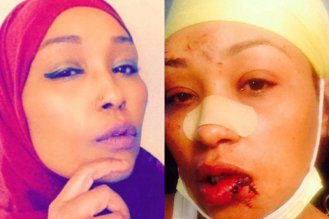
The victim has a deep cut across her nose; a cut on her right eyebrow and a big, deep, cut on her lower lip. That's bad, but it could have been worse. Apparently her eyes are okay, and she probably got medical attention promptly.
Burchard-Rish was charged Monday: and there may be more legal trouble coming.
Hate Crimes and Attitudes
 I'm not a big fan of hate crime/bias-motivated crime laws, mostly because I think they wouldn't be needed if America's courts paid attention to earlier legal sanctions against slander and physical violence.
That said, I think this attack looks a lot like a 'hate crime.'
The violence of the attack encouraged my suspicion that the 'non-English' language would be Arabic or Spanish. I was wrong. The victim was speaking Swahili:
"Attack on diner at Coon Rapids Applebee's being examined for hate-crime charges"At this point, I could start ranting about the dangers of insufficiently-American foreigners, the need for beer mug control laws, or why restaurants breed violence and obesity.
"The victim, targeted because she wasn't speaking English, suffered deep cuts on her face in the beer-mug attack, according to assault charges."
Shannon Prather Star Tribune (November 7, 2015)
"An Anoka County prosecutor said Friday that authorities are looking into possible hate-crime counts against a woman charged with attacking a diner at the Coon Rapids Applebee's because she was speaking Swahili.
"The victim suffered deep cuts to her face when she was struck with a beer mug Oct. 30 as she ate lunch with her husband and friends, Anoka County authorities said this week.
"Jodie Burchard-Risch, 43, of Ramsey, was charged Monday in Anoka County District Court with third-degree assault.
"On Friday, the Minnesota chapter of the Council on American-Islamic Relations (CAIR-MN) called for hate-crime charges against Burchard-Risch...."
That would be silly — but no more silly, I think, than many political debates. And that's another topic.
 I'm not a Swahili-speaking young woman, so why should I care what happened in that restaurant?
For starters, I don't think 'my end of the boat isn't sinking' makes sense in situations like this. If I don't care when folks who aren't just like me get hurt, I can't reasonably expect sympathy if I'm the next target.
I don't fit today's 'victim' stereotype, but some 'real Americans' might see folks like me as a threat to 'their' country.
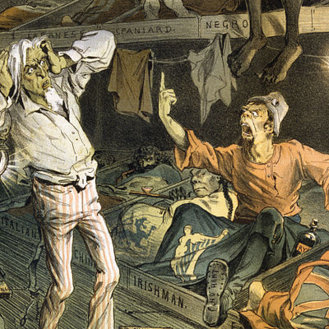
I look like a WASP, but I'm not. I'm a half-Irish Catholic. Happily, most Americans have realized that many Irishmen aren't violence-prone drunkards with criminal tendencies.
I've discussed attitudes, bias, and internment camps, before. (A Catholic Citizen in America June 21, 2015; Another War-on-Terror Blog September 12, 2009; January 22, 2009)
Avoiding Hasty Generalizations
 I've seen a few folks who might speak Swahili in the small central-Minnesota town I call home, but I haven't heard that language here — apart from someone saying the Lord's Prayer in Swahili at the parish church.
I have, however, heard Spanish more frequently in recent years: mostly while standing in a grocery checkout line: and, rarely, an east-Asian language I didn't recognize.
My lack of violent response to these 'foreign threats' is no virtue. I see new families moving in as a sign that my town is in good shape, and likely to endure: at least for another generation or two.
Besides, as an American, I'd be very concerned if folks weren't pulling up stakes and moving here.
Maybe it's easier to divide the world into 'people like me' and 'foreign threats.' But that attitude doesn't make sense. Not to me.
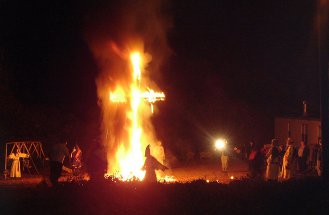
Sure, some folks who speak Swahili, Arabic, Spanish, or Latvian, might try to blow up the post office or kill me. But but assuming that all Africans, Arabs, Hispanics, or whatever, are threats that makes about as much sense as assuming that all Christians are in the Ku Klux Klan. And that, sadly, is not another topic. (A Catholic Citizen in America January 18, 2015)
Living with difference:
- "Charleston Church Shooting: Emotions and Reason"
A Catholic Citizen in America (June 21, 2015)
Particularly - "Remembering 9/11, Living in a Big World"
A Catholic Citizen in America (September 11, 2014)
Particularly - "Holy Land Foundation Sentencing: It's About Terrorism, Not Islam"
(May 27, 2009)
Particularly - "Muslim Family Talks Safety, Gets Booted From Flight"
(January 2, 2009)
Particularly - "Al Aqaeda Leader's "House Slave" Remarks Not Big Hit With American Muslims"
(November 21, 2008)