
Showing posts with label nuclear reactor. Show all posts

Friday, June 27, 2008

North Korea Disables Reactor: Progress, of a Sort

After making sure that politicos and journalists from around the world were watching, North Korea's regime blew up the Yongbyon reactor's cooling tower. Whatever condition the reactor is in, it won't be used. Those things generate a lot of heat, and now the radiator's busted.

And, North Korea has said that they extracted plutonium to be used in nuclear weapons. Maybe around 110 pounds. That doesn't sound like much, but it's enough for 10 nuclear bombs: assuming that each has 5 kilograms of plutonium. That's enough for something shy of the 20 kiloton explosion (like the Trinity test, in 1945): if I did my math right. It's not as powerful as the bomb that devastated Nagasaki, but it's a serious weapon.
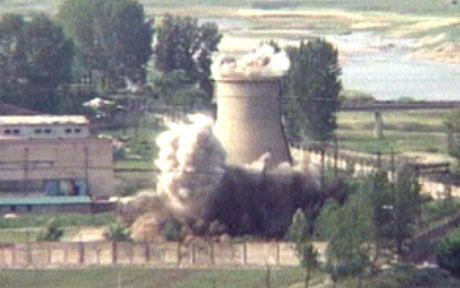

(from Telegraph.co.uk, used w/o permission)

There's a diversity of opinion on just what North Korea's media event means, including:
  • " 'This is a critical piece of equipment for the nuclear reactor,' said analyst John Wolfsthal, of the Center for Strategic and International Studies, who has been following North Korea since the 1980s. 'Without this facility, the reactor can't operate and can't produce more plutonium for weapons.' "
    (CNN)
  • "The tower is a technically insignificant structure, relatively easy to rebuild. North Korea also has been disabling - though not destroying - more sensitive parts of the nuclear complex, such as the 5-megawatt reactor, a plant that makes its fuel and a laboratory that extracts plutonium from its spent fuel.
    " 'It's symbolic. But in real terms, whether demolishing or not a cooling tower that has already been disabled doesn't make much difference,' said Lee Ji-sue, a North Korea expert at Seoul's Myongji University."
    (International Herald Tribune)
I'm inclined to agree with Lee: today's implosion even made a great show, but probably has little practical effect on North Korea's nuclear weapons program.

On the other hand, blowing up that tower has done more good than boost ratings for some news networks.
  • Even though it could be re-started easily, that nuclear facility is out of service for now: thanks to a deal between North Korea, America, South Korea, Japan, Russia and China
  • After this dramatic show, it's going to be a bit harder for national leaders to ignore a North Korean nuclear program
Is this news event an epochal event, heralding the dawn of a new age? Hardly.

I think that it's mildly hopeful, and may have positive results, down the road.

In the news:

Sunday, June 22, 2008

Syria, the IAEA, Nuclear Weapons, and a Prediction

United Nations nuclear inspectors are planning to go to Damascus soon. The hope is that they'll gather facts and do a thorough investigation into whether or not Syria has - or had - a nuclear weapons program.

Quite recently, the International Atomic Energy Agency, (IAEA) found out that they'd be allowed to bring ground-penetrating radar, to probe under the building that the Syrians built over the site that Israeli jets bombed last year.

There's still reason to believe that the United Nations inspectors will be told where they can look, how they can look, and what they can use to look for evidence.

Besides that, Syrian crews have had nine months to clean up the alleged empty sand, or agricultural station, or unused military facility, that Israeli jets blew up last year. It looks like there's been a controlled explosion there, and new construction.

I think it's fairly safe to predict what will happen.
  • Syria will put strict limits on what the IAEA inspectors can do, and where they can go
  • The IAEA technicians will not find obvious, compelling, in-your-face, evidence of a nuclear reactor in the places they've been allowed to see
  • This will be hailed as proof that Syria never had a nuclear weapons program
  • Israel will be condemned for launching an unprovoked attack
  • America will be condemned for supporting Israel
I could be wrong. But previous experience suggests that this is what will happen after the IAEA's little three-day trip to Syria.
More, at "UN atomic inspectors begin Syria mission"
Associated Press (June 23, 2008)

Related posts in this blog, about "Syria, the IAEA, Israel, Claims and Denials"

Syria, the IAEA, Israel, Claims and Denials

"Another War-on-Terror Blog" posts on the Israeli raid in Syria and its aftermath:

Wednesday, June 4, 2008

Syria, the IAEA, an Inspection, and a Missing Reactor

The International Atomic Energy Agency (IAEA) is going to send a inspection team to Syria. They're going to look at a site that Israel bombed recently.

Syria says there's no reactor there, and they're right.

On September 6, 2007, Israeli warplanes dropped bombs on what Syria has said was
  • Empty sand
  • An agricultural facility
  • An unused military facility of some sort
Before the Israeli jets blew the place up, it looked a lot like a reactor that's in North Korea. And, by curious coincidence, there were quite a few North Koreans around there.

But, Syria says that there's no reactor there. And, they're right. There won't be any evidence of one lying around either, unless they were very, very clumsy.

As the International Herald Tribune recalled today, Syria "wiped the Euphrates site clean of rubble late last year and erected a new building where the destroyed one had been — a step nuclear experts said would complicate the job of hunting for atomic clues. Some analysts said the rapid cleanup and new construction had been tacit admissions of guilt."
("UN nuclear inspectors to visit Syria" International Herald Tribune (June 3, 2008))

There certainly isn't a nuclear reactor there now, and unless the Syrian clean-up crew was clumsy, I doubt that the handful of inspectors the IAEA sends is going to find any evidence to speak of.

As for other places that the IAEA ought to be interested in, forget it. "Diplomats: 3 suspect Syrian nuke sites off limits" (Associated Press (June 3, 2008)).

The International Herald Tribune article offers quotes from some of the people involved.
  • "Mohamed ElBaradei, director general of the atomic agency, announced the impending visit at a meeting of the agency's board in Vienna. 'I look forward to Syria's full cooperation,' he said."
  • "The press secretary at the Syrian Embassy in Washington declined to comment specifically on the inspection visit, and other Syrian officials also did not comment. But Ahmed Salkini, the press secretary, said in a statement that Syria had always had a good working relationship with the atomic agency 'and we intend to keep it that way.'"
    "He added: 'This fabricated story by the U.S. administration will deconstruct from within and without. We are working on different fronts, and with different parties, to ensure that this fabrication is exposed to the world, and this administration embarrassed, once again.' " [emphasis mine]
  • David Albright, president of the Institute for Science and International Security in Washington: " 'If the Syrians think that a quick visit and some interviews' will clear up the nuclear suspicions, he said, 'they're sadly mistaken.' "
I sincerely hope that the inspection will be more than "a quick visit and some interviews." I could be mistaken, but I've gotten the impression that Syria and a few other countries have a very "good working relationship with the atomic agency" - and that may explain why America didn't share intelligence about the Syrian reactor (or agricultural facility, or empty desert) with the IAEA.

More at Posts from "Another War-on-Terror Blog," on the Israeli raid and its aftermath:

Monday, May 5, 2008

Syria's Reactor and North Korea - Again

You've read about it in the news: Both are in CNN's Politics*com section.

That ambassador mentioned in the headline is the Syrian ambassador.

"He noted that the photos showed just one building -- which didn't have enough power or other complex facilities nearby, such as reprocessing plant for extracting plutonium from spent nuclear fuel -- in order to operate a nuclear program.

" 'I had to ask myself, is this Hollywood or Foggy Bottom?' he said, calling it 'Iraq déjà vu.' "

I'm sure that the ambassador will find many people agreeing with him, in principle, in America: 'Everybody knows' that the Bush administration lied to justify an attack on Iraq. I think the motive is supposed to have something to do with an oil company.

Returning to reality, I recommend reading: There's more information there, including a video and links to a rather interesting transcript.

My last post on this topic, "Unilateral Attack Sparks International Condemnation! Syria Had No Reactor! Pay No Attention to the North Koreans!" (April 26, 2008) was cited by another blog, American Interests.

In the interests of full disclosure: I'm biased. In a situation like this, I am more inclined to believe Israel, and American intelligence agencies, than a nations whose leadership has at best a policy of active cooperation with organizations dedicated to eradicating Israel from the face of the Earth. (More at my previous blog post, cited above.)

Posts from "Another War-on-Terror Blog," on the Israeli raid and its aftermath:
1("Country Reports on Terrorism 2005" Chapter 6 -- State Sponsors of Terror Overview GlobalSecurity.org).

Saturday, April 26, 2008

Unilateral Attack Sparks International Condemnation! Syria Had No Reactor! Pay No Attention to the North Koreans!

International diplomacy, particularly what's going on with Syria, Israel, and the non-reactor that the Jews didn't blow up, would be hilarious, if people's lives didn't depend on what happens.

Oh, yes: "unilateral" popped up again. I'll get back to that.

Syrian seems to have chosen the story that Israelis bombed an "unused military facility."

Briefly, here's what seems to be going on:
  • September 6, 2007: Israeli warplanes bomb a nuclear reactor that was within weeks of becoming operational
  • September, 2007: Israel says nothing; Syria says Israeli warplanes bombed
    • Empty sand
    • An agricultural facility
    • An unused military facility of some sort
  • April, 2008: American intelligence reports to Congressional committees; some details come out, including a photo of a North Korean nuclear scientist talking to his Syrian counterpart
  • April 26, 2008: same old, same old:
    • Syria decides on their "unused military facility" story
    • Israel blamed for taking unilateral action
    • IAEA is upset that they didn't know about the reactor
      • Not at Syria, which should have informed the IAEA
      • At America - and Israel
I will admit that I'm inclined to sympathize more with Israeli and American leadership, than Syria's. It probably has something to do with Syria's policy of giving support, political and material, to Hezbollah and Palestinian terrorist groups. And, that Damascus serves as a leadership center1 for:
  • Hamas
  • Palestinian Islamic Jihad (PIJ)
  • The Popular Front for the Liberation of Palestine (PLFP)
  • The Popular Front for the Liberation of Palestine-General Command (PFLP-GC)
I know: "America is just as bad." That claim is generally backed by a reminder that America supported groups and individuals which eventually were involved in the Taliban's rule of Afghanistan, or other instances of imperfect precognition. Never mind that the former Soviet Union was having its own "Vietnam" in Afghanistan, making life a trifle awkward for Afghanis in the process.

As for Israel, I think that critics have a point. This nation, surrounded by people and governments that made the slogan, "death to the Jews! Death to the great Satan America!" famous, might have noted that Syria was building a reactor - almost certainly for military purposes - and then:
  1. Asked to have the matter brought up in the next U.N. Security Council meeting (I believe that might be the appropriate body)
  2. Prepared speeches
  3. Addressed the U.N. Security Council, when an opening in the agenda became available
  4. Prepared responses to objections raised, and counter-claims from Syria
  5. Go To Step 3
Or, the Israeli government could have decided to save themselves - and a great many other nations - from a nuclear threat: just as they did with Saddam Hussein's nuclear program in 1981. Their action was "unilateral." In a world where international organizations seem more interested in protracted cycles of rhetoric, than in confronting issues with goal-oriented diplomacy or, failing that, military action: I think that Israel was acting with intelligent self-interest.

As for the International Atomic Energy Agency, I think that the IAEA might be well advised to criticize Syria, which was obligated to report nuclear work like the "unused military facility" it was building. I'll admit to a bias.

I've been disturbed by a certain lack of fit between reality and the world that the IAEA lives in. For example, the glowing report the IAEA gave to the Chernobyl situation recently.

And, when it comes to matters involving Islamic enthusiasts and their stated goals of wiping out Israel and western culture, I have a niggling doubt that the IAEA Director-General, Mohamed El-Baradei, will be completely objective.

I know: it's unreasonable. But, I submit, no more unreasonable than a similar doubt as to the commitment of a (hypothetical) director of a Jewish civic rights oversight agency in 1938, whose name was something like Heinrich von Schwinghammer.

My concerns over the IAEA's seeming hesitancy to engage nations which are real threats may be no more than my view, as an outsider, of the delicate negotiations and sensitivity that must exist in such cases.

Syria's non-reactor, and related matters, in the news: A short history of Syria, which I believe puts some of the Syrian government's policies in a more complete light: Posts from "Another War-on-Terror Blog,on the Israeli raid and its aftermath:
1("Country Reports on Terrorism 2005" Chapter 6 -- State Sponsors of Terror Overview GlobalSecurity.org).

Thursday, April 24, 2008

Syrian Ambassador: Reactor? That's No Reactor

Western news media, at least, have taken to calling Syria's whatsit that Israel bombed last year a "reactor." I think they're right.

Once more, I have to point out that "Another War-on-Terror Blog" isn't political. But, politicians make decisions that affect war and peace. For that reason, politics has to be discussed. Particularly in an election year.

Although my favorite of the Syrian stories about what Israeli warplanes bombed on September 6, 2007, is that it was an agricultural facility, I must admit that evidence favored it being a nuclear reactor, nearly identical to one in North Korea.

I miss the radioactive kimchi scenario, though ("Radioactive Kimchi, or Nuclear Bomb Material?" (September 23, 2007).

Syria Says: Is Not!

The Syrian ambassador to the United Kingdom was much more eloquent than that, of course. Sami al-Khiyami Said that Syria and North Korea were being very nice: "This has nothing to do with North Korea and Syria. They [the Americans] just want to exert more pressure on North Korea. This is why they are coming up with this story," he told Reuters.

Member of Congress Says It's a Plot!

New York's own Representative Gary Ackerman, who had his own hearing about U.S. policy toward Syria, says that the White House didn't give everybody the same amount of information. He called that "bizarre behavior." "This is the selective control of information that led us to war in Iraq," Ackerman said.

He could be right, but I thought that some of what the CIA told a Congressional committee today was very, very secret: Not the sort of thing you want everyone to know.

Ackerman's not alone, though Michigan's Representative Pete Hoekstra, a leading member of the House Intelligence Committee, said: " 'I think many people believe that we were used today by the administration because — not because they felt they had to inform Congress because it was their legal obligation to do that, but because they had other agendas in mind,' he said.

With due respect to the representative from Michigan, that sounds an awful lot like 'it's some kinda plot.'

And, other members of Congress talked, too: Maine's Senator Susan Collins brought up a sensible point, that revealing this much information could compromise American intelligence sources.

As to that, it will help if members of Congress keep their collective yap shut.

Which, thankfully, they are: so far.

But tomorrow's another day.

Israeli Raid on Syrian Reactor in Today's News

  • "US video to link North Korea to Syrian nuclear reactor: reports"
    AFP (April 24, 2008)
    Excerpt:
    "WASHINGTON (AFP) — The US government on Thursday will show lawmakers a video linking North Korea to a Syrian nuclear reactor the Israelis bombed in September, leading US newspapers said Thursday.
    "The New York Times and The Washington Post, citing unnamed senior officials said the video showed North Koreans inside the secret Syrian facility code-named Al Kibar."
  • "Syria 'had covert nuclear scheme' "
    BBC (April 24, 2008)
    Excerpt:
    "The United States has accused North Korea of helping Syria build a nuclear reactor that 'was not intended for peaceful purposes'.
    "The site, said to be like one in North Korea, was bombed by Israel in 2007."
  • "Syria denies building nuclear reactor with N.Korea"
    International Herald Tribune (April 24, 2008)
    Excerpt:
    "LONDON: Syria on Thursday dismissed U.S. accusations that North Korea was helping it build a nuclear reactor that could produce plutonium.
    "Syria's ambassador to Britain, Sami al-Khiyami, told Reuters that the accusation, which President George W. Bush's administration was expected to lay out to lawmakers on Thursday, was to put pressure on North Korea in talks about Pyongyang's nuclear programme.
    " 'This has nothing to do with North Korea and Syria. They just want to exert more pressure on North Korea. This is why they are coming up with this story,' Khiyami said."
  • "Official: Syrian Nuclear Reactor Was Weeks From Functioning"
    FOXNews (April 24, 2008)
    Excerpt:
    "WASHINGTON — A Syrian nuclear reactor built with help from North Korea was weeks away from functioning, a top U.S. official said Thursday after lawmakers were briefed on the site destroyed last year by Israeli jets.
    "The official, who wanted anonymity, told The Associated Press that the facility was mostly completed but still needed significant testing before it could be declared operational."

Wednesday, April 23, 2008

Return of the Radioactive Kimchi!! North Korean Nuclear Reactor in Syria Back in the News

September 6, 2007: Israeli jets bombed empty sand, an agricultural station, or a warehouse in Syria, according to various Syrian reports. The Israeli government was very, very quiet about what happened.

The Syrian government was probably responsible for the cleanup crew that went out and removed debris from the attack, so now it does seem to be just empty sand.

That was then, this is now.

It looks like Congressional intelligence committees will get confidential briefings tomorrow, about information regarding the Syrian nuclear reactor. Or empty sand. Or warehouse. Or agricultural station.

If members of Congress maintain their tradition for keeping secrets, particularly in an election year, I'd say that the first leak will come less than two hours after the first briefing ends. It will be interesting to see what various members of Congress say that they heard.

The Syrian claim that the Jews blew up an agricultural facility isn't as crazy as it sounds. I outlined a non-impossible scenario in an earlier post:

"That agricultural research facility that Syria says the Israeli Air Force didn't bomb may be just that: an ag station.

"As for the North Korean protest: I'm surprised that no one has realized what happened.

"It's obvious, when you think about it: North Korea is upset because North Korean nationals there: expert chefs and agricultural specialists, and a large quantity of radioactive Kimchi.

"After all the trouble China is having with lead-coated toys and lethal pharmaceuticals, North Korea is understandably hesitant to admit that the fermented cabbage they were shipping to Syria was radioactive."

On a more serious note, here's a sampling of recent news coverage, announcing the upcoming briefings:
  • "Hands Across the Border - Syria and North Korea"
    Washington Post, White House Watch, by Dan Froomkin, Columnist
    Excerpts:
    "Jay Solomon writes in the Wall Street Journal (subscription required): 'North Korea was helping Syria build a plutonium-producing nuclear reactor before Israel bombed the site last September, the Bush administration is set to tell Congress.
    " 'The new information could increase the position of hard-liners in Congress and the administration who have argued against a deal being negotiated to dismantle North Korea's nuclear-weapons program. The hard-liners say Pyongyang hasn't provided enough assurances it will dismantle its atomic arsenal in return for economic and diplomatic incentives....' "
  • "Administration to Brief Congress on North Korea's Efforts to Help Syria Build Nuclear Facility"
    FOXNews.com (April 23, 2008)
    Excerpts:
    "Congressional intelligence committees will be told Thursday that North Korea was helping Syria build a plutonium-producing nuclear reactor before Israeli warplanes bombed the site last September.
    "North Korea has long been suspected of helping Syria advance its secret nuclear program, but both countries deny it. Pyongyang says it has never spread its nuclear expertise beyond its borders."
  • "N Korea 'helped Syria with nukes' "
    The Australian (April 24, 2008) (I know: I think the International Date Line is involved.)
    Excerpts:
    "Korea was helping Syria build a plutonium-producing nuclear reactor before Israel bombed the site last September, the Bush administration is to tell the US Congress.
    "The new information could increase the position of hardliners in Congress and the administration who have argued against a deal being negotiated to dismantle North Korea's nuclear-weapons program."
Posts from "Another War-on-Terror Blog," September and October of 2007, on the Israeli raid and its aftermath:

Thursday, February 28, 2008

Peach Bottom Nuclear Plant: Security was the Pits

The point of this post is that people matter. Individual people. Even in a world of 6,000,000,000, and in a nation of 300,000,000, decisions made by one or two people can affect thousands, or millions.

For example: "Peach Bottom Plant Worker Fired" WJZ TV news video (November 1, 2007)

It's an inspiring sight: individuals whose job it is to guard one of America's nuclear power plants:
  • Armed
  • On duty in the ready room
  • Fast asleep
It's hard to get many details, but apparently security guards at Pennsylvania's Peach Bottom Nuclear Power Plant had made arrangements to cover for each other while they slept on the job. There's an opposing view, that the guards were forced to sleep, by having to work too much.

The guard who videotaped them snoozing has been fired. Understandably, since after he got no response going through the 'proper' channels, the tape went public.

I know that it's in a company's best interests to listen to internal reports of incompetence, and that there are whistle blower laws: But I also know that there are many managers and executives who are breathtakingly foolish.
  • Good news:
    Security at Peach Bottom didn't rely entirely on the snoozing guards
  • Bad news:
    If something had gone wrong at Peach Bottom, about 188 square miles could have become uninhabitable, and thousands of people would have died - including some in New York City and Washington, D.C.
How many people remember Chernobyl?


View Larger Map

There's been some attention paid to Peach Bottom since then, and it may be a while before guards hit the snooze button there. It's even possible that there will be a little more attention paid to the possibility that terrorists might decide to walk in and make a nuclear 'accident' happen.

Meanwhile, I'm profoundly grateful that for my immediate family, the nearest nuclear power plant is dozens of miles away, and, on average, downwind.

Related posts, on Individuals and the War on Terror.
A rather official view of atomic reactors and safety is online, at the Federation of American Scientists (FAS) website: "CRS Report for Congress - Nuclear Power Plant Security and Vulnerabilities" (January 18, 2008) (Order Code RL34331)

Friday, November 2, 2007

Pipe Bomb at Palo Verde Nuclear Reactor

Well, that was exciting.

A contract worker tried driving into the Palo Verde had a "small capped pipe that contained suspicious residue" in the back of his pickup. In plain view.

He was stopped about a half-mile from the containment domes. The worker went into custody, and the nuclear power plant went into lockdown.

So far, there's no indication that this is a case of domestic terrorism. Or, I suspect, that it isn't.

Although I rather doubt that the pipe bomb was there to provide fireworks or be used as a hammer.

I actually feel a bit safer, after this incident. Although what happened today couldn't be considered a serious attempt at an attack, Palo Verde's security seems to respond rather good.

A spokesman for Palo Verde's operator, Arizona Public Service, said that every vehicle going into the plant goes through an "extensive" inspection. "It's not an accident they found it," the spokesman said.. "It's not like an inspection you go through at the airport. The security is highly trained and they are damned good at what they do and they did it today."

There's a video at MyFoxPhoenix.com.

It's good to read about situations where protective systems work. I rather hope that there's a follow-up article on this event. I'd like to know what that dipstick from South Carolina thought he was doing with a pip bomb in the back of his pickup.

Unique, innovative candles


Visit us online:
Spiral Light Candle  • Find a Retailer
• Spiral Light Candle Store

Blogroll

Note! Although I believe that these websites and blogs are useful resources for understanding the War on Terror, I do not necessarily agree with their opinions. 1 1 Given a recent misunderstanding of the phrase "useful resources," a clarification: I do not limit my reading to resources which support my views, or even to those which appear to be accurate. Reading opinions contrary to what I believed has been very useful at times: sometimes verifying my previous assumptions, sometimes encouraging me to change them.

Even resources which, in my opinion, are simply inaccurate are sometimes useful: these can give valuable insights into why some people or groups believe what they do.

In short, It is my opinion that some of the resources in this blogroll are neither accurate, nor unbiased. I do, however, believe that they are useful in understanding the War on Terror, the many versions of Islam, terrorism, and related topics.