Showing posts with label Egypt. Show all posts

Sunday, August 25, 2013

Egypt, Opinions, and Cautious Optimism

Mainstream news from Egypt is like most old-school journalism: death; bloodshed; more death; "the center cannot hold;" and all that.

Now and then a journalist decides that talking to folks who aren't trying to topple a regime, or struggling to hold power, might be a good idea. In this case, I think the results are encouraging:
"Muslim Brotherhood's bid to scapegoat Christians failing, say Egyptians"
Lisa Daftari, FoxNews.com (August 25, 2013)

"As their nation descends into violent chaos, Egyptians are increasingly blaming the Muslim Brotherhood, despite attempts by the Islamist group to scapegoat Christians and the military, according to several sources who spoke to FoxNews.com from Cairo.

" 'The Muslim Brotherhood has lost all sympathy with their points due to their violence,' said a Long Island, N.Y., Egyptian-American, who is in a Cairo suburb for a family wedding.

"The man, a Coptic Christian who asked that his name not be used until he and his family are safely back in the U.S., told FoxNews.com he arrived in the Cairo suburb of Heliopolis last weekend, just days after Muslim Brotherhood supporters began clashing violently with security forces. Since then, nightly curfews, angry mobs and closed roads that cut off supplies to restaurants and groceries have made his homeland unrecognizable...."

One Man's Opinion

I could say that this Egyptian-American doesn't count, because he doesn't live in Egypt. Besides, he's a Christian: so I could pick from a broad range of stereotypes.

More to the point, that's just one man's opinion.

I don't blame him for keeping his head down until he was out of Egypt. There's quite a bit of trouble in that country, ever since Egypt's military decided that Egypt didn't need a rogue president. Folks who like the way President Morsi was 'protecting' Egypt from those who disagreed with Morsi's brand of Islamist rule were understandably upset, and by now the body count is over 1,000.

One Woman's Opinion

I do not think that the trouble with Egypt is that they've got Muslims there. I've run into too many folks who follow Islam and think terrorism is a bad idea:
"...A Muslim woman named Nina told FoxNews.com most citizens - Christian and Muslim - are solidly behind the military, which has been criticized by the west for its decisive crackdown on Muslim Brotherhood supporters.

" 'I am Muslim and I am against terrorism and I support the revolution [which ousted Morsi] and I support all the decisions of the Egyptian army forces,' she said. 'We love Egypt so much and we hope the foreign countries stop misunderstanding about us and the situation now in Egypt.'..."
(Lisa Daftari, FoxNews.com)
Well, that's just one woman's opinion.

Let's see what one of those 'religious' people say:

Another Man's Opinion

"...Even at mosques, the tide seems to be turning against the Muslim Brotherhood, according to one man who spoke from Cairo.

" 'They gather around mosques, from five to 100 of them, to show they are important and the goal is to go and cut off the roads and rally to get more supporters,' he said.

" 'Sometimes during Friday prayers, the sheikh wants to push people to support the Muslim Brotherhood, but modern Muslims are dominant and not deceived anymore with fake words that defending the Muslim Brotherhood is defending Islam,' he said...."
Some Muslims probably still keep themselves isolated from the rest of the world. I think a few folks from any large selection of humanity are trying very hard to stay ignorant. Many of us, though, seem to be willing to learn what's going on outside our neighborhood.

Yet Another Man's Opinion

Finally, Osama el-Quossi, a "former jihadist and Salafist cleric," said that the Muslim Brotherhood is trying to blame Egypt's Christians for the current trouble. True, Egypt's Christian minority didn't support Morsi: but quite a few Muslims weren't behind him, either. 'Blame the Christians' doesn't seem to be working:
"...'The Brotherhood lost everything, politically and economically,' Osama el-Quossi told MCN. 'They lost the citizens' sympathy, so they used religion to gain support of ordinary people. '"
(Lisa Daftari, FoxNews.com)

Living in a Big World

Lisa Daftari probably could have found four other folks in Egypt who would obligingly chant "death to the great Satan America," or whatever slogan is in fashion this year. Although I'm fairly sure that she decided to focus on one among many attitudes held by Egyptians, I strongly suspect that she's reporting what many folks feel.

I think many, probably most, folks don't like being shot at or blown up: preferring to raise their families, go to work, and get on with their lives.

Egypt has around 200,000 Internet hosts, 2,000,000 Internet users, and upwards of 83,000,000 cell phones. Since there are about 85,290,000 Egyptians: folks living there are rather well-connected to the rest of the world.

My guess is that many Egyptians, and Americans, and folks around the world, know too much to believe the old fears about 'foreign threats.'

I'm quite certain that the next few decades, and probably centuries, will be difficult. But I'm also cautiously hopeful that the emerging global civilization will be an improvement over the mess we've had so far.

Related posts:

Thursday, July 4, 2013

Egypt and an Uncoup

If the joint chiefs of staff placed America's president under house arrest, locked up the House majority leader, and declared that new elections would be held this august, that would bother me.

America doesn't work that way.

Egypt, President Morsi, and an Uncoup

I heard about Egypt's military prying President Morsi out of office last night. National leaders made the usual 'military coups are bad' statements, while Egypts military leadership said that they'd see to it that free elections happened in the near future.1

President Morsi's truncated term in office isn't surprising. Last year he said:
  • He's making Egypt
    • Safe for freedom and democracy
    • Stable
  • Nobody can change the new rules
    • Except him
    (November 23, 2012)
Maybe I'm too cynical, but when a nation's leader takes personal control of executive and legislative functions: I'm dubious about the leader's motives. 'To preserve freedom, I'm taking over' has an unpleasant ring to it.

Quite a few folks in Egypt were disappointed by Morsi. He'd promised that he and his Muslim Brotherhood would let everybody have a say in how they ran Egypt.

One of the problems with elections and an informed electorate, from an old-school viewpoint, is that 'the Masses' expect leaders to keep their word.

Right now, I think there's a chance what happened in Egypt isn't a coup. Egypt's military may have stepped in to keep Morsi and company from dragging Egypt back to the 'good old days' of elite rule.

Elections and Assumptions

Like I've said before, I like the way America's government is supposed to work. Open elections, accountability, and due process are good ideas: even when I feel frustrated with the lot we've got running this country.

I don't, however, think that every country should have a bicameral legislature and use a photocopy of the Constitution. That system works for us, but every country has a unique history and culture.

I hope that Egyptians develop a form of government that works for them: all of them.

Related posts:
News and views:

1 Excepts from news and views:
"Egypt army arrests key Muslim Brotherhood figures"
BBC News (July 4, 2013)

"Egypt's military has moved against the leadership of the Muslim Brotherhood, a day after deposing President Mohammed Morsi.

"Mr Morsi is in detention, as well as senior figures in the Islamist group of which he is a member. Hundreds more are being sought.

"The top judge of Egypt's constitutional court, Adly Mahmud Mansour, has been sworn in as interim leader.

"He has pledged to hold elections based on 'the genuine people's will'.

"At a news conference, Muslim Brotherhood spokesman Gehad el-Haddad declared 'our full refusal and revoking of the military coup' and demanded Mr Morsi's immediate release, along with the other detainees.

"He declared the Brotherhood's 'full denial of co-operation' with the new regime and said it would take part in all 'peaceful, people-led protest'.

"Meanwhile, Egyptian Foreign Minister Kamel Amr - who resigned from Mr Morsi's government on Monday - said he had assured US Secretary of State John Kerry in a telephone call on Thursday that the overthrow of President Morsi had not been a military coup, but the 'overwhelming will of the people'.

"The upheaval in Egypt comes after days of mass rallies against Mr Morsi and the Brotherhood, who are accused of pursuing an Islamist agenda and failing to tackle Egypt's economic problems...."

"Brotherhood leader arrested, Egypt's Islamists call protests"
Asma Alsharif, Shadia Nasralla, Reuters (July 4, 2013)

"Egyptian security forces arrested the leader of the Muslim Brotherhood on Thursday, security sources said, in a crackdown against the Islamist movement after the army ousted the country's first democratically elected president.

"The dramatic exit of President Mohamed Mursi was greeted with delight by millions of jubilant people on the streets of Cairo and other cities overnight, but there was simmering resentment among Egyptians who opposed military intervention.

"An Islamist coalition led by the Brotherhood called on people across the nation to protest in a "Friday of Rejection" following weekly prayers, an early test of Mursi's ongoing support and how the military will deal with it...."

"Obama chose his words on Egypt carefully -- for a reason"
Jake Tapper, CNN (July 4, 2013)

"President Barack Obama's statement about the Egyptian military's seizure of power is as telling for what he doesn't say as for what he does: he doesn't mention the word 'coup.'

"He doesn't call upon the military to restore power to 'the democratically elected civilian government,' but rather to 'a democratically elected civilian government.'

"In other words, it need not be deposed President Mohamed Morsy's.

"The thinking of the president and administration officials, according to a knowledgeable source, is that while the administration is not explicitly supporting the removal of Morsy from power -- it expressly did not support the move -- it is seeking to push the Egyptian military in a direction...."

Monday, December 10, 2012

Egypt, America, and 'Preserving Freedom'

I wasn't entirely satisfied with last month's election here in America.

Still, it could be worse.

I could be living in Egypt.1

Morsi? Morsy?

Egypt's President is محمد مرسى عيسى العياط‎, or Mohamed Morsi Isa El-Ayyat. I've seen his name spelled Morsi and Morsy. For now, I'm using "Morsi."

My native language, English, uses the Latin alphabet, and I've discussed transliteration before. (October 22, 2011)

Moving on.

Playing the Class Card

One of the nice things about allowing folks with ability to earn more than average is that, when things get rough, you can blame them.

Someone working for Egypt's president said that "blamed a small but powerful minority for the political upheaval." (CNN)

In my 'good old days,' it was the fault of 'pinko intellectuals' or 'bloated capitalists;' now it's the 'radical religious right,' or the 'liberal elite.' Tomayto, tomahto.

Expedient, Yes: Prudent, No

I acknowledge that when a leader starts facing the consequences of some unusually clueless move, it's easy to blame 'those people over there.' Sometimes passing the buck works: but I don't think it's the best idea. Not in the long run.

I don't doubt that folks in Egypt who are professionals, entrepreneurs, or simply have access to more information than average, are the ones trying to keep their president from taking personal control of their country.

Unlike President Morsi, though: I think they're probably right.

Freedom and Stability

Maybe Egypt's president is right, and the only way to preserve freedom in Egypt is have troops arrest citizens who don't agree with the government. Maybe not.

I'm guessing "not," but I could be wrong.

"Freedom" and "stability" sound good: and can describe worthy ideals.

But "freedom" doesn't mean "free to agree with me," or shouldn't; and "stability" shouldn't mean "keeping things just the way they are," or shouldn't.

Egypt and America

Minutiae of culture and language aside: I don't think folks in Egypt and America, or anywhere else, are all that unlike. Human nature, for good or ill, is - reliable:
"Human nature will not change. In any future great national trial, compared to the men of this, we shall have as weak and as strong, as silly and as wise, as bad and as good."
(Abraham Lincoln, Response to a serenade (November 10, 1864))
That said, all countries are not alike.

Wait a few decades, and one country often won't be 'alike.'

The America I grew up in was a place where someone could still believe that an "American" was someone with a nice English name, who either had English ancestors or who was desperately trying to pass for Anglo.

That changed in the last half-century. I like the new America, for the most part, but it's driving some folks nuts.

While writing this post, I looked up Egypt and America. The countries are similar in one or two ways. Both call the head honcho a "president," and both are republics. On the other hand, nobody's likely to get Egypt and the the United States confused:
  • Egypt
    • Ethnic groups (2006 census)
      • Egyptian 99.6%
      • Other 0.4%
    • Language
      • Arabic (official)
      • English and French widely understood by educated classes
    • Religion
      • Muslim (mostly Sunni) 90%
      • Coptic 9%
      • Other Christian 1%
    • Government
      • Republic
    ("Egypt," World Factbook, CIA (page last updated November 14, 2012))
  • United States
    • Ethnic groups
      • White 79.96%
      • Black 12.85%
      • Asian 4.43%
      • Amerindian and Alaska native 0.97%
      • Native Hawaiian and other Pacific islander 0.18%
      • Two or more races 1.61% (July 2007 estimate)
      • Hispanic
        • Note: a separate listing for Hispanic is not included because the US Census Bureau considers Hispanic to mean persons of Spanish/Hispanic/Latino origin including those of Mexican, Cuban, Puerto Rican, Dominican Republic, Spanish, and Central or South American origin living in the US who may be of any race or ethnic group (white, black, Asian, etc.)
    • Language (2000 census)
      • English 82.1%
      • Spanish 10.7%
      • Other Indo-European 3.8%
      • Asian and Pacific island 2.7%
      • Other 0.7%
      • note: Hawaiian is an official language in the state of Hawaii
    • Religion (2007 est.)
      • Protestant 51.3%
      • Roman Catholic 23.9%
      • Mormon 1.7%
      • Other Christian 1.6%
      • Jewish 1.7%
      • Buddhist 0.7%
      • Muslim 0.6%
      • Other or unspecified 2.5%
      • Unaffiliated 12.1%, none 4%
    • Government
      • Constitution-based federal republic
        • Strong democratic tradition
    ("United States," World Factbook, CIA (page last updated November 28, 2012))
With so many flavors of "American," I think it's getting increasingly difficult to appeal to knee-jerk paranoia in the 'average American." That doesn't keep my country's alleged best and brightest from trying, though: and that's another topic.

Related posts:
In the news

1 From the news:
"Egypt crisis: Morsi gives army arrest powers before vote"
(December ,10 2012)

"Egyptian President Mohammed Morsi has ordered the military to maintain security and protect state institutions in the run-up to a controversial referendum on a new constitution.

"The army has also been given the power to arrest civilians.

"Mr Morsi has tried to calm public anger by annulling a decree giving him huge powers, but rejected a call to scrap the 15 December constitutional vote.

"Opposition leaders called for protests on Tuesday against the referendum.

"The opposition was "not aiming at toppling the president" but wanted a better constitution, former Foreign Minister Amr Moussa told the BBC.

"Islamist groups have said they will hold counter demonstrations, raising fears of further bloody clashes on the streets of the Egyptian capital.

"In another apparent concession, the president suspended a big tax increase on the sale of a variety of goods including soft drinks, cigarettes and beer...."

"Top Morsy aide: Small, powerful minority behind Egypt's political upheaval"
Reza Sayah and Amir Ahmed, CNN (December 10, 2012)

"A top aide to Egyptian President Mohamed Morsy blamed a small but powerful minority for the political upheaval that has plagued the country ahead of a planned constitutional referendum.

"The statements are the latest in a volley of accusations between Morsy's supporters and opponents, and they highlight a political crisis that at times has spilled into the streets, prompting the president to deploy troops and tanks to protect government buildings.

" 'You have the majority of the poor people, the simple, definitely for the president and for the constitution,' Muhammad Rifaa al-Tahtawi, Morsy's chief of staff, told CNN on Sunday.

" 'You have a majority among the elite who are not for this constitution. Businessmen, media people. They are definitely a small minority, but powerful minority.'..."

"Egypt's opposition rejects constitutional referendum"
Reuters (December 9, 2012)

"Egypt's main opposition coalition rejected on Sunday Islamist President Mohamed Mursi's plan for a constitutional referendum this week, saying it risked dragging the country into 'violent confrontation'.

"Mursi's decision on Saturday to retract a decree awarding himself wide powers failed to placate opponents who accused him of plunging Egypt deeper into crisis by refusing to postpone the vote on a constitution shaped by Islamists.

" 'We are against this process from start to finish,' Hussein Abdel Ghani, spokesman of the National Salvation Front, told a news conference, calling for more street protests on Tuesday.

"The Front's main leaders - Nobel peace laureate Mohamed ElBaradei, former Foreign Minister Amr Moussa and leftist Hamdeen Sabahy - did not attend the event...."

Sunday, December 9, 2012

Business (not) as Usual in Egypt

Egypt hasn't been "stable" since around February of 2011, when quit a few folks in the Middle East decided that they were fed up with stability. I can't say that I blame them:
The new(ish) Egyptian president seems to be trying to return the sort of stability Mubarak enjoyed. Some folks in Egypt may have thought it was a good idea. Quite a few didn't. (November 23, 2012)

So far, several Egyptians have been killed, President Morsi either left his office in a hurry, or he didn't, and Egypt is missing a political party headquarters.

One more thing, President Morsi changed his mind about stability. Sort of. Maybe.

"Safeguarding the Revolution"

"Egypt crisis: President Morsi annuls decree"
BBC News (December 9, 2012)

"Egyptian President Mohammed Morsi has annulled a decree he issued last month that hugely expanded his powers and sparked angry protests, officials say.

"However, a news conference in Cairo was told that a controversial referendum on a draft constitution would still go ahead as planned on 15 December.

"Mr Morsi's critics have accused him of acting like a dictator, but he says he is safeguarding the revolution...."
I take what I read in the news with a grain of salt: or two; or an entire salt lick. When someone's political opponents or "critics" say that an official is acting like a dictator, all I can be sure of is that they don't like what the official is doing.

In Mr. Morsi's case, though, there seemed to be more than 'politics as usual' going on. His new rules:
  • Keep judges from
    • Reviewing Mr. Morsi's decisions
    • Interfering with a committee that Mr. Morsi's party is running
  • Say that only Mr. Morsi can change the rules
Maybe President Morsi really is "safeguarding the revolution." I think it's reasonable, though, to wonder whose revolution is being safeguarded.

"Not Legally Possible?" Maybe

"...'The constitutional decree is annulled from this moment,' said Selim al-Awa, an Islamist politician acting as a spokesman for a meeting Mr Morsi held with political and public figures on Saturday.

"But he said the referendum on a new constitution would go ahead because it was not legally possible for the president to postpone it.

"The meeting had been boycotted by the main opposition leaders who had earlier called for their supporters to step up their protests.

"They want both the decree and the referendum cancelled...."
(BBC News)
My hat's off to the current Egyptian administration, if they're really going ahead with a dubious referendum because Egyptian law says they have to. I think some laws are stupid: but I also think that stupid laws should be changed, not ignored.

In some ways, I'm more concerned about folks who think it's okay for leaders to break the law, than I am about other folks who think it's okay to fly airliners into office buildings. It's not much of a choice: but at least the suicide pilots are generally an external threat.

"Reactionary Figures," Protests, and an Incendiary Statement

"...The president's supporters say the judiciary is made up of reactionary figures from the old regime of strongman Hosni Mubarak.

"But his opponents have mounted almost continuous protests since the decree was passed.

"They are also furious over the drafting of the new constitution because they see the process as being dominated by Mr Morsi's Islamist allies.

"Several people have been killed in the recent spate of anti-government protests, and the presidential palace has come under attack.

"The Cairo headquarters of the Muslim Brotherhood, the movement to which Mr Morsi belongs, were set on fire."
(BBC News)
I don't think the Muslim Brotherhood are 'good guys.' I don't think they're 'bad guys,' either.

I'm dubious about folks who act as if they think God follows their policies and preferences: and folks like that aren't always 'those people over there.'

When I was growing up, some radio preachers seemed to think that Jesus was an American, and that's not quite another topic.

I do think that Egyptians are no more uniform in their views and beliefs, than Americans. Dead Egyptians, arson with a political target, and continued protests seem to back up that view.

As for those "reactionary figures?" Maybe Mubarak's old pals really are behind at least some of the trouble in Egypt. Or maybe not.

Blaming a hated, and comfortably distant, foe is an old trick. America's old establishment had the communist threat, today's lot have vast right-wing conspiracies, and that's yet another topic.

Related posts:

Tuesday, December 4, 2012

Egypt, Morsi, and Dealing With Change

It looks like at least 100,000 folks in Egypt don't like their new president's recent actions. That's how many showed up at a demonstration in Cairo today.1

One official says that President Morsi left when the crowds outside "grew bigger;" another official, speaking for Mr. Morsi, said that the President's departure was routine.

Whatever Morsi's motives, I'd say that Egypt isn't the 'stable' country it was under Mubarak.

As I've said before, "stability" isn't necessarily a good thing: not when it means that a small group makes decisions for a nation; tells the general public what the leaders think is 'proper;' and criticizing the leaders is punished.

Folks whose position or influence make them part of that small group don't, understandably, like criticism; sometimes don't distinguish between reasonable complaints and treason; and aren't necessarily 'those people over there.'

Related posts, about dealing with:

1 Excerpt from the news:
"Egyptian President Morsi leaves presidential palace as protests turn violent"
Foxnews.com (December 4, 2012)

"Egyptian President Mohammed Morsi left the presidential palace Tuesday as violence erupted between police and at least 100,000 protesters gathered in Cairo.

"In a brief outburst, police fired tear gas to stop protesters approaching the palace in the capital's Heliopolis district. Morsi was in the palace conducting business as usual while the protesters gathered outside. But he left for home through a back door when the crowds 'grew bigger,' according to a presidential official who spoke on condition of anonymity because he was not authorized to speak to the media.

"The official said Morsi left on the advice of security officials at the palace and to head off 'possible dangers' and to calm protesters. Morsi's spokesman, however, said the president left the palace at the end of his work schedule through the door he routinely uses...."

Friday, November 23, 2012

Egypt, America: Change, Freedom, and Other Threats to the Status Quo

Egypt's president says:
  • He's making Egypt
    • Safe for freedom and democracy
    • Stable
  • Nobody can change the new rules
    • Except him
That's a simplified version of what I found in the news.1

Most of the new Egyptian decree sounds okay: being safe is nice; folks seem to like freedom; and democracy is supposed to be a good idea, too. I think part of the trouble folks have is that the president says that nobody can change the new rules, except him.

I can see their point: but not because President Mursi is an "Islamist."

'Free to Agree With Me?'

Freedom doesn't, or shouldn't, mean "free to agree with the boss," or "free to support 'proper' opinions." Like I've said before, I remember the trailing edge of McCarthyism, and endured political correctness while doing time in American academia.

Although their vocabulary was different, supporters of both said they were defending freedom. I think they believed it; and probably couldn't understand that another person might disagree without being pinko, homophobic, or whatever.

What 'Everybody Knows, That Just Ain't So'

Today's 'real Americans,' and those who graduated from campus activism to successful career tracks, have an odd sort of common belief: Muslims are evil, or at least dupes of Islam. An oversimplification? Yes: but I think it's good enough for a quick sketch of the attitude toward 'those people.'

What sets today's establishment apart is that all religion is supposed to be dangerous, or at least 'intolerant.'

"The establishment" isn't what it used to be, and that's almost another topic:
As the name of that blog suggests, I'm one of 'those religious people.' Worse, I'm a Catholic: which doesn't mean what you may have heard.

By the way, I discuss political issues, but this isn't a "political" post, and there's a reason why it's hard to pigeonhole my views as liberal or conservative:
I'm getting seriously off-topic. Sort of.

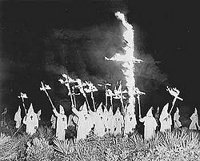
'Kill a Commie for Christ,' and Assumptions

Denver News (1921), from The Library of Congress (American Memory Collection), http://memory.loc.gov/ammem/, via wikipedia.org, used w/o permissionLet's say that the more violent iterations of the Ku Klux Klan were the only sort of 'Christianity' a person heard about. Assuming that folks who 'protected' their America from foreigners, blacks, and other 'anti-Christian' influences, were typical Christians wouldn't be hard.

Equally rabid patriots who inspired the 'kill a commie for Christ' slogan didn't help, in my opinion.

My reaction to ranting radio preachers and their secular counterparts eventually led to my becoming a Catholic, and that's definitely another topic.

Beware Rabid 'Defenders'

In a way, I'm not half as concerned about foreign threats, as I am about some of the folks determined to 'protect' my country.

These days, I don't see a 'vast right-wing conspiracy' as a serious threat to America's freedom. Too many folks remember various red scares, or were told about them in the government schools. Yet another topic.2

I am concerned about folks who apparently want to 'protect' America from the supposed dangers of religious belief: any religious belief.

That's another over-simplification. I've written about tolerance, real and imagined, fairly often: and put links under "Tolerance," below.

Egypt and a Changing World

Maybe the Egyptian president really will bring freedom, democracy, and stability, to Egypt: and then let someone else have a say in how his country is managed. I'm dubious about that: but it's possible.

I think it's more likely that Mr. Morsi wants Egypt to be a nice, orderly, "stable" country: like North Korea, Burma/Myanmar; and 20th century Latin American rulers whose title was "president," since American support depended on a show of "democracy." Cynical? Maybe.

I don't mind stability, or freedom. But I think there are different sorts of "stability:"
  • Good news
    • Choosing leaders without bloodshed
    • Citizens living without fear of criminals in the
      • Private sector
      • Government
  • Bad news
    • Protecting folks with power
      • Political
      • Military
      • Economic
    • Silencing criticism
    • Preventing change
I realize that change is unsettling, sometimes painful. But change happens, change can be good, and resisting change can create new problems: and even more unsettling, painful change. My opinion.

Getting a grip about:
In the news:

1From the news:
"Egypt President Mursi defends new powers amid protests"
BBC News (23 November 2012)

"President Mohammed Mursi has appeared before supporters in Cairo to defend a new decree that grants him sweeping powers.

"He told them he was leading Egypt on a path to 'freedom and democracy' and was the guardian of stability.

"He was speaking as thousands of opponents gathered in Cairo's Tahrir Square and offices of the president's party were attacked in several cities.

"The decree says presidential decisions cannot be revoked by any authority...."

"Egypt's President Expands His Own Powers"
Sam Dagher in Cairo and Jay Solomon in Washington, The Wall Street Journal (November 22, 2012)

"Egyptian President Mohammed Morsi, coming off a heady week of high-stakes diplomacy that thrust his government onto the international stage, pushed to consolidate his power at home with a set of decrees aimed at sidelining a judiciary that has been one of the last institutions challenging the Islamist government.

"The declarations, which appeared to stun the Obama administration, brought into the open a long-simmering confrontation between Mr. Morsi's Islamist government and a judiciary that is populated with many secular-leaning judges appointed by the former regime of Hosni Mubarak.

"U.S. officials on Thursday said there was no indication that Mr. Morsi was going to make this move when Secretary of State Hillary Clinton visited Cairo Wednesday, and the administration widely praised the Egyptian president for brokering the cease-fire between the militant group Hamas and Israel that also involved the U.S. and a host of regional powers. The agreement ended more than a week of Hamas rocket attacks on Israel and repeated bombardment of Gaza by the Israeli military.

"A senior U.S. State Department official said Mr. Morsi's actions 'have raised some concerns' and that officials are watching the developments closely....

"...The set of decrees exempt the president's decisions from all judicial review and bars the courts from dissolving a constitutional-drafting committee that has increasingly come under the sway of Mr. Morsi's allies in the Muslim Brotherhood.

"Several prominent Egyptian liberal political leaders, including some who ran in this year's presidential election, met in Cairo on Thursday, with most expressing their shock at Mr. Morsi's moves.

" 'Morsi today usurped all state powers and appointed himself Egypt's new pharaoh. A major blow to the revolution that could have dire consequences,' wrote Mohammed ElBaradei, a former candidate and former head of the International Atomic Energy Agency, on his official Twitter account.

"The negotiations over Gaza, whose conclusion was announced by Egyptian Foreign Minister Mohammed Kamel Amr with Mrs. Clinton at his side, elicited praise for Egypt's new leader, who came to power this year in the wake of the revolution that overthrew Mr. Mubarak. The Obama administration talked with cautious optimism of teaming up with Mr. Morsi to attempt to make progress on regional issues that have been stalled for decades....

"...U.S. officials have urged Mr. Morsi to pursue changes that include gender and religious rights in Egypt. 'We encourage all parties to work together and we call for Egyptian leaders to resolve these issues through democratic dialogue,' the official said....

"...While the immediate impact of the declarations remains unclear, observers said they could help further strengthen the Muslim Brotherhood's dominance of the constitutional-drafting process and perhaps open the door to retrials of former regime officials and connected businessmen who were found not guilty in corruption trials.

"Mr. Morsi's allies defended the decrees as necessary to prevent former regime influence from derailing an increasingly turbulent transition.

"They insisted that the extraordinary powers bestowed by the decrees will disappear once a new constitution is drafted and goes into effect....

"Yet the declarations also sealed Mr. Morsi's position as the dominant figure over Egypt's transition to a system many hope will be more democratic—and raised new concerns that Mr. Morsi and the Muslim Brotherhood are eliminating all checks on their authority...."

2 Some Americans who home school their kids may be intellectually-challenged sociopaths with strong anti-science beliefs. I think that stereotype is seriously flawed, but what would I know? I'm one of those home-schooling parents: and 'everybody knows' what they're like.

I've harangued about education, science, and religion, a bit in another blog:

Wednesday, May 2, 2012

Six Battalions, the United Nations, ' - - - and it is the Fault of the Jews'

Israel has an ancient history - but it's a very new country. The most recent diaspora was a very long one. Descendants of Abraham and Israel didn't manage to re-establish a national government until the mid-20th century, after a hiatus of nearly 1,900 years. Quite a bit happened in their absence, and the current government is a new entity, not a continuation of what was around when the Roman Republic became the Roman Empire.

I think some problems in the Middle East stem from a domestic dispute that happened about 7,000 years after Jericho's founding, and 4,000 years before our time. (October 8, 2007) Israel's current government is new: the area Israel is in is anything but.

Israel isn't America

"Israeli politics in tailspin over Iran"
Jon B. Alterman, CNN (May 2, 2012)

"Israel, by necessity, has developed one of the most able security and intelligence apparatus in the world. There has been no necessity to develop a world-class political apparatus, however, and it shows.

"In a single week, the Israeli army's chief of staff, the former head of internal security and the former head of external security have all publicly questioned Israeli Prime Minister Benjamin Netanyahu's judgment on Iran. While the current army chief spoke narrowly about the Iranian government, the former security officials directed their fire at Israeli politicians. On Friday, the former internal security chief told an Israeli audience, 'I don't believe in a leadership that makes decisions based on messianic feelings' -- and he was speaking not of Iran, but of Israel.

"Last week was Israel's independence day, traditionally an occasion of pride and celebration. Instead, Israelis are in a deep funk...."
America has a two-party system that's lasted as long as it has because folks in both parties have been moderately competent at appealing to a fairly wide swath of the voting public. My opinion.

Not all countries have a stable two-party system. When folks from the 'Dental Floss Party,' the 'Union of Thatch Roof Owners,' and whatever other outfits have enough backing to get a foot in the local equivalent of Congress: politics won't look like politics in America. But I think a system like that can work. Take France, as an example.

Israel doesn't have a generations-deep tradition of two-party politics. On top of that, America is over three and a half times as old as Israel's current government. We've had time to thrash out a modestly adequate system. When the country I'm in was as old as Israel is now, filibusters were new; war with Mexico was brewing; a major internal war wouldn't come for a couple decades: and that's almost another topic.

I think it takes time for a country to work out a system as comparatively practical and SNAFU-free as what America has.

I realize that CNN has to attract readers, and that criticizing the way foreigners run their country is a perennial crowd pleaser. Oh, well.

The United Nations is "Appalled" by Israel: Again; Still

"UN 'appalled' by Israel treatment of hunger strikers"
Yolande Knell, BBC News (May 2, 2012)

"A UN expert has said he is appalled by the 'continuing human rights violations in Israeli prisons', as Palestinian inmates continue a mass hunger strike.

"Special Rapporteur [!] Robert Falk said Israel had to treat hunger strikers in line with international standards.

"Israel's Prison Service says some 1,550 Palestinians in jail are on strike.

"Doctors have expressed serious concern about two men who have been refusing food for 63 days in protest at being detained without charge or trial...."
"Without charge or trial" may or may not be a valid complaint.

The hunger strikers, who decided to be hunger strikers? I suppose Israel's government could force them to eat. Which could be showcased as appalling indifference to the hunger strikers' conscience, or religious feelings, or whatever.

Given the sort of knee-jerk 'blame the Jews' reaction to unpleasant realities I've come to expect from the United Nations and other 'civilized' folks: this latest complaint sounds like more of the same.

'The Jews starve people' is another perennial favorite in some circles. (April 19, 2008)

Moving on.

Sinai Peninsula: Remarkable Coverage

"Tel Aviv boosts troops at borders with Egypt and Syria"
RT (May 2, 2012)

"Israel is to deploy at least 22 reserve battalions on its borders with Egypt and Syria, claiming the growing instability in the two countries makes it necessary to be ready for possible external security threats.

"The Israeli Defense Force (IDF) has been given an approval of a call-up of additional force by Foreign Affairs and Defense Committee although they exceed the average. Reservists from six battalions have already received their orders, even though many of them are soldiers who have already completed their annual reserve duty.

"Israeli generals say these troops are needed to deal with security threats which are coming from Israel's borders with Egypt and Syria, and also because of growing instability in those countries.

"The situation on the Sinai Peninsula which borders Israel is becoming unmanageable, RT's correspondent Paula Slier reports from Israel. Since the ouster of former Egyptian President Hosni Mubarak, she said, Sinai police have been attacked more than 50 times by local Palestinian jihadist groups, as well as by the local branch of Al-Qaeda which is operating in the region. ..."
RT's coverage is remarkable, I think, for not trotting out 'experts,' 'concerned citizens,' and the United Nations being appalled, for the usual 'and it is the fault of the Jews' show.

Maybe they're part of that vast conspiracy of Jews we keep hearing about. Or, not.

The Wall Street Journal: 'Well! What Do You Expect?'

"Israel Fortifies Border Fence With Lebanon"
Associated Press, via The Wall Street Journal (May 1, 2012)

"Israel has begun fortifying a fence along its volatile border with Lebanon, reinforcing an especially dangerous section that has been susceptible to sniper fire and other threats, military officials said Tuesday.

"The military said the project was strengthening a half-mile (one kilometer) section of an existing fence in Israeli territory, and no modifications to the route were being made. Even so, to avoid friction, it said construction was coordinated with the Lebanese army and the U.N. peacekeeping force in the area, UNIFIL.

"Israel has no diplomatic relations with Lebanon. The two countries have been in a state of war for six decades.

"The project is taking place near the spot where an Israeli officer was killed by a sniper two years ago. The shooting took place as the Israeli army was clearing brush that it said Lebanese guerrillas could use for cover...."
This Associate Press article, on The Wall Street Journal's website, is another fairly calm discussion of what sadly is business-as-usual in the Middle East. I suppose a dedicated conspiracy buff could be convinced that 'the Jews' really control the AP and The Wall Street Journal - and the Internet - and the brains of everybody who doesn't have aluminum foil inside his hat.

A bit more seriously, I don't like the way Egypt is developing, now that the old strongman got booted out. Still, it could be worse. A lot worse. Iran is a case-in-point.

If I seem indifferent or unconcerned: sorry about that. What's been happening for the last several decades in that part of the world is not good news. But what I've seen in the news recently, although reason for concern, isn't all that different from what I've been seeing for most of my life. I'm not going to go ballistic over 'more of the same.'

Related posts:
Background, the United States at 64:
A tip of the hat to Patty Garza, on Google+, for the heads-up on news from the Egypt-Israel border.

Friday, December 30, 2011

Egypt: NGO Raids, Police, and Office Equipment

I'm still cautiously optimistic about "Arab spring."

What we've seen so far is more about upsetting the apple cart, than building new and better governments. Durable autocracies in Libya, Tunisia, and Egypt, are gone. Syria's boss got dropped from the Arab League. Bahrain's king may be learning that killing his subjects isn't a good idea.

That's cautiously optimistic.

Years, Decades, Generations

There's a chance that at least some of the countries where folks ousted an autocrat will have trouble for years. Maybe decades. Some may even elect a home-grown equivalent of Iran's ayatollahs.

But I think that enough folks in places like Egypt and Libya have gotten a taste of freedom: and liked it. They've also learned how to use the Internet and other Information Age technologies and social structures: and are catching up on what's happened in the last few thousand years. Particularly since the 18th century.

In the long run, generations from now, I think there's a good chance that folks in the Middle East will develop governments that serve the citizens: not just the local gentry.

Meanwhile, it's rough going.

'Because We Can?'

Egypt's old-school autocrat, Mubarak, is out. Right now, Egypt has a military government. That, by itself, isn't bad news: not in my opinion, anyway.

Raids on Non-Governmental Organizations (NGOs): that's bad news.1

At least two of the NGOs have been observing Egypt's elections. They "...may have received illegal foreign funding and have been operating without licenses from the Foreign Ministry and local ministries...." (CNN) 'Obviously' they're foreign spies?!

Actually, it's anyone's guess why Egyptian police took stuff from these outfits.

Maybe it's just because they have the power to do so: and like to flex their muscles. Or maybe not.

'Commies,' 'Hate Speech,' and Stolen Office Equipment

An op-ed in the United Kingdom2 said that it's probably because Egypt's current bosses don't like it when folks act on their own volition. He may be right about that.

I remember the 'good old days,' when 'regular Americans' had conniptions when commies and pinkos disagreed with them. More recently, defenders of 'tolerance' have labeled opposing views as "hate speech." Tomayto, tomahto.

A partial list of what got stolen confiscated may suggest another motive:
"...Police took laptops, desktops, video conferencing equipment, cell phones and other electronics, Hughes said. They also took between 15 and 20 boxes of documents...."
(CNN)
Here in America, that's several thousand dollars' worth of merchandise. I don't have too much trouble imaging that an enterprising, and ethically-challenged, enforcer might decide to supplement his income with a little informal taxation.

However, I think the UK op-ed author has a very plausible explanation. I think I can understand why Egypt's current bosses want to control what others say, and how they say it. But that doesn't mean I think it's a good idea.

Related posts:

1 News and views:
"NGOs puzzled by Egyptian raids"
CNN (December 30, 2011)

"A day after Egyptian police raided the offices of 10 nongovernmental organizations across the country, the groups remained in the dark about what the authorities were looking for.

" 'We asked them if there was something specific we could help them find,' Julie Hughes, Egypt country director for the National Democratic Institute (NDI), told CNN Friday. 'They refused to answer.'

"Two other U.S.-based agencies, Freedom House and the International Republican Institute (IRI), were also raided.

"Police took laptops, desktops, video conferencing equipment, cell phones and other electronics, Hughes said. They also took between 15 and 20 boxes of documents.

"The actions were part of an investigation into allegations that groups may have received illegal foreign funding and have been operating without licenses from the Foreign Ministry and local ministries, according to Adel Saeed, spokesman for the general prosecutor's office...."

"Egypt rights groups blast raids on NGO offices"
AP, via CBS News (December 30, 2011)

"Several Egyptian rights groups on Friday accused the country's ruling military council of using 'repressive tools' of the deposed regime in waging an 'unprecedented campaign' against pro-democracy organizations.

"The groups' joint statement came just hours after security forces stormed offices of 10 rights organizations, including several based in the United States. The Interior Ministry said the raids were part of the investigation into foreign funding of rights groups.

"The military, which took over control after a popular uprising toppled longtime President Hosni Mubarak in February, has often accused the groups of promoting protests with the help of funds from abroad...."
2 Op-ed about Egypt's police raids:
"Egypt's raids on NGOs are about control"
Brian Whitaker, guardian.co.uk (December 30, 2011)
"Restricting NGO funding is typical of authoritarian regimes happy to take foreign aid but less happy about human rights

"Imagine you live in Saudi Arabia and want to start a discussion group with some friends. The only way to do it legally is to ask the king's permission.

"Musa al-Qarni dutifully wrote a letter to the king but never got a reply – so he went ahead anyway. A few months later, Qarni was arrested and carted off to jail after secret police commandos stormed the villa in Jeddah where he and several men 'widely known for their advocacy on issues of social and political reform' were meeting.

"In most Arab states any sort of civil society organisation, even something as innocent as a youth group or stamp-collecting club, has to be registered with the authorities, and if the authorities don't like the sound of it they may refuse or simply ignore the request, leaving the applicants in a legal limbo.

"In Bahrain and Oman they can refuse permission on the grounds that the organisation is unnecessary or, in Oman's case, 'for any other reasons' decided upon by the ministry of social affairs. In Qatar, if a society wants to admit non-Qatari members it must ask the prime minister first...."

Tuesday, May 10, 2011

Incinerated Church, Dead Christians: But it Could be Worse

The score, when the fires went out, was three churches burned or damaged, 12 Christians dead, and 232 wounded; to 190 rioters arrested. I haven't seen an official ruling, but offhand I'd say that the rioters won.

The good news, from my point of view, is that neither the Egyptian police or army seem to have shot Christians or burned churches. Someone even arrested about 190 of the 3,000-odd Muslims who expressed themselves with Molotov cocktails and bullets. Those folks may even go to trial, if the army and police can work out how the trial should be run.

With Friends Like These - - -

I've already said this today, but - with friends like these, Islam doesn't need enemies.

Before I forget, an important point: NOT ALL MUSLIMS IN EGYPT BURN CHURCHES.
"...Hundreds of outraged Christians and sympathetic Muslims demonstrated in Cairo's Tahrir Square on Sunday, demanding better protection from the police and military for Coptic Christians...."
(Catholic News Agnecy, via EWTN)

Egypt, Florida, and Getting a Grip

I do not think that all Muslims are crazed arsonists. I also am as certain as I can be that some non-Muslims are, at best, jerks.

Another point: In my opinion, America isn't perfect. We even have folks in this country who act as if burning something like a church or a book is a good idea. Like that outfit in Florida.

One way in which Egypt and America differ, though, is in the matter of scale. Some 3,000 religious crazies in Egypt torched entire churches. And, a non-trivial point, killed a dozen folks they don't like.

In Florida about 50 folks - probably the entire membership of the Dove World Outreach Center - set fire to one (1) Quran. And killed zero (0) people they didn't like.

Briefly, in my opinion, burning a Quran
  • Was a bad idea
  • Should not have been done
  • Was not a good idea
  • Was protested by a great many people:
    • Muslims
    • Christians
      • Including me
  • Was a very bad idea
    • And should not have been done
I've discussed the Florida book-burners before:

Tunisia, Egypt, Even Libya: Cautiously Optimistic

I do not think that folks in Tunisia and Egypt kicking out their bosses was a bad idea. The Middle East, and other parts of the world, have "stable" governments that could - in my opinion - stand being swapped out for something that works for the governed.

On the other hand, I do not think that Tunisia and Egypt, now that they're no longer being mismanaged by old-school autocrats, will suddenly become rainbow-colored lands where everybody smiles and sings "Age of Aquarius." No, I really do not think that will happen.

Which is not the same as feeling that all is lost and "...the center cannot hold; mere anarchy is loosed upon the world...." (Yeats)

I think we're looking at change - quite a bit of change - in most of the world. Change happens, change sometimes hurts, but I am convinced that change can be good.

I put an excerpt from what got me started on this topic at the end of this post.1

Somewhat-related posts:
In the news:

1 from the news:
"Members of the Salafist Jihadi Islamist movement attacked three Coptic churches in the Egyptian city of Giza on May 7, killing a dozen people and injuring more than 200.

" 'We have no law or security - we are in a jungle,' said Giza's Coptic Orthodox Bishop Anba Theodosius. 'We are in a state of chaos. One rumor burns the whole area. Every day we have a catastrophe.'...

"...The attack began on the evening of May 7 when a mob of 3,000 Muslims, thought to be followers of the hardline Salafist school of Islam, converged on St. Mina's Church. Leaders of the mob accused members of the Coptic clergy of kidnapping a Christian woman who had married a Muslim man.

"Their kidnapping story sounded like a familiar pretext, a variation on a story used to stir up tensions and justify violence against Middle Eastern Christians in the past. None of the parishioners had ever heard of the woman being "tortured" inside of their church....

"...When the army arrived, nearly five hours later, they made an attempt to seal off the neighborhood. But they did not stop rioters from attacking St. Mina's Church, hurling Molotov cocktails at Coptic homes, and proceeding to two other churches in the area.

" 'The army was not able to control the situation,' Deacon Youssel Edward stated. 'The mob was chanting "Islamic, Islamic." '...

"...Hundreds of outraged Christians and sympathetic Muslims demonstrated in Cairo's Tahrir Square on Sunday, demanding better protection from the police and military for Coptic Christians.

"Nabil Sharaf el Din, an Egyptian journalist, told a Coptic television station that the army 'is either incapable, or is an accomplice to the Salafis.' He said that the Egyptian military, which took power after the Feb 11 resignation of former president Hosni Mubarak, could end up discredited if it fails to take a 'stern position' with the hardline Muslim group...."
(Catholic News Agency, via EWTN (May 10, 2011))

Thursday, March 10, 2011

Beer, Basketball, the War on Terror, Today's News, and Me

One of the reasons I started this blog, back in July of 2007, was to provide a sort of scrapbook of news items relating to the war on terror. Which, officially, doesn't exist any more. Not as an officially-recognized term, anyway. (March 30, 2009)

Whatever it's called, what I regard as the first major global conflict of the 21st century is still going on. And, in my opinion, will continue for years. Probably decades. Generations, maybe.

It's not that I'm pessimistic: quite the contrary. I believe that, in the end, we will still be able to enjoy beer and basketball - or decide not to; that women will have the option to drive cars; and that wearing trousers will not be a capital offense.

The reason I think this conflict will not be resolved quickly is that it is not only spread across the world: but is complex. What I think may take the most time is enough people deciding that they can live with a world that's changed since the days of Ur and the Chaldeans.

Economics, Religion, and a Burr Under the Saddle

At the risk of being pegged as one of the folks who see everything as a class conflict between bourgeois capitalists and the oppressed proletariat, I think economics is involved in the war on terror.

That's because I think that theocracies like the Ayatollahs' Iran aren't good for business, among other things. I've discussed economics, and thinking straight, before.
Where was I? War on terror. Economics. Religious crazies in charge isn't good for business. Right. Moving on.

I also think that the war on terror exists in large part because we live in a world of individual rights, Barbies, soap operas, bikinis, and Mickey Mouse. That offends folks like the Ayatollahs and Al Qaeda's leaders. They seem to have a burr under their saddle about people not being sufficiently 'Islamic.' Their own particular flavor of "Islam," of course. It's hard to imagine Shia and Sunni chauvinists, for example, getting along.1

I'm not entirely happy with all aspects of contemporary Western culture: but my beliefs include a high respect for tolerance and freedom. And that's another topic, for another blog.
I've discussed 'tolerance,' real and imagined, before: and my take on culture shock as a factor in the war on terror.

News and Views North Africa and the Middle East

I don't think that information technology 'made' folks in places like Tunisia, Egypt, and Libya, get fed up with their autocrats. I do think that Information Age technology and the social structures that are evolving around it lubricated the revolts: in part by letting individuals learn that they weren't the only ones who were ready for change.

I also think that folks like the Libyan colonel and the Saudi royal family aren't the only ones who are having a hard time adjusting to the Information Age. And that is yet another topic. (February 23, 2011, August 14, 2009)

Now, excerpts from news and views about -

Bahrain

"Sectarian clashes erupted at a school in Bahrain on Thursday, fueling fears a planned march on the royal court on Friday could inflame the Gulf island where a majority of citizens is Shi'ite but the ruling family is Sunni...."
(Reuters)

Egypt

"The Army joined with armed thugs yesterday to force protesters out of Cairo's Tahrir Square – one of many incidents lately that make Egyptians blame regime elements for trying to limit the scope of the revolution...."
(Christian Science Monitor)

Libya

"France became the first Western country to recognize Libya's opposition as the country's legitimate representative. The move comes as the European Union agreed to toughen sanctions against the North African country and its leader, Moammar Gadhafi...."
(Voice of America News)
"Secretary of State Hillary Clinton, testifying Thursday before the House Appropriations Committee, said, 'We are suspending our relationships with the existing Libyan embassy, so we expect them to end operating as the embassy of Libya.'..."
(CNN)

Saudi Arabia

"Saudi police opened fire Thursday to disperse a protest in the mainly Shiite, oil-producing east, leaving at least one man injured, as the government struggled to prevent a wave of unrest sweeping the Arab world from reaching the kingdom...."
(msnbc.com)

Yemen

"President Ali Abdullah Saleh on Thursday proposed a new constitution that allows transition of some powers from the executive authority to the parliament, but opposition parties rejected the proposal and said Saleh's initiatives were too late...." (News Yemen)

"National Democratic Front Party (NDFP(announced on Thursday full support to the recent national initiative made by President Ali Abdullah Saleh at the General National Conference to come out of the current crisis witnessed by the national arena...."
(Yemen News Agency (SABA))
Somewhat-related posts:
News and views:

1 "The Search for Al Qaeda: Its Leadership, Ideology, and Future," Bruce Riedel, Brookings Institution, via Intelligence in Recent Public Literature, CIA (2008)

Unique, innovative candles


Visit us online:
Spiral Light Candle  • Find a Retailer
• Spiral Light Candle Store

Blogroll

Note! Although I believe that these websites and blogs are useful resources for understanding the War on Terror, I do not necessarily agree with their opinions. 1 1 Given a recent misunderstanding of the phrase "useful resources," a clarification: I do not limit my reading to resources which support my views, or even to those which appear to be accurate. Reading opinions contrary to what I believed has been very useful at times: sometimes verifying my previous assumptions, sometimes encouraging me to change them.

Even resources which, in my opinion, are simply inaccurate are sometimes useful: these can give valuable insights into why some people or groups believe what they do.

In short, It is my opinion that some of the resources in this blogroll are neither accurate, nor unbiased. I do, however, believe that they are useful in understanding the War on Terror, the many versions of Islam, terrorism, and related topics.