Showing posts with label Africa. Show all posts

Saturday, November 7, 2015

Beer Mug Assault and Burning Crosses

I ran into this last night:
"Charges: Woman attacked non-English speaking Applebee's diner"
KARE 11 Staff, KARE (November 5, 2015)

"A woman is charged with assault for allegedly smashing a beer mug across a diner's face at a local Applebee's -- all because the victim wasn't speaking English, according to the complaint.

"Jodie Marie Burchard-Risch, 43, was charged with third-degree assault for an incident that occurred on Oct. 30 at the Applebee's in Coon Rapids.

"According to the criminal complaint, Burchard-Risch was dining with her husband when she became upset after hearing the victim speaking in a foreign language in the neighboring booth...."
Managers at Applebee's tried to get Burchard-Risch to leave at that point. She did: after yelling a bit more at the other diner and using her beer mug as a weapon, hitting the other woman's face.

One of Applebee's managers followed Burchard-Risch out of the restaurant, staying with her until responding officers arrested her.

The victim has a deep cut across her nose; a cut on her right eyebrow and a big, deep, cut on her lower lip. That's bad, but it could have been worse. Apparently her eyes are okay, and she probably got medical attention promptly.

Burchard-Rish was charged Monday: and there may be more legal trouble coming.

Hate Crimes and Attitudes


I'm not a big fan of hate crime/bias-motivated crime laws, mostly because I think they wouldn't be needed if America's courts paid attention to earlier legal sanctions against slander and physical violence.

That said, I think this attack looks a lot like a 'hate crime.'

The violence of the attack encouraged my suspicion that the 'non-English' language would be Arabic or Spanish. I was wrong. The victim was speaking Swahili:
"Attack on diner at Coon Rapids Applebee's being examined for hate-crime charges"
"The victim, targeted because she wasn't speaking English, suffered deep cuts on her face in the beer-mug attack, according to assault charges."
Shannon Prather Star Tribune (November 7, 2015)

"An Anoka County prosecutor said Friday that authorities are looking into possible hate-crime counts against a woman charged with attacking a diner at the Coon Rapids Applebee's because she was speaking Swahili.

"The victim suffered deep cuts to her face when she was struck with a beer mug Oct. 30 as she ate lunch with her husband and friends, Anoka County authorities said this week.

"Jodie Burchard-Risch, 43, of Ramsey, was charged Monday in Anoka County District Court with third-degree assault.

"On Friday, the Minnesota chapter of the Council on American-Islamic Relations (CAIR-MN) called for hate-crime charges against Burchard-Risch...."
At this point, I could start ranting about the dangers of insufficiently-American foreigners, the need for beer mug control laws, or why restaurants breed violence and obesity.

That would be silly — but no more silly, I think, than many political debates. And that's another topic.

I'm not a Swahili-speaking young woman, so why should I care what happened in that restaurant?

For starters, I don't think 'my end of the boat isn't sinking' makes sense in situations like this. If I don't care when folks who aren't just like me get hurt, I can't reasonably expect sympathy if I'm the next target.

I don't fit today's 'victim' stereotype, but some 'real Americans' might see folks like me as a threat to 'their' country.

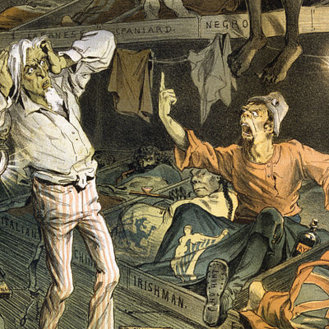
I look like a WASP, but I'm not. I'm a half-Irish Catholic. Happily, most Americans have realized that many Irishmen aren't violence-prone drunkards with criminal tendencies.

I've discussed attitudes, bias, and internment camps, before. (A Catholic Citizen in America June 21, 2015; Another War-on-Terror Blog September 12, 2009; January 22, 2009)

Avoiding Hasty Generalizations


I've seen a few folks who might speak Swahili in the small central-Minnesota town I call home, but I haven't heard that language here — apart from someone saying the Lord's Prayer in Swahili at the parish church.

I have, however, heard Spanish more frequently in recent years: mostly while standing in a grocery checkout line: and, rarely, an east-Asian language I didn't recognize.

My lack of violent response to these 'foreign threats' is no virtue. I see new families moving in as a sign that my town is in good shape, and likely to endure: at least for another generation or two.

Besides, as an American, I'd be very concerned if folks weren't pulling up stakes and moving here.

Maybe it's easier to divide the world into 'people like me' and 'foreign threats.' But that attitude doesn't make sense. Not to me.

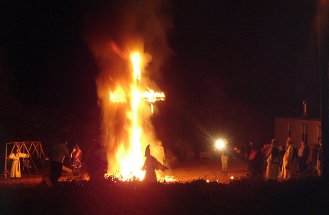
Sure, some folks who speak Swahili, Arabic, Spanish, or Latvian, might try to blow up the post office or kill me. But but assuming that all Africans, Arabs, Hispanics, or whatever, are threats that makes about as much sense as assuming that all Christians are in the Ku Klux Klan. And that, sadly, is not another topic. (A Catholic Citizen in America January 18, 2015)

Living with difference:

Friday, January 20, 2012

Bombs, Berserk Vendors, and Getting a Grip

About a dozen centuries after the Lindisfarne incident, Europeans decided to try the European Union as an alternative to more traditional forums for international debate: like World Wars I and II. Change happens: and folks can learn.

But change isn't easy.

Bombs and Berserk Street Vendors

What got me started today was the trouble in Kano, Nigeria. An outfit called Boko Haram says it set off the bombs. They're probably right.

According to the BBC, Boko Haram is an "Islamist" group that doesn't like Western culture. So far, they'd fit right in with some of America's more determinedly earnest serious thinkers: not that either the folks in Boko Haram or refugees from the '60s are likely to see it that way.

Dealing with Trousers, Miniskirts, and Other Threats

I've noticed that quite a few folks don't particularly like change. What sets Boko Haram and a bunch of hotheaded vendors in Malawi apart is how they deal with a world that isn't just like the one their grandfathers told them about. There's more going on in Nigeria than epic culture shock, and I'll get back to that.
"Nigeria's militant Islamist group Boko Haram - which has caused havoc in Africa's most populous country through a wave of bombings - is fighting to overthrow the government and create an Islamic state.

"Its followers are said to be influenced by the Koranic phrase which says: 'Anyone who is not governed by what Allah has revealed is among the transgressors'.

"Boko Haram promotes a version of Islam which makes it 'haram', or forbidden, for Muslims to take part in any political or social activity associated with Western society.

"This includes voting in elections, wearing shirts and trousers or receiving a secular education...."
(BBC)
Meanwhile, several countries over, some other folks lashed out at the post-Magna-Carta world:
"Malawian women protested Friday to demand an end to attacks on those who were stripped naked on the streets for wearing pants, leggings and miniskirts, instead of dresses.

"Street vendors accused women of defying cultural norms and attacked them this week in Lilongwe and Blantyre, two of the nation's largest cosmopolitan centers.

" 'They beat them up and stripped them naked, claiming they did not follow the tradition,' said Seodi White, a rights activist and protest organizer...."
(CNN)
I suppose I could claim that these two incidents 'proves' that:
  1. Africans are crazy
  2. It's America's fault
  3. Men are pigs
  4. Squirrels are plotting to take over the world
Of those options, I pick 'none of the above:' although numbers one through four have a very tiny amount of truth in them. Here's what I mean:

People are Crazy

Logic and emotion don't play well together. It has to do with the way the human brain is wired, and I've been over that before. (December 23, 2008) I'm not making excuses: but I think the folks running Boko Haram and that bunch of street vendors are under a lot of stress. That may help explain why they're acting in what I think is a self-destructive way.

It's America's Fault

No, I don't think so. Any more than it's the architect's fault when someone gets drunk and crashes into a building the architect designed.

But women in Malawi wouldn't get in trouble for wearing miniskirts if:
  • Hammurabi and others hadn't started writing down laws
    • In stone
      • Literally
  • Ways to make a democracy work hadn't been thrashed out by ancient
  • King John hadn't signed the Magna Carta
  • An odd lot of revolutionaries hadn't made thirteen colonies into one of the world's leading producers of sitcoms and soybeans
So, in a way, what happened in Malawi and Nigeria is the fault of folks who haven't been accepting the status quo for going on 38 centuries now. In a way.

Men are Pigs

It's been a long time since I've heard "male chauvinist pig," except in context of recent American history. I am not a born-again feminist, and think that blaming all men for what ails the world makes about as much sense as blaming the commies, capitalists, or squirrels.

On the other hand, the incident in Malawi was very likely set off by some of the local 'good old boys' whose world is changing. Fast.

About two thirds of adults in Malawi are literate: 76% of the men, just under half of the women. (CIA World FactBook) I don't set quite as much stock in getting a college degree as some folks do: but I think being able to read and write are vital skills.

Or, looking at it from another angle, folks who have control of a society might not want the folks whose lives they're running to be able to read. Particularly these days, when that pesky Internet is causing so much trouble.

I've discussed SOPA in another blog, and that's not entirely another topic. Briefly, I think SOPA and PIPA are very bad ideas. But then, I'm one of those rank outsiders, and I rather like freedom of expression:Moving on.

Africa: Looking Past the Bombings

Africa as a big continent. There's a lot going on there, besides the occasional terrorist activity and dubiously-fair election.

Soccer's 28th Africa Cup of Nations

I'm not a huge sports fan, but I understand how important games like soccer, basketball, and cribbage can be in a culture. Cribbage?! Never mind.

I also think that, although 'world peace through rugby matches' won't work by itself, there's value in getting folks from different countries together - and letting them notice that they each go crazy over the same games.

it's a start.

I sincerely hope that nobody gets killed during this year's Africa Cup of Nations. The folks who organize and participate in that massive get-together have had quite enough trouble, I think:
"African ambition: Tiny nations host football feast"
Chris Murphy, CNN (January 20, 2012)

"This weekend's kick-off at the 28th Africa Cup of Nations launches a three-week explosion of color and noise in the soccer-crazy continent....

"...the 2010 installment in Angola was overshadowed by a machine gun attack on the Togo team bus that left three people dead and organizers -- the Confederation of African Football (CAF) -- having to defend the decision to stage it there...."

Drought, Famine, Death

Folks in Texas have been suffering a drought. I'm concerned about them: but I'm more concerned about folks in east Africa with the same problem.

It's not that I don't like Texas: but Texans aren't faced with a drought and rebuilding nations and cultures after centuries of colonial mismanagement. Here's what brought that to mind:
"East Africa drought update"
Vatican Radio, via NEWS.VA (January 19, 2012)

"What is the current situation like for those living in the Horn of Africa and east Africa where last year some 13 million people were threatened by famine as a result of drought and conflict? The humanitarian crisis there has mostly slipped off the radar of the international community compared to the height of the crisis last summer. The good news, however, is that the number of people at risk of outright famine has been dramatically reduced thanks to last year’s massive aid programme mounted by the U.N. and relief agencies.

"One of the agencies that were in the forefront of the relief operation was the Caritas Internationalis Confederation...."
If you never heard of that "Caritas" outfit, I'm not surprised. They don't get a whole lot of press coverage.

I've been more likely to post about the African drought situation in another blog:

Nigeria, Fuel Prices, and National Politics

"AFRICA/NIGERIA-The President cuts the price of petrol,
but the protest continues; the Bishops:
'we think of the nation's welfare'
"
Agenzia Fides, via NEWS.VA (January 16, 2012)

"The President of Nigeria, Goodluck Jonathan, announced today, January 16, the reduction of the price of petrol from 141 to 97 naira per litre, although it has not re-introduced the old price of 65 naira per litre before January 1, when the government suddenly decided to eliminate subsidies for fuel prices. The President's decision is intended to contain the strong popular protest, led by the powerful local unions, which have paralyzed the country for days...."
I remember "the" energy/oil crisis. Several of them, including:I don't think high fuel prices are helping folks in Nigeria stay calm: and I've mentioned how emotions and logic get along like mongoose and cobra before.

The point is that Boko Haram isn't operating in a vacuum. Folks in Nigeria are upset about high fuel prices, and other less-than-ideal aspects of their economic and political situation. My guess is that quite a few of them have legitimate complaints.

But all that angst also makes it easier for hotheads to convince some folks that the answer is to kill someone. I don't think that's a reasonable approach: but - emotion and logic, again.

Epic Culture Shock

In a way, I'm what my culture calls "lucky." My ancestors were following the edge of a continental glacier north and west, when Hammurabi and other rulers started a reform of laws that's still a work in progress. We had centuries to get used to changes that kept upsetting apple carts in the northwestern part of Eurasia. Stuff was going on elsewhere in the world, too: but I'm talking about the melanin-deficient lot I'm descended from.

Like I said, I'm lucky. I'm from a culture that's gone through a lot of change, for a long time. Quite a few individuals still go ballistic when one more set of changes comes down the road: but as a group, I think we've become a moderately accustomed to having to re-learn customs on a fairly regular basis.

Then there are folks in places like parts of the Middle East and Africa. Until decades - maybe a generation or two - ago, life hadn't changed all that much since Abram moved out of Ur and changed his name.

Then, within one lifetime, everything changed.

It's almost as if someone with a nice, steady job in Uruk, during the Ubaid period, took a wrong turn on his way home, and landed in New York City's Times Square. Or someone living in today's Brooklyn stepped off the MTA, and found herself in whatever New York City is called, around the year 6012.

Like I said, I'm not making excuses for outfits like Boko Haram. But I recognize that they're being dragged over several thousand years of change, fast. Maybe it's no wonder that some folks in that position snapped.

Related posts:
In the news:
Background:
  • "Angola"
    CIA World FactBook (page last updated January 11, 2012)
  • "Equatorial Guinea"
    CIA World FactBook (page last updated January 11, 2012)
  • "Gabon"
    CIA World FactBook (page last updated January 19, 2012)
  • "Malawi"
    CIA World FactBook (page last updated December 13, 2011)
  • "Nigeria"
    CIA World FactBook (page last updated January 4, 2012)

1 Excerpts from the news:
"Nigeria's Kano rocked by multiple explosions"
BBC News (January 20, 2012)

"The Nigerian authorities have imposed a 24-hour curfew in Kano after at least seven people were killed in co-ordinated bomb attacks in the northern Nigerian city.

"Police stations and the regional police HQ were among the targets. Gunfire was also heard in several locations.

"The militant Islamist group Boko Haram says it carried out the attacks...."
"African ambition: Tiny nations host football feast"
Chris Murphy, CNN (January 20, 2012)

"This weekend's kick-off at the 28th Africa Cup of Nations launches a three-week explosion of color and noise in the soccer-crazy continent....

"...the 2010 installment in Angola was overshadowed by a machine gun attack on the Togo team bus that left three people dead and organizers -- the Confederation of African Football (CAF) -- having to defend the decision to stage it there...."
"Malawian women protest after attacks for wearing pants, miniskirts"
Faith Karimi, CNN (January 20, 2012)

"Malawian women protested Friday to demand an end to attacks on those who were stripped naked on the streets for wearing pants, leggings and miniskirts, instead of dresses.

"Street vendors accused women of defying cultural norms and attacked them this week in Lilongwe and Blantyre, two of the nation's largest cosmopolitan centers...."
"East Africa drought update"
Vatican Radio, via NEWS.VA (January 19, 2012)

"What is the current situation like for those living in the Horn of Africa and east Africa where last year some 13 million people were threatened by famine as a result of drought and conflict? The humanitarian crisis there has mostly slipped off the radar of the international community compared to the height of the crisis last summer. The good news, however, is that the number of people at risk of outright famine has been dramatically reduced thanks to last year’s massive aid programme mounted by the U.N. and relief agencies.

"One of the agencies that were in the forefront of the relief operation was the Caritas Internationalis Confederation...."
"AFRICA/NIGERIA-The President cuts the price of petrol,
but the protest continues; the Bishops:
'we think of the nation's welfare'
"
Agenzia Fides, via NEWS.VA (January 16, 2012)

"The President of Nigeria, Goodluck Jonathan, announced today, January 16, the reduction of the price of petrol from 141 to 97 naira per litre, although it has not re-introduced the old price of 65 naira per litre before January 1, when the government suddenly decided to eliminate subsidies for fuel prices. The President's decision is intended to contain the strong popular protest, led by the powerful local unions, which have paralyzed the country for days...."

Saturday, March 19, 2011

Ivory Coast, Cote d'Ivoire: Bodies in the Street

Libya, Yemen, Bahrain, and assorted other places in north Africa and the Middle East aren't the only places with trouble:
"At least 25 people were killed in what the United Nations called Friday a shocking escalation of violence in Ivory Coast, wracked by an electoral crisis that many fear is sliding toward another civil war.

"Doctors Without Borders treated 66 people with gunshot wounds and injuries caused by shell explosions in the wake of the attacks, according to a news release from the medical aid group. Women and children were among those injured, the statement said...."
(CNN)
If "Ivory Coast" doesn't ring a bell in your memory, you may know the country as the Cote d'Ivoire. (CIA)

That "electoral crisis" happened because the territory's boss, Laurent Gbagbo, likes to be called "president." He had an election recently, and the wrong candidate won: Alassane Ouattara, who had the unmitigated gall to get more votes than the boss.

Naturally, Gbagbo had his people say that the election was no good - and that Gbagbo was president. I'm simplifying what's been in the news considerably - but that's what it boils down to, in my opinion.

There wouldn't have been a crisis, if it weren't for the folks in Cote d'Ivoire who voted for the wrong man insisting that the idea of an election was to see who gets the most votes. Interestingly, a considerable number of national leaders around the world agree with the non-Gbagbo folks.

Which is taken as proof of colonial oppression, among other things - and that's almost another topic.

I live in a country where we have elections at regular intervals: followed, in recent years at least, by lawsuits in which some judge decides who won. It's not a perfect system, but it works. I'm hoping that lawsuits - and the circumstances which sometimes make them necessary - will become less common, and that is another topic.

I think that elections can be used to determine which people form the leadership of a country. But it's not the only system that can work. I've discussed that before. (December 29, 2008)

Trouble in Africa: So What?

I've got a few reasons for writing this post.
The World, Beyond 'Today's Top Stories'
First, what's happening in Ivory Coast/Cote d'Ivoire is terribly important to the folks living there. I like to highlight what isn't the top news of the day now and then.

That's partly because I think that the world we live in is complicated. What's going on in Libya and Japan this weekend is important, particularly - again - to the folks living there. But I think it's a good idea to remember that what news editors decide is top-priority isn't necessarily everything that's significant on any given day.

Which is one reason that I depend more on written news resources, than radio and television news. And I'm wandering off-topic.
'Simple' is for Sitcoms
Also, the Ivory Coast/Cote d'Ivoire mess lets me sound off on a few points that I think are important. In my opinion:
  1. Where you've got human beings, you've got trouble
    • Every national government is run by human beings
      • No matter what, you'll have trouble
      • The trick is to keep it below the bodies-in-the-street level
  2. Folks in Africa aren't having a good time
    • Due in part to clueless nation-building almost a century ago
    • And see point #1
  3. Allegedly "democratic" governments and "elections" are no guarantee of good leadership
    • Again, see point #1
I'm not going to do the conventional hand-wringing about racism and oppression and class struggle. First, you've probably heard it all before. Second, I think the cliched slogans tend to encourage seeing events like the killing in Ivory Coast as overly-simplified 'good guy/bad guy' stories.

Sort of like the 'commie plots' and 'red menace' of the mid-20th-century. It made for some funny stories about Frank Burns on M*A*S*H, but what makes a good sitcom doesn't often, I think, make a good way of looking at the world.
Looking Beyond 19th Century Values
I don't think the Treaty of Versailles did a good job of getting folks whose homes had been colonized headed for independence: and I know it wasn't the only botched opportunity in history. (December 27, 2008)

But, just as I don't think the Victorian-era notions about 'civilized people' and 'natives' made much sense, I don't think it makes sense to put a new coat of paint on "the white man's burden," and assume that Western civilization is solely responsible for the world's ills.

Change Happens

Something that Ivory Coast/Cote d'Ivoire, Libya, Bahrain, and Tunisia have in common is that relatively long-established regimes have either ended, or are being threatened by folks who got fed up.

In a way, I'm not surprised. One of the few constants in the human experience is change. And it's been that way for a long time:
"Nothing endures but change."
(Heraclitus, 540 BC - 480 BC)
(from October 29, 2009)
What I'm hoping we'll see in old-school autocracies is not a return to 'the good old days' when some little circle of people - or a single man - decided what everybody in the country should do. Even if it was 'for their own good.'

Does that mean I think every country should be a republic with strong democratic traditions? (Small "d.") With a bicameral legislature and a taste for hamburgers, apple pie, and potato chips?

No. That's worked pretty well for America, in my opinion: but I'm inclined to believe what I've been told: that not all countries are just like America. Which is just as well, I think. It'd be a pretty dull world if everybody was alike.

On the other hand, I think we'd all be better off in a world where leaders didn't try to instill loyalty by killing their subjects. Or regard the folks they're serving as subjects, when it comes to that.

Related posts:
In the news:

Friday, February 25, 2011

Zimbabwe, Where Watching the Wrong Videos is Treason

One thing about the shenanigans during American elections: It could be worse. Take Zimbabwe, for example.

Zimbabwe isn't, in my opinion, one of Africa's success stories. Not yet, anyway.

It's part of a landlocked area of Africa that's been called, in whole or in part, Nyasaland, Northern Rhodesia, Southern Rhodesia, the Federation of Rhodesia, just plain Rhodesia, Zambia, Zimbabwe, and Malawi. ("Rhodesia," Wikipedia) Local bosses haven't been re-naming their holdings quite so often in recent decades: but my guess is that the map will be re-drawn a few more times in the next generation or so.

The part that's called Zimbabwe these days is in the news again.

A Zimbabwean college professor was tortured for showing students videos he found on the Internet. According to the boss of Zimbabwe, that's treason.

Zimbabwe is, on paper, a parliamentary democracy. The country's boss, Robert Mugabe, was prime minister from 1980 to 1987, he the apparently decided he'd like to be president, instead: and has been president ever since.

Mugabe's had elections, to show how democratic (small "d") his country is. How much the election results reflected what Mugabe's subjects actually wanted has been, in my opinion, debatable. ("Zimbabwe," CIA World Factbook, "Robert Mugabe," Wikipedia)
"Last Saturday, Munyaradzi Gwisai, a lecturer at the University of Zimbabwe’s law school, was showing a group of students and activists internet videos about the tumult sweeping across North Africa when state security agents burst into his office.

"The agents seized laptop computers, DVD discs, and a video projector before arresting 45 people, including Gwisai, who runs the Labor Law Center at the University of Zimbabwe. All 45 have been charged with treason - which can carry a sentence of life imprisonment or death - for, in essence, watching viral videos.

"Over the next 72 hours, Gwisai and five others were brutally tortured, he testified on Thursday at an initial hearing.

"There were 'assaults all over the detainees’ bodies, under their feet and buttocks through the use of broomsticks, metal rods, pieces of timber, open palms and some blunt objects,' The Zimbabwean newspaper reports, in an account of the court proceedings.

"In Zimbabwe, under dictator Robert Mugabe, watching internet videos can be a capital offense, it would seem. The videos included BBC World News and Al Jazeera clips, which Gwisai had downloaded from Kubatana, a web-based activist group in Zimbabwe.

"Nine out of ten people lack internet access in Zimbabwe, and cable TV is an extravagant luxury. DStv, the monopoly satellite provider, costs $70 per month – out of reach for most in a country where teachers make $150 per month...."
(Wired)
If Mugabe keeps Internet access in his country away from most of his subjects, and stops letting newspapers publish stories like the one involving Munyaradzi Gwisai, he may hang on to his position. Then again, he may not.

I think we're looking at more change in the status quo of countries like Zimbabwe. Tunisia and Egypt have already kicked out their bosses; folks in Bahrain and Libya aren't sitting down and keeping quiet any more; and those aren't the only places where 'the masses' are getting uppity.

Finally, I don't think Muslims have a monopoly on badly-run autocracies. Zimbabwe's a case in point. Robert Mugabe's outfit presents itself as a contemporary secular democracy, and the territory's people as a whole are hardly a homogeneous bunch.

Zimbabwe religious beliefs:
  • Syncretic (part Christian, part indigenous beliefs)
    50%
  • Christian
    25%
  • Indigenous beliefs
    24%
  • Muslim and other
    1%
    ("Zimbabwe," CIA World Factbook)

Related posts:
In the news:Background:

Monday, January 24, 2011

Tunisia, Egypt, and the World: Speculation and Opinion

We're seeing more 'after Tunisia, what?' speculation in the news. Like a piece on the CNN website that boils down to 'we don't know.' There's an interesting set of observations on the way, though:It does look like:
"Tunisia has brought a blast of reality to Mideast politics. Aging autocrats have been put on notice they can no longer count on docile citizens.
(CNN)

Setting Fire to Yourself?!

On the other hand, maybe there's not so much change coming. Like what didn't happen in Egypt. The Tunisian turnover seems to have been sparked by Mohamed Bouazizi. He was a young vegetable market trader who was upset about Tunisian economics: and so he set fire to himself. He's dead now, no surprise there.

About a half-dozen Egyptians set fire to themselves after Tunisia's former president hightailed it for Saudi Arabia. The smoke has cleared from those demonstrations - and the Egyptian government is still there. No great uprising.

While I'm thinking of it: setting fire to oneself because you don't think your leaders are doing a good job never made much sense to me. Setting fire to the leaders: maybe. But either alternative has serious problems, ethical and otherwise.

I discussed Tunisia, Twitter, and being tense about change yesterday. At length.

Today, I'm going to touch on an opinion that may sound odd, coming from someone who is quite glad to be an American. I don't think democracy is the best form of government. I certainly don't think it's the only way that decent people would want to run a country.

The Ideal Form of Government: One that Works

As I said, I'm glad that I'm an American, living in a country where not even a moderately inept (my opinion), clueless (my opinion), meddlesome (my opinion again) government has bollixed up a nation of people who like to get things done - and know how to do so.

Our "Constitution-based federal republic; [with a] strong democratic tradition" (World Factbook, CIA) has, for the most part, worked pretty well - for us. Most of Europe - including countries that still have monarchs - use some flavor of democracy to take money from their citizens and provide bureaucrats with a means to earn a living.

These Western countries could be doing a lot worse.

But I don't think that a constitution-based federal republic is the only 'right' way to run a country. I've written about this before:

Military Rule as the Ideal Form of Government

No, I don't really think so, but look at this:
  • Government by Religious Leaders
    Example: Afghanistan under the Taliban
    Result: Terrorism
  • Government by Monarch
    Example: Saudi Arabia
    Result: Terrorists
    • (15/19 of the 9/11 hijackers were Saudis)
  • Government by Elected Leaders
    Example: Somalia
    Result: Terrorists - and pirates
  • Government by Military Ruler
    Example: Guinea
    • Assuming that the elections were as faked as critics claim
    Result: No terrorism (and no pirates, either)
You see?! That 'proves' that military rule is superior to old-fashioned monarchies, theocracies, and constitutional democracies.

What's Wrong With This Picture?

Pretty obvious, isn't it? I carefully selected examples that supported my claim. That can make for effective propaganda, but it's not good reasoning.

As a matter of fact, I don't have the visceral, reflexive revulsion that many Americans have toward the idea of having a country run by military or religious rulers. I think it depends on what individuals are running the show, and which side of the eighteenth century most of the country's people live on.
(December 29, 2008)
Does this mean that I think Saudi Arabia's monarch is doing a wonderful job, and that Queen Elizabeth II should disband parliament?

No.

But I don't think it would be better if all countries, everywhere, were McYankee clones, complete with bicameral legislatures.

What I do think is that countries work better if their leaders have some common sense; and care more about how the folks who share the country with them live, than how many solid-gold faucets are in the presidential palace.

I think that the American system, choosing leaders based on how well they dress, talk, and do their hair, works fairly well. I also think that systems that choose leaders based on what family they were born into can work fairly well, too.

I think what kind of people the leaders are matters more than how they got into the top jobs. Which isn't as radical as it may sound. Think about it: just how altruistic would you expect a person to be: who had bribed, poisoned, and stabbed his way into office?

Related posts:News and views:

Sunday, January 23, 2011

Tunisia, Twitter, Change, and Staying Sane

This post isn't about the War on Terror so much as it's about what I think is behind what Al Qaeda, the Taliban, and like-minded folks are trying to do.

It looks like they've seen today's world: and don't like it. (February 6, 2009, October 8, 2007) That's understandable, I think:
"...Ishmael to Internet in One Lifetime

"I've made the point before, that many Muslims have been dragged across several thousand years of history and cultural change in one or two generations. Stable cultures, carrying on traditions which had been ancient when Abraham moved out of Ur, were relatively isolated until Western civilization needed petroleum.

"Then, the world of individual rights, Barbies, beer, bikinis and Mickey Mouse dropped into their quiet world. It must have been like a retirement community suddenly having a frat house near the golf course...."
(September 24, 2009)
I do not think that justifies flying airliners into skyscrapers. Like I've written before, understanding does not mean agreeing. I think it's a good idea to understand why someone is doing something - not to find excuses for inexcusable behavior, but to make reasonable decisions when considering how to act.

Like it or not, there's another election coming up in a couple years - and I intend to be an informed voter. And that's almost another topic.

Osama bin Laden isn't the only person who doesn't seem comfortable with change.

Take the former president of Tunisia, for example. He's out of a job now. In part, it seems, because of some newfangled technology and new social structures that developing as people use it.

Tunisia: Times Change

Tunisia is in the news again. Or, rather, still.1

I've noticed a few developments:
  • Zine el Abidine Ben Ali seems to have arrived safely in Saudi Arabia
    • Some of his family didn't
      • Maybe they didn't notice the changes fast enough
  • The General Tunisian Workers' Union (UGTT) want more change
    • They're not the only ones
  • People were killed during anti-presidential demonstrations
    • 78
    • Or over a hundred
    • Depends on who you ask
  • Tunisia isn't carrying on with business as usual
    • Which, in my opinion, is just as well
My guess is that Tunisia won't be having nice, polite, uncontested elections - ever. That doesn't seem to be the way things work: just look at America's last few election cycles. Then there were those "hanging chads." And that's another topic.

Now that a government that sounds a bit like Chicago's old-style political machines is (most likely) on its way out, though, I'd say that folks in Tunisia have a good chance of improving their country.

Today, Tunisia; Tomorrow, the World?

The idea that Twitter - and other online communities and media - brought down the former permanent president of Tunisia is wending its way through the digestive tract of traditional news media.1

My guess is that this latest apple cart upset by Information Age culture and tech is causing no small degree of indigestion along the way.

That's because I don't think that the powers-that-be in Algeria, Egypt, and Yemen are the only ones threatened by folks with Twitter accounts and blogs.

I think America, and the western world in general, is experiencing changes on a scale we haven't seen since Gutenberg started printing with movable type.

As I've said elsewhere, change hurts. And change happens.

Hello Internet; Goodbye Editorial Control

I think that when folks stopped having to depend on traditional information gatekeepers2 for knowledge of what was going on outside their circle of friends and acquaintances: the established order lost a major tool for controlling 'the masses.'

Not that east coast newspaper editors, American educators, and media executives thought about it that way. I find it quite hard to believe that there's some sort of vast conspiracy 'behind the scenes.' Although I think that sort of thing can make a pretty good story. (January 14, 2009)

Conspiracy? No: Cultural Blind Spots? Maybe

America is, in my opinion, just what the CIA World Factbook says it is: a "constitution-based federal republic; [with a] strong democratic tradition." That's lower-case "democratic," by the way. I don't think the CIA is a tool of the Democratic party; the Republicans; or the space-alien, shape-shifting lizard people.

I also prefer to believe that many senior news editors, studio executives, and college professors mean well. I do, though, get the impression that quite a few of the 'proper sort' feel that they have a profound understanding of the world - and that it is their burden to manage what the 'common' people see and read. Sort of an upgrade of the old "White Man's burden." Only more "tolerant," in a politically-correct way. And since these folks seem convinced that they, and they alone, are "tolerant," they don't see that they're filtering out facts they don't like.

Or they think that it's the right thing to do.

I think it may seem 'obvious' to someone with letters after his name, or who has an executive secretary taking his calls, that he and his good buddies can handle the grim realities of the world: and that the rabble can't. Or, rather, that they might come to the wrong conclusions: conclusions that aren't consistent with what he decided should be so.

Sometimes it's a "she:" that's one change that came out of the '60s that I think made sense. Which isn't another topic.

Change Hurts: Change Happens

I've said this before, quite a bit. Change happens: Deal with it.

I remember the '50s. "Happy Days," it wasn't - except for folks like Mr. Cunningham. And even white, male World War II vets had their troubles. Think The Man in the Gray Flannel Suit. Which I've mentioned before. (November 10, 2010)

I remember the '60s, too. I don't think the Timothy Leary/Jimi Hendrix thing was a good idea - at all. But the social revolution was more than encouraging bright, talented people to scramble their brains.

Back in the 'good old days' that I remember, for example, quite a few folks were convinced that women should know their place: barefoot, pregnant, and in the kitchen. Some still believe that.

But that changed for a great many Americans.

Folks who had grown up thinking that the "Happy Days" lifestyle was the only possible way to live - or at least the only one that decent people should want - were not happy when they stopped being at the apex of society. Or seeming to be, at any rate.

They complained. A lot. But change happened, anyway.

I Don't Want the '50s Again

I've been called a conservative. I can see why. There seem to be three major currently-recognized philosophical positions: Liberal; Moderate; Conservative. Four, if you count apathy. My views are least unlike "conservative" of that triad - or quadrad.

And yet, I don't think that women are entertaining sex machines and household appliances: more useful than a toaster, but less indispensable than high-definition television. Go figure. I'll get back to that.

I certainly do not want a return to the 'good old days' when women were considered odd if they showed an interest in power tools, or men if they were good at graphic design. Partly because my wife is the one with power tools, and I once made a living doing graphic design.

The '60s saw changes in a lot more than just what folks expected men and women to be like.

It's a good thing, in my opinion, that the United States is finally making reparations for a shameful history of treaty violations: but again, that's a family thing for me. I'm related to folks of the Lakota.

It even looks like America may be sorting out how do deal with the idea that people shouldn't be evaluated based on who their ancestors were - even if those ancestors came from northwestern Europe. Which is a good thing. Again, in my opinion.

The changes of the last five decades have been - and are - painful. But I think many were for the better - and anyway, change happens.

New Technology, New Social Structures: Dangerous, Sort of

Maybe I'd be more worried about this here newfangled Internet, and online communities, if I hadn't been through this sort of thing before.

I remember when the telephone was destroying the youth of America. According to some terribly serious folks, anyway. Same with television.

Then, as broadcast television was being supplanted by cable: cable television was feared and reviled as that which would destroy America's cultural unity. In a way, the hand-wringers had that one right. Before cable, just about everybody had either seen the latest "Leave It to Beaver," "Bewitched," or "M*A*S*H" episode: or had heard about it. We had something besides the weather to talk about.

Now, with hundreds of channels, you can't count on someone else having seen the same thing you did the night before. Divisive? Maybe. I prefer having more choices: including skipping television entirely and seeing what's online.

The Internet was, and is, seen as a threat, too. I've mentioned the time when the Christian Coalition and the Feminist Majority tried - together - to get a Federal agency that would manage what Americans were allowed to see. (March 9, 2008)

I think that ideological odd couple shows how frightened at least some folks in the establishment are, of the power that most Americans now have. We no longer depend on a relatively small number of the 'right sort' to decide what we're allowed to see and read. If we're interested, we can go online and do our own research: and draw our own conclusions.

Not everybody comes to the same conclusions I do: But I'd much rather live now, when each of us can learn something besides what the established order thinks we should - than back in the 'good old days.'

Not everybody feels that way, so we're hearing about how Twitter twists the youth - and that's a topic I've posted about before. (see Related posts)

Sex Machines, Toasters, and High-Definition Television

I said I'd get back to philosophical positions, women, and toasters. This is the last section of this post, and is more detailed look at my views of a set of cultural values that I think are still in a state of flux: the position or women, and men, in society.

I am not all that sympathetic with the bra-burning set. I've been called a male chauvinist pig too many times. But weird demands and assertions aside - it's my considered opinion that women and men are people, and should be treated as such.

The two halves of humanity differ from each other, and exhibit a vast range of individual differences - we've got upwards of 6,768,000,000 distinct versions of humanity as of July of last year. (CIA World Factbook (updated on January 13, 2011))

Back in my "good old days," the problem was that women weren't recognized as being 'as good as men.' Or, from the point of view of guys who like things just the way they were, some women didn't 'know their place.'

Now the problem, from some points of view, is that some women don't know their place - behind whatever liberal notion is in fashion at the moment. And, again, that isn't another topic.

As I've tried to show, I think there's a social revolution going on: one that today's establishment likes as little as the establishment of my teens liked what 'those crazy long-haired kids' were doing.

One of a great many aspects of American culture that's changing is, in my opinion, the role or roles that women are expected to fill. Men, too.

Finally, a clarification about my take on "barefoot, pregnant, and in the kitchen."
  • Barefoot:
    • I wear shoes as little as possible - even during central Minnesota winters
      • Nothing ideological
        • I have a hard time finding ones that fit
        • The things cost a lot
  • Pregnant:
    • I like babies
      • And the process that gets them started
    • I also think life is precious
      • Even life that has to have frequent diaper changes
    • But I don't think women are just for having babies
      • Or that men are just for getting them started
  • In the kitchen
    • I think my wife's job of job of maintaining our household and being a mother is
      • Demanding
      • Complex
      • Vital
      • Arguably more important than any of my 'real' jobs were
    • I think my job as father is more important than my 'real' jobs
    • Which doesn't mean that women shouldn't have 'real' jobs
      • Just that there's more to life than a 'career' for
        • Men
        • Women
Related posts:
News and views:
Background:
  • "Tunisia"
    World Factbook, CIA (last updated January 12, 2011)

1 Excerpt from the news:
"Two allies of Tunisia ousted leader Ben Ali 'detained' "
BBC News Africa (January 23, 2011)

"Tunisian police have detained two politicians close to ousted President Zine al-Abidine Ben Ali, state media report.

"Mr Ben Ali's former adviser Abdelaziz bin Dhia and former Interior Minister and head of Senate Abdallah Qallal were now under house arrest, they said.

"The news came as a new protest march against the interim government reached the capital Tunis....

"...PM Mohamed Ghannouchi has pledged to quit after elections, which are expected within six months...."

"...The media also said that the police were searching for Abdelwahhab Abdalla - another former adviser to Mr Ben Ali.

"Last week, some 33 members of Mr Ben Ali's family were arrested as they tried to leave the country....

"...On Sunday, a new protest march reached Tunis.

"Some 1,000 demonstrators from Menzel Bouzaiane - the rural area where protests against Tunisia's authoritarian rule began in December - had joined the 'Caravan of Liberation' to the capital.

"The main trade union, the General Tunisian Workers' Union (UGTT), has backed the protest, which set off on Saturday....

"...Mr Ghannouchi has left Mr Ben Ali's ruling Democratic Constitutional Rally (RCD) party and insisted that figures from the previous regime who have remained in positions of power - including the ministers of defence, interior, finance and foreign affairs - have 'clean hands'.

"But this has failed to satisfy many opposition figures and protesters.

"On Saturday, policemen - who had defended the regime of the ousted president - were among those protesting, which the BBC's Magdi Abdelhadi in the Tunisian capital says marked a very dramatic development.

"The official death toll during the unrest leading to Mr Ben Ali's flight was 78, though the UN says more than 100 people died. Authorities have promised to investigate the deaths of protesters.
(BBC)

"Tunisians mourn protest victims as small demonstrations continue"
Edition: International, CNN (January 23, 2011)

"Tunisia on Sunday ended a three-day mourning period for dozens of people killed in protests that ousted the country's long-term president.

"As the mourning period came to a close, small protests broke out in the capital, Tunis.

"Protesters have decried a new government formed in the wake of President Zine al-Abidine Ben Ali's ouster.

"They have called it a sham, and demanded that officials with connections to the old guard be fired.

"The nation's interim prime minister said that his country would hold its first free democratic elections since gaining independence and vowed to leave politics after the ballot.

" 'We want to make the next elections the first transparent and legitimate elections since independence,' Tunisian Interim Prime Minister Mohammed Ghannouchi said Friday.

"Ghannouchi said he will retire from politics after the elections are held.

"Tunisia gained independence from France in 1956.

"Ghannouchi said upcoming political reforms would 'scrap all undemocratic laws including laws involving political parties, the elections and the anti-terrorism law that was abused by the former regime.'

" 'I lived like all Tunisians, in pain and fear' under the former president, Ghannouchi said...."
(CNN)

Saturday, January 15, 2011

Tunisia: 24 Hours, Three Presidents

Tunisia is a little wedge of a country between Libya and Algeria.

It's been quite a stable country, by some standards: the same fellow's been President of Tunisia since 1987. Somehow, Zine el Abidine Ben Ali kept winning elections.

That was then, this is now. The former Tunisian president is believed to be hightailing it for Saudi Arabia, and the country's on its third president so far. Since this morning.
"...Ben Ali's longtime ally, Prime Minister Mohammed Ghannouchi, stepped in briefly with a vague assumption of power that left open the possibility that Ben Ali could return. But on Saturday, the head of the Constitutional Council declared the president's departure permanent and gave Fouad Mebazaa, leader of the lower house of parliament, 60 days to organize new elections...."

"...In his first televised address, the interim president asked the prime minister to form a '"national unity government in the country's best interests' in which all political parties will be consulted 'without exception nor exclusion.'

"The move was one of reconciliation, but it was not clear how far the 77-year-old Mebazaa, who has been part of Tunisia's ruling class for decades, would truly go to work with the opposition. It was also unclear who would emerge as the country's top political leaders, since Ben Ali utterly dominated politics, placing allies in power and sending opponents into jail or exile...."
(Associated Press, via FoxNews.com)
Quite a few people have been killed since the excitement started today. There's been a major fire, and one prison released inmates - a humanitarian gesture, I take it, since that's where the fire was. 42 prisoners had been killed by the time the 1,000-odd others were released.

One lesson of what's happening in Tunisia may be that there are worse things than America's traditional lawsuits to decide who won an election.

Another is, I think, that this isn't the '50s any more. Or the '60s.

An article/op-ed in Wired (January 14, 2011) suggested that we're looking at what happens when Information Age technology and social structures wash over a country that's run by folks whose power depends at least in part of controlling what their subjects know.

I've discussed information gatekeepers before. In America, they've been the editors of east coast newspapers, book and magazine publishers, executives of media companies, professors, and the rest of the folks who run the education establishment.

And that's not quite another topic.

Related posts:News and views:Background:
  • "Tunisia"
    World Factbook, CIA (last updated January 12, 2011)

Friday, December 3, 2010

Today's News: Now What?!

Today's news is more of the same: only more so, in the case of Korea.

This is a somewhat rambling post. A point I'm trying to make is that not all countries are the same. I've said this before. (June 9, 2009)

That may seem obvious, but I've gotten the impression that folks with quite a few sorts of views sometimes think that all countries are pretty much like America - except that America is at fault for their problems; or that all countries should be like America. I don't mind living in a world where everybody isn't exactly like me - and that's another topic.

Korea

"South Korea's defense minister vows airstrikes if North Korea attacks"
CNN (December 3, 2010)

"South Korea's new defense minister said his country would respond with airstrikes if North Korea attacks it again, South Korean state media reported Friday. It is some of the strongest rhetoric since the conflict broke out late last month.

" 'We will definitely air raid North Korea, Kim Kwan-jin said at his confirmation hearing when asked how the South would respond if struck again, according to the official Yonhap News Agency.

"Kim was appointed defense minister last week amid growing tensions on the Korean peninsula following an exchange of gunfire between the two sides.

"His comments reflect a potential shift in South Korea's policy toward provocations from the North. Previously, South Korean President Lee Myung-bak warned of severe consequences if the North launched another attack, but declined to name specifics...."
I can't say that I'm happy about this development.

I'd prefer that North and South Korea get along. Better yet, that the country have one government. One run by sane people, who had some sort of checks and balances to keep them from being too irresponsible.

While I'm wishing, I'd prefer that America's checks and balances worked. And that's yet another topic, sort of.

This isn't a perfect world, so North Korea is run by Dear Leader, who seems to be arranging for his son to take over. South Korea is run by a President, a National Assembly, and a Supreme Court.

North Korea has a billion-dollar economy which produces armaments, textiles, and agricultural products, among other things.

South Korea has a trillion-dollar economy, making electronics, cars, and ships - also music videos and various consumer products. (CIA World Factbook, "Korea, South" (last updated November 17, 2010)"Korea, North" (last updated November 9, 2010))

I think the radical differences between the two halves of Korea are due mostly to the style of leadership on each side - but that's my opinion. Dear Leader's take is that the half of the country he doesn't control is the "South Korean puppet group." (November 23, 2010)
'I Predict' - Something Will Happen
As for 'what next?' That's a good question: but I really don't know.

The most recent attacks could be another case of bad behavior, followed by demands for concessions. If Dear Leader was younger, I'd probably think he probably just wanted more lobster, or maybe a special seat at the United Nations.

What troubles me is Kim Jong Il's age, and what appear to be his efforts at setting up his son to be the next warlord. When Kim Jong Il dies: well, the death of a warlord has sometimes set off quite a scramble among the folks who want the position. This lot has nuclear weapons, and missiles that can reach quite a few countries bordering the Pacific.

One of the wannabes might get the idea that incinerating, say, Tokyo, Vladivostok, or Seoul, was a good way to show determination. Or someone in North Korea might start believing their own propaganda. Again, my opinion.

On the other hand, the government in Seoul might get a telephone call tomorrow, from Pyongyang - collect - saying: 'sorry about that: it was all a big misunderstanding, it's a mess here, and we'd like you to take over now.'

I really don't think that'll happen.

Afghanistan

"Obama in Afghanistan, U.S. to release war review soon"
Caren Bohan, Reuters Edition: U.S. (December 3, 2010)

"President Barack Obama visited Afghanistan on Friday but bad weather kept him on a U.S. military base and forced him to cancel a planned face-to-face meeting with Afghan President Hamid Karzai.

"Obama was due to speak with Karzai by phone from Bagram Air Base outside the capital, U.S. officials said. They previously hoped to set up a secure videophone line but weather and technical difficulties prevented that.

"The trip, the second to Afghanistan of Obama's presidency, comes as the White House prepares to release a review of the war strategy the week of December 13.

"It will assess and potentially recommend changes to the strategy Obama rolled out a year ago when he ordered 30,000 additional U.S. troops to that war zone.

"Obama is under pressure to show progress in the increasingly unpopular nine-year-old war and the visit is a chance for a first-hand assessment...."
I've said it before: 'It's different, when you're in charge.'

Let's remember that Afghanistan was run by the Taliban, 1996-2001, and had a series of civil wars before that. The country is not in great shape. (CIA World Factbook, "Afghanistan" (last updated November 22, 2010))

Whatever the president of the United States says, week after next, it's going to be criticized. I'm no great fan of the current president, but I'm waiting until I see what the man has to say, before commenting on it.

And, if there's an unfavorable fluff-to-content ratio, I may not comment at all. Moving on.

Ivory Coast, Africa

"Ivory Coast poll overturned: Gbagbo declared winner"
BBC News Africa (December 3, 2010)

"Ivory Coast's Constitutional Council has overturned earlier poll results and declared President Laurent Gbagbo the winner of Sunday's run-off.

"On Thursday the electoral commission head said opposition candidate Alassane Ouattara had defeated Mr Gbagbo.

"But the Constitutional Council chairman said results in seven regions in the north, where Mr Ouattara draws most of his support, had been annulled.

"The poll was intended to reunify the nation after a civil war in 2002.

"Paul Yao N'Dre, chairman of the Constitutional Council which validates election results, said Mr Gbagbo had won a little more than 51% of the vote.

"The head of the electoral commission had said Mr Gbagbo won 46% of ballots cast....

"...On Thursday evening, the military closed the country's borders and international news sources were suspended...."
Okay. This sounds familiar.
  • 'Elected' leader stages election
  • 'Wrong' candidate wins
  • Ballots for 'wrong' candidate declared invalid
  • 'Elected' leader's enforcers
    • Close borders
    • Shut down news
No bragging about how that could never happen in this country. I live in Minnesota. 'Nuff said. This isn't a 'political' blog.

If "Ivory Coast" doesn't sound familiar, you may know the country as Cote d'Ivoire. (CIA World Factbook) Cote d'Ivoire is in better shape than Somalia: but most countries are.

About the recent election, Laurent Gbagbo's folks may be right - there might be legitimate reasons for throwing out ballots from areas that supported the other fellow. A point in Gbagbo's favor, given my biases, is that the 'official' count is around 51% - not the 99%, give-or-take, that some folks presumably got. Officially.

So, what does this election SNAFU have to do with the war on terror?

Directly, not all that much.

Indirectly, Cote d'Ivoire is a pretty good example of how countries aren't all alike.

For example, part of Cote d'Ivoire's economy involves what's politely termed "trafficking in persons." Illegal immigrants occasionally show up on the domestic staff of American political leaders - and folks breaking into this country are a hot-button issue. But forced servitude isn't - really - a significant part of America's economy. The opinions of a few college professors and terribly earnest folks notwithstanding.

The idea that people are commodities that can be bought and sold is not a good fit with the ideals of personal freedom that quite a few folks in America and Western civilization at least pay lip-service to.

I've made the point before: Islam is at least as diverse as Protestant Christianity. Muslims seem to have an extremely wide range of beliefs, based in part on local and regional cultures. Islam is not some monolithic block of Osama bin Laden clones.

However, the local/regional flavors of Islam often tolerate quaint customs. Like forced servitude. It's not called that - not in polite society, anyway. But the folks whose leaders are sitting on the heart of Islam import "...workers from South and Southeast Asia who are subjected to conditions that constitute involuntary servitude including being subjected to physical and sexual abuse, non-payment of wages, confinement, and withholding of passports as a restriction on their movement...." (CIA World Factbook, "Saudi Arabia" (last updated November 9, 2010))

'The war on terror' isn't a war on Islam. But outfits like the Taliban and Al Qaeda have attitudes and beliefs that aren't all that unlike those of the Saudi upper crust. Those beliefs aren't a good fit - at all - with the way Americans, and folks in Western countries generally, have gotten used to living.

Folks living in Cote d'Ivoire, by the way, are about 1/3 Muslim, 1/3 Christian, and 1/3 something else. And I'm not trying to say that Islam causes slavery. Cultures that Islam appears in these days? That's yet again another topic.

Related posts:

Monday, July 12, 2010

Bombs in Uganda: Islam, Martyrs, and Making an Impression

Over seventy people in Uganda were killed while they watched the soccer World Cup games. Al Shabaab, a "Somali Islamist militant movement" (CNN), says they did it. For Islam and country, of course:
"...'And the best of men have promised and they have delivered,' said an Arabic statement issued by Al-Shabaab's press office and obtained by CNN. 'Blessed and exalted among men -- (taking) full responsibility ...We wage war against the 6,000 collaborators; they have received their response.'

"The 6,000 is an apparent reference to African Union peacekeepers in Somalia. Uganda contributes troops to the peacekeeping effort.

" 'We are behind the attack because we are at war with them,' Al-Shabaab spokesman Ali Mohamoud Rage told reporters at a news conference in Mogadishu, Somalia.

" 'We had given warning to the Ugandans to refrain from their involvement in our country. We spoke to the leaders and we spoke to the people and they never listened to us.'

"Rage said young suicide bombers carried out the attacks, but did not specify their nationalities. 'May Allah accept these martyrs who carried out the blessed operation and exploded themselves in the middle of the infidels,' he said...."
(CNN)
My guess is that folks in Uganda are thinking about Al-Shabaab now. Uganda's president, Yoweri Museveni, raised a significant, if rhetorical, question:
"...'If you want to fight, why don't you attack soldiers or military installations instead of fighting innocent people watching football?' said Museveni, who on Monday visited a rugby sports center where two of the blasts occurred Sunday...."
(CNN)
The two targeted sites mentioned in the CNN article were an Ethiopian restaurant and a rugby center.

This is speculation, but I suggest three possible reasons for picking such sincerely civilian targets:
  1. Killing lots of innocent people makes the survivors feel bad
  2. By now, hitting civilian targets is a tradition among 'defenders of Islam' like Al-Shabaab
  3. Civilians often can't shoot back
    • Soldiers can

With Friends Like This, Islam Doesn't Need Enemies

My guess is that the people Al Shabaab wound up and sent to commit suicide and kill rooms full of people were quite sincere. They probably believed that they'd get a celestial whoopie house, or whatever Al Shabaab's recruiting line is.

Whoever's running Al Shabaab may really believe that they're setting up their 'martyrs' to get a grade-A-number-one harem, or a ever-full hookah, or whatever their clerics dreamed up as a reward.

That seems to work for the folks who get sent out to kill themselves. I doubt that praising "martyrs" who kill themselves and take dozens of football (soccer, here in America) fans with them is going to help Islam's image.

There are already quite a few folks who assume that all Muslims are homicidal maniacs following an insane religion. Al Shabaab's efforts won't change their minds - and might convince others that the anti-Islam crowd is right.

I've said this before: With friends like these, Islam doesn't need enemies.

Related posts:In the news:

Unique, innovative candles


Visit us online:
Spiral Light Candle  • Find a Retailer
• Spiral Light Candle Store

Blogroll

Note! Although I believe that these websites and blogs are useful resources for understanding the War on Terror, I do not necessarily agree with their opinions. 1 1 Given a recent misunderstanding of the phrase "useful resources," a clarification: I do not limit my reading to resources which support my views, or even to those which appear to be accurate. Reading opinions contrary to what I believed has been very useful at times: sometimes verifying my previous assumptions, sometimes encouraging me to change them.

Even resources which, in my opinion, are simply inaccurate are sometimes useful: these can give valuable insights into why some people or groups believe what they do.

In short, It is my opinion that some of the resources in this blogroll are neither accurate, nor unbiased. I do, however, believe that they are useful in understanding the War on Terror, the many versions of Islam, terrorism, and related topics.